
Vendor Management Best Practices: Complete Guide for 2026
15 vendor management best practices for procurement teams. Covers onboarding, compliance, performance tracking, risk management, and technology.
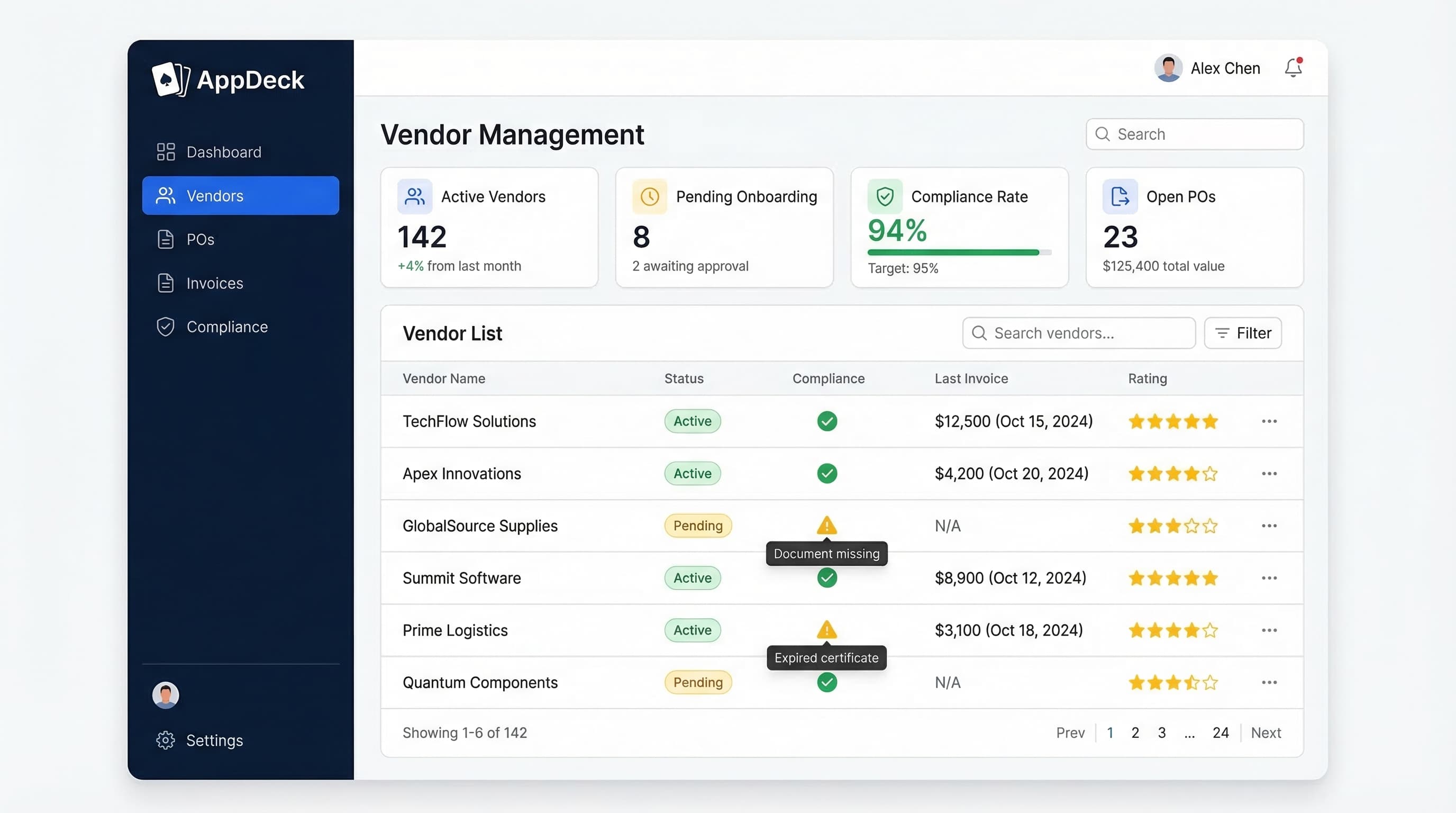
TL;DR: 15 vendor management best practices for procurement teams. Covers onboarding, compliance, performance tracking, risk management, and technology.
Introduction
Effective vendor management reduces costs, mitigates risk, and improves quality across your entire supply chain. Yet most companies still manage their vendors with scattered spreadsheets, email chains, and manual follow-ups. The result? Missed compliance deadlines, inconsistent onboarding, zero visibility into vendor performance, and procurement teams drowning in administrative work.
After 15+ years advising enterprises on vendor management strategy and technology, I've seen the same patterns over and over. Companies that treat vendor management as a strategic function consistently outperform those that treat it as an afterthought. The difference isn't just operational efficiency — it's competitive advantage.
In this guide, I'll walk through 15 vendor management best practices that procurement teams should implement in 2026, plus a complete vendor onboarding checklist you can put to work immediately.
What you'll learn:
- How to centralize and standardize vendor operations
- A complete vendor onboarding checklist (copy-ready)
- Performance tracking frameworks that drive accountability
- Risk management strategies for modern supply chains
- How technology eliminates 60% of vendor management admin work
Why Vendor Management Matters
Vendor management isn't just a procurement function — it's a business-critical discipline that directly impacts your bottom line, risk exposure, and competitive position.
The Numbers Tell the Story
Scale of vendor relationships:
- The average mid-market company works with 200+ vendors
- Enterprise organizations manage 1,000-5,000+ vendor relationships
- Each vendor relationship generates dozens of documents, contracts, and compliance requirements
The cost of poor vendor management:
- Companies without formal vendor management processes pay 10-20% more than necessary on procurement
- Organizations with mature vendor management programs save 15-25% on total procurement costs
- The average company loses $1.5M annually to invoice errors, duplicate payments, and missed discounts
Compliance and risk exposure:
- ❌ 62% of data breaches originate from third-party vendors
- ❌ Expired insurance certificates create uncovered liability windows
- ❌ Non-compliant vendors put your regulatory standing at risk
- ❌ Poor vendor due diligence leads to supply chain disruptions
The strategic upside:
- ✅ Strong vendor relationships drive innovation and preferential treatment
- ✅ Vendor consolidation creates volume leverage and better pricing
- ✅ Performance data enables data-driven sourcing decisions
- ✅ Proactive compliance management eliminates audit surprises
What Good Vendor Management Looks Like
Before (reactive):
- Vendor information scattered across email, drives, and spreadsheets
- Compliance tracked manually (or not at all)
- No performance metrics — decisions based on gut feel
- Onboarding takes weeks with back-and-forth emails
- No visibility into total vendor spend
After (strategic):
- Single source of truth for all vendor data in a centralized portal
- Automated compliance tracking with proactive reminders
- Performance scorecards reviewed quarterly
- Standardized onboarding completed in days
- Real-time spend analytics and reporting
Result: Lower costs, reduced risk, better vendor relationships, and procurement teams focused on strategy instead of administration.
15 Vendor Management Best Practices
1. Centralize Vendor Information
The problem: Vendor data lives in 5+ places — your ERP, shared drives, individual email inboxes, accounting software, and various spreadsheets. Nobody knows where to find the current version of a vendor's insurance certificate or which contact to call when there's a delivery issue.
The solution: Establish a single source of truth for all vendor data. Every document, contact, contract, and communication in one place.
What to centralize:
- ✅ Vendor profiles (contacts, addresses, classifications)
- ✅ Contracts and agreements (MSAs, SOWs, NDAs)
- ✅ Compliance documents (insurance, licenses, certifications)
- ✅ Performance data and scorecards
- ✅ Communication history
- ✅ Financial information (banking, tax IDs, payment terms)
- ✅ Purchase history and spend data
Implementation tip: A vendor portal provides this centralized hub while also giving vendors self-service access to update their own information — reducing your team's data entry burden significantly.
2. Standardize Vendor Onboarding
The problem: Every department onboards vendors differently. Marketing has their process, operations has theirs, IT has another. Some collect insurance certificates, others don't. Some run background checks, others skip them. The result is inconsistent data, compliance gaps, and duplicated effort.
The solution: Create a single, repeatable onboarding process that every vendor goes through, regardless of which department sponsors them.
Standard onboarding workflow:
- Application — Vendor completes a standardized qualification form
- Qualification — Procurement team reviews against criteria (financial stability, capacity, certifications)
- Document collection — Gather all required compliance and legal documents
- Approval — Routing through appropriate stakeholders (procurement, legal, compliance, department head)
- Setup — Create vendor record in systems, set up portal access, confirm payment details
- Welcome — Send onboarding guide, introduce key contacts, communicate expectations
Key principle: Don't let urgency bypass the process. "We need this vendor yesterday" is how compliance gaps happen. A standardized process should take days, not weeks — speed comes from process efficiency, not from skipping steps.
3. Maintain a Vendor Onboarding Checklist
Every vendor onboarding should follow a comprehensive checklist. This prevents gaps, ensures consistency, and creates an audit trail. Below is the checklist I recommend to every client.
Complete Vendor Onboarding Checklist:
Pre-qualification:
- ✅ Business registration verification
- ✅ Years in business confirmed
- ✅ Financial stability assessment (D&B report or financial statements)
- ✅ References collected (3 minimum)
- ✅ Capability assessment completed
- ✅ Conflict of interest screening
Documentation:
- ✅ W-9 / tax ID collection
- ✅ Certificate of insurance (COI) — general liability, professional liability, workers' comp
- ✅ NDA execution
- ✅ Master service agreement (MSA) or purchase agreement
- ✅ Banking information for payments (ACH/wire details)
- ✅ Compliance certifications (ISO, SOC 2, industry-specific)
- ✅ Diversity certification (if applicable)
- ✅ Security questionnaire (if applicable — especially for IT vendors)
Setup:
- ✅ Primary and secondary contact information
- ✅ Vendor record created in ERP/procurement system
- ✅ Portal access provisioned
- ✅ Payment terms agreed and documented
- ✅ SLA/performance expectations communicated
- ✅ Purchase order process explained
- ✅ Invoice submission process documented
Verification:
- ✅ Background check completed (if applicable)
- ✅ Insurance coverage amounts verified as adequate
- ✅ Contract terms reviewed by legal
- ✅ Compliance officer sign-off (for regulated industries)
- ✅ Department head approval documented
- ✅ Welcome communication sent with key contacts
Pro tip: Build this checklist into your vendor portal workflow so nothing gets missed and every step is tracked with timestamps and responsible parties. Manual checklists in Word documents get forgotten — system-enforced checklists don't.
4. Track Compliance Documents Proactively
The problem: Insurance certificates expire. Business licenses lapse. Certifications come up for renewal. If you're tracking these in a spreadsheet, you'll miss expirations. When something goes wrong and you discover a vendor's insurance lapsed three months ago, you have a serious liability problem.
The solution: Implement proactive compliance tracking with automated reminders.
What to track:
- Certificate of insurance (COI) — general liability, professional liability, workers' comp, auto
- Business licenses and registrations
- Professional certifications and licenses
- Industry-specific compliance (HIPAA, PCI-DSS, SOX)
- Safety certifications (OSHA, ISO 45001)
- Background check renewals
- Contract renewal dates
Proactive tracking timeline:
- 90 days before expiration: Internal flag to procurement team
- 60 days before expiration: Automated reminder to vendor requesting updated document
- 30 days before expiration: Escalation to vendor's account manager
- 14 days before expiration: Final warning — vendor notified that non-compliance may result in payment hold
- Expiration day: Automatic flag on vendor record — no new POs until compliance restored
Key metric: Compliance rate should be 95%+ across all active vendors. If you're below that, your process has gaps.
5. Implement Performance Scorecards
The problem: When it's time to renew a vendor contract or source a new supplier, the decision often comes down to "who do we like working with?" That's subjective and unreliable. Without data, you can't identify underperformers or reward top performers.
The solution: Implement quarterly vendor performance scorecards using consistent, measurable criteria.
Recommended scorecard dimensions:
| Dimension | Weight | Metrics |
|---|---|---|
| Quality | 25% | Defect rate, rejection rate, first-pass yield |
| Delivery | 25% | On-time delivery %, lead time accuracy |
| Responsiveness | 20% | Response time, issue resolution speed, communication quality |
| Cost Competitiveness | 15% | Price vs. market, total cost of ownership, invoice accuracy |
| Innovation | 15% | Improvement suggestions, new solutions, proactive problem-solving |
Scoring scale:
- 5 — Exceptional: Consistently exceeds expectations
- 4 — Good: Meets all expectations, often exceeds
- 3 — Satisfactory: Meets basic expectations
- 2 — Needs Improvement: Below expectations in key areas
- 1 — Unacceptable: Significant performance issues
Review cadence:
- Tier 1 vendors (strategic): Quarterly reviews with face-to-face meetings
- Tier 2 vendors (important): Semi-annual reviews
- Tier 3 vendors (commodity): Annual reviews
Action thresholds:
- Score 4.0+: Preferred vendor status, contract extension, volume increase
- Score 3.0-3.9: Maintain with improvement plan for weak areas
- Score 2.0-2.9: Formal improvement plan required, begin sourcing alternatives
- Score below 2.0: Transition plan initiated
6. Segment Vendors by Strategic Importance
The problem: You can't manage 200+ vendors with the same level of attention. Treating a $2M strategic technology partner the same as a $5K office supply vendor wastes resources and under-serves critical relationships.
The solution: Segment vendors into tiers and apply different management intensity to each.
Tier 1 — Strategic Partners (top 10-15% of vendors)
- High spend, high impact on operations
- Difficult to replace, long switching costs
- Management: Dedicated relationship manager, quarterly business reviews, joint innovation planning
- Examples: Core technology providers, primary raw material suppliers, key logistics partners
Tier 2 — Important Vendors (next 20-30%)
- Moderate spend, meaningful operational impact
- Replaceable but switching has costs
- Management: Semi-annual reviews, annual performance assessments, active relationship maintenance
- Examples: Secondary suppliers, professional services firms, facility maintenance providers
Tier 3 — Commodity Vendors (remaining 55-70%)
- Lower spend, standardized products/services
- Easily replaceable with minimal switching costs
- Management: Annual compliance check, automated performance monitoring, efficient transactional processes
- Examples: Office supplies, standard shipping, basic maintenance services
Why segmentation matters: It focuses your team's limited time and energy where it creates the most value. Your strategic partners deserve quarterly face-to-face reviews. Your commodity vendors need efficient, automated processes.
7. Conduct Regular Business Reviews
The problem: Many vendor relationships operate on autopilot. You sign a contract, place orders, pay invoices, and never discuss performance, improvements, or strategic alignment. Over time, small issues compound into major problems.
The solution: Schedule and conduct regular business reviews with your most important vendors.
Business review agenda template:
1. Performance review (20 minutes)
- Review scorecard results
- Discuss wins and areas for improvement
- Compare to previous quarter
2. Issue resolution (15 minutes)
- Open issues and action items from last review
- New issues raised by either side
- Root cause analysis for recurring problems
3. Market and business update (10 minutes)
- Vendor shares market conditions, pricing trends, supply chain updates
- Your team shares demand forecasts, strategic direction, upcoming needs
4. Improvement opportunities (10 minutes)
- Cost reduction ideas
- Process improvement suggestions
- New products or services that could add value
5. Action items and next steps (5 minutes)
- Document all commitments
- Assign owners and deadlines
- Confirm next review date
Review cadence:
- Tier 1 vendors: Quarterly (in-person or video)
- Tier 2 vendors: Semi-annually
- Tier 3 vendors: As needed (typically only when issues arise)
8. Manage Vendor Risk
The problem: Most organizations don't think about vendor risk until something goes wrong — a key supplier goes bankrupt, a vendor has a data breach, or a geopolitical event disrupts supply chains. By then, you're in crisis mode.
The solution: Proactively identify, assess, and mitigate vendor risks across multiple categories.
Risk categories and mitigation strategies:
Financial stability risk:
- Monitor vendor financial health (annual financial review, D&B ratings)
- Set spend concentration limits (no single vendor exceeds 30% of category spend)
- Require financial disclosures for Tier 1 vendors
- Mitigation: Maintain qualified backup vendors for critical categories
Single-source dependency risk:
- Identify all single-source vendors
- Qualify alternative suppliers for critical materials and services
- Maintain safety stock for critical items
- Mitigation: Dual-source strategy for all Tier 1 categories
Geopolitical risk:
- Map supply chain geography
- Monitor political stability in vendor locations
- Assess tariff and trade policy exposure
- Mitigation: Geographic diversification, nearshoring options
Compliance risk:
- Track regulatory changes affecting vendors
- Monitor vendor compliance certifications
- Conduct periodic compliance audits
- Mitigation: Proactive compliance tracking (see Best Practice #4)
Cybersecurity risk:
- Assess vendor data access and handling practices
- Require security questionnaires and SOC 2 reports
- Monitor for vendor data breaches
- Mitigation: Limit vendor data access, require breach notification clauses, annual security reviews
Key principle: Risk management isn't about eliminating all risk — it's about knowing what risks you're carrying and having a plan for when things go wrong.
9. Negotiate Beyond Price
The problem: Too many procurement negotiations focus solely on unit price. You beat the vendor down on price, then get surprised by delivery issues, poor support, and hidden costs that wipe out your "savings."
The solution: Negotiate total cost of ownership and total value, not just unit price.
Negotiation dimensions beyond price:
- Payment terms: Net 60 vs. Net 30 improves your cash flow at zero cost to negotiate
- Volume discounts: Tiered pricing based on commitment levels
- Delivery terms: Free shipping thresholds, expedited delivery options, drop-ship capabilities
- SLAs and guarantees: Response time commitments, uptime guarantees, quality thresholds with credits
- Warranty and support: Extended warranty periods, dedicated support contacts, on-site support inclusion
- Innovation commitments: Quarterly improvement reviews, early access to new products, co-development opportunities
- Contract flexibility: Shorter initial term with renewal options, volume adjustment clauses, exit provisions
- Rebates and incentives: Annual spend rebates, early payment discounts, marketing development funds
Total cost of ownership (TCO) formula:
TCO = Purchase Price + Shipping + Handling + Storage + Quality Costs
      + Administration + Disposal - Rebates - Early Payment Discounts
Negotiation tip: The best vendor negotiations feel collaborative, not adversarial. Frame discussions around mutual value creation: "How can we structure this so it works well for both of us?" Vendors who feel squeezed on price will find ways to cut corners on quality and service.
10. Automate Purchase Order Workflows
The problem: Manual PO creation is slow, error-prone, and lacks controls. Someone types a PO in a spreadsheet, emails it for approval, then emails it to the vendor. Lost POs, unauthorized purchases, and budget overruns are the predictable result.
The solution: Automate the entire purchase order workflow from requisition to vendor notification.
Automated PO workflow:
- Requisition — Requester submits need through portal or procurement system
- Budget check — System automatically validates against department budget
- Approval routing — Automatically routed based on amount thresholds:
- Under $1K: Auto-approved (within pre-approved categories)
- $1K-$10K: Manager approval
- $10K-$50K: Director + procurement approval
- $50K+: VP + procurement + finance approval
- PO generation — System creates PO with correct vendor details, pricing, and terms
- Vendor notification — PO automatically sent to vendor through portal or email
- Acknowledgment — Vendor confirms receipt and delivery timeline
- Tracking — Real-time status visibility for all stakeholders
Benefits:
- ✅ 70% faster PO processing time
- ✅ Zero unauthorized purchases (approval controls enforced)
- ✅ Automatic budget compliance
- ✅ Complete audit trail
- ✅ Real-time spend visibility
11. Streamline Invoice Processing
The problem: Vendor invoices arrive via email, mail, and fax. Someone manually enters them into the accounting system. Matching invoices to POs is tedious. Approval routing is manual. The result: slow payments, frustrated vendors, missed early payment discounts, and frequent errors.
The solution: Implement vendor self-service invoice submission with automated matching and approval.
Streamlined invoice workflow:
- Vendor self-service submission — Vendors submit invoices directly through the portal
- Automated 3-way matching — System matches invoice to PO and receiving confirmation:
- ✅ PO exists and is open
- ✅ Goods/services received and confirmed
- ✅ Invoice amounts match PO within tolerance (typically 2-5%)
- Exception handling — Mismatches flagged for human review (only the exceptions, not every invoice)
- Approval routing — Matched invoices auto-routed for approval based on amount and department
- Payment scheduling — Approved invoices queued for payment per agreed terms
- Vendor visibility — Vendors can track invoice status in real-time through the portal
Impact metrics:
- ✅ 80% reduction in invoice processing time
- ✅ 90% reduction in invoice errors
- ✅ 95%+ on-time payment rate (vs. industry average of 65%)
- ✅ Early payment discounts captured consistently
- ✅ Vendors stop calling to ask "where's my payment?"
12. Use a Vendor Portal
The problem: Vendor communication happens across email, phone, shared drives, and various systems. Vendors call and email constantly asking about payment status, document requirements, and PO confirmations. Your team spends 40-60% of their time on repetitive vendor inquiries instead of strategic work.
The solution: Implement a self-service vendor portal that gives vendors direct access to the information they need.
What vendors can do through a portal:
- ✅ Submit and track invoices in real-time
- ✅ View PO status and history
- ✅ Update their own company information and contacts
- ✅ Upload compliance documents (insurance, certifications)
- ✅ Track payment status and history
- ✅ Communicate with your team through centralized messaging
- ✅ Access onboarding requirements and documentation
- ✅ View performance scorecards and feedback
Impact of vendor self-service:
- 70% reduction in vendor inquiry emails and phone calls
- 60% reduction in procurement admin time
- 50% faster document collection during onboarding
- Real-time visibility eliminates "where's my payment?" calls
- Better vendor satisfaction through transparency and responsiveness
What to look for in a vendor portal:
- Easy vendor onboarding (vendors should be set up in minutes, not days)
- Intuitive interface (vendors won't use a portal that's hard to navigate)
- Document management with expiration tracking
- Invoice submission and payment tracking
- Communication tools (messaging, announcements)
- Customizable branding (your brand, not the software vendor's)
- Mobile access (vendors are on the go too)
AppDeck Vendor Portal provides all of these capabilities with setup in under an hour and a modern interface that vendors actually want to use. No more chasing vendors for documents or fielding payment status calls.
13. Maintain Clear Communication Channels
The problem: Critical vendor communications happen via personal email accounts. When someone leaves the company, institutional knowledge walks out the door. Important agreements are buried in someone's inbox. Nobody knows what was discussed or promised.
The solution: Centralize all vendor communication through your portal or a dedicated system — and establish clear communication protocols.
Communication best practices:
Centralize:
- All formal vendor communications through the portal messaging system
- No critical business decisions via personal email
- Contract-related discussions documented in the vendor record
- Issue reports and resolution tracking in one place
Standardize:
- Designated vendor contacts for each category (primary and backup)
- Escalation paths defined and documented
- Response time expectations communicated (24 hours for routine, 4 hours for urgent)
- Regular communication cadence established (monthly check-ins for Tier 1)
Document:
- Meeting notes captured and stored in vendor record
- Verbal agreements confirmed in writing
- Change requests documented with approval trail
- Performance discussions recorded with action items
Key principle: If it's not documented, it didn't happen. When there's a dispute over what was agreed, the documented communication trail protects both parties.
14. Plan for Vendor Transitions
The problem: Companies rarely plan for vendor transitions until they're forced into one — the vendor goes out of business, the relationship sours, or a better option emerges. Without a transition plan, switching vendors becomes a crisis that disrupts operations.
The solution: Maintain an exit strategy for every Tier 1 and Tier 2 vendor relationship.
Vendor transition plan components:
1. Pre-transition preparation (ongoing):
- Maintain qualified backup vendors for critical categories
- Document all vendor-specific processes and configurations
- Ensure your team has knowledge of vendor's work (no single points of failure)
- Keep contracts current with reasonable termination provisions
2. Transition triggers (define in advance):
- Performance score below threshold for 2 consecutive quarters
- Compliance failure (unresolved within 30 days)
- Financial instability indicators
- Better alternative identified with significant TCO improvement
- Strategic direction change requiring different capabilities
3. Transition execution:
- 30-day notice: Formal notification to outgoing vendor
- Knowledge transfer: Document all processes, configurations, passwords, access credentials
- Data migration: Export all vendor-held data in usable formats
- Parallel operation: Run with both vendors for 30-60 days
- Stakeholder communication: Notify all internal users of timeline and changes
- Post-transition review: Assess what went well and what needs improvement
4. Contract provisions to include:
- Termination for convenience clause (90 days notice)
- Data portability requirements (vendor must provide your data in standard formats)
- Transition assistance obligation (vendor must cooperate during transition period)
- IP and work product ownership clarity
Key principle: The time to plan a vendor transition is before you need one. When you're scrambling to replace a vendor in crisis mode, you'll make poor decisions under pressure.
15. Continuously Improve Your Process
The problem: Many organizations set up a vendor management process once and never revisit it. The world changes — new risks emerge, regulations evolve, technology improves, your business grows. A process designed three years ago may not serve you well today.
The solution: Treat vendor management as a living discipline that gets reviewed and improved regularly.
Annual vendor management program review:
Process assessment:
- Is onboarding still efficient? Where are the bottlenecks?
- Are compliance tracking methods keeping up with regulatory changes?
- Are performance scorecards measuring what matters?
- Is communication flowing effectively through the right channels?
Technology assessment:
- Is your current toolset meeting your needs?
- Are there manual processes that should be automated?
- Has your vendor count outgrown your current systems?
- Are you leveraging available analytics and reporting?
Benchmarking:
- How do your procurement costs compare to industry benchmarks?
- What's your vendor onboarding cycle time vs. best-in-class?
- How does your compliance rate compare?
- What are peer organizations doing differently?
Vendor feedback:
- Survey your vendors annually on their experience working with you
- Ask: What's working well? What's frustrating? What would make the relationship better?
- Vendors who enjoy working with you deliver better results
Key metric improvements to target year-over-year:
- Onboarding cycle time: Reduce by 10-15% annually
- Compliance rate: Target 95%+ and maintain
- Invoice processing time: Reduce by 20% annually
- Vendor satisfaction score: Improve by 5-10% annually
- Procurement cost savings: Target 3-5% annual improvement
Vendor Onboarding Checklist
Use this structured checklist for every new vendor. Organized by phase for easy implementation.
Phase 1: Pre-Qualification
| Step | Task | Owner | Status |
|---|---|---|---|
| 1 | Vendor application form completed | Vendor | ☐ |
| 2 | Business registration verified | Procurement | ☐ |
| 3 | Years in business confirmed (minimum 2 years for Tier 1) | Procurement | ☐ |
| 4 | Financial stability assessment (D&B report or financials) | Finance | ☐ |
| 5 | References collected and checked (3 minimum) | Procurement | ☐ |
| 6 | Capability and capacity assessment | Department Lead | ☐ |
| 7 | Conflict of interest screening | Compliance | ☐ |
Phase 2: Documentation
| Step | Task | Owner | Status |
|---|---|---|---|
| 8 | W-9 / tax ID collected | Finance | ☐ |
| 9 | Certificate of insurance (COI) received and verified | Risk/Procurement | ☐ |
| 10 | General liability coverage confirmed adequate | Risk | ☐ |
| 11 | Professional liability coverage confirmed (if applicable) | Risk | ☐ |
| 12 | Workers' compensation coverage confirmed | Risk | ☐ |
| 13 | NDA executed | Legal | ☐ |
| 14 | Master service agreement (MSA) executed | Legal | ☐ |
| 15 | Banking/ACH information collected | Finance | ☐ |
| 16 | Compliance certifications verified (ISO, SOC 2, etc.) | Compliance | ☐ |
| 17 | Diversity certification collected (if applicable) | Procurement | ☐ |
| 18 | Security questionnaire completed (if IT/data vendor) | IT Security | ☐ |
Phase 3: System Setup
| Step | Task | Owner | Status |
|---|---|---|---|
| 19 | Vendor record created in ERP/procurement system | Procurement | ☐ |
| 20 | Portal access provisioned and tested | IT/Procurement | ☐ |
| 21 | Payment terms configured | Finance | ☐ |
| 22 | PO process and submission instructions provided | Procurement | ☐ |
| 23 | Invoice submission process documented and shared | Finance | ☐ |
| 24 | SLA/performance expectations documented | Department Lead | ☐ |
| 25 | Vendor assigned to correct category and tier | Procurement | ☐ |
Phase 4: Verification & Activation
| Step | Task | Owner | Status |
|---|---|---|---|
| 26 | Background check completed (if applicable) | HR/Compliance | ☐ |
| 27 | All insurance coverage amounts verified as adequate | Risk | ☐ |
| 28 | Contract terms reviewed and approved by legal | Legal | ☐ |
| 29 | Compliance officer sign-off (regulated industries) | Compliance | ☐ |
| 30 | Department head approval documented | Department Lead | ☐ |
| 31 | Welcome email sent with key contacts and resources | Procurement | ☐ |
| 32 | Vendor confirmed portal access and login working | Vendor | ☐ |
| 33 | First PO test transaction completed | Procurement | ☐ |
Implementation tip: This checklist should be built into your vendor portal as an automated workflow, not managed as a standalone document. When it lives in your portal, every step is tracked, timestamped, and assigned — nothing falls through the cracks.
Common Vendor Management Mistakes
After advising dozens of organizations on vendor management, these are the mistakes I see most frequently. If any of these sound familiar, you know where to start improving.
Mistake #1: No Formal Onboarding Process
What happens: Each department brings on vendors independently. Marketing collects different information than operations. Half your vendors are missing key compliance documents. When audit time comes, you're scrambling.
The fix: Implement a standardized onboarding process with the checklist above. Every vendor, every time, no exceptions.
Mistake #2: Reactive Compliance Management
What happens: You discover a vendor's insurance expired three months ago — after an incident. Or you learn a vendor lost their ISO certification at the worst possible time. You're always catching up instead of staying ahead.
The fix: Automated compliance tracking with proactive reminders at 90, 60, and 30 days before expiration (see Best Practice #4).
Mistake #3: Managing All Vendors the Same Way
What happens: You either over-manage commodity vendors (wasting resources on quarterly reviews for office supply companies) or under-manage strategic vendors (treating a $2M technology partner the same as a $500/month service).
The fix: Vendor segmentation with tiered management intensity (see Best Practice #6).
Mistake #4: Ignoring Vendor Feedback
What happens: You survey customer satisfaction religiously but never ask vendors about their experience. Meanwhile, your best vendors are frustrated by slow payments, unclear requirements, and unresponsive contacts — and they're prioritizing your competitors.
The fix: Annual vendor satisfaction survey. Ask what's working and what isn't. Act on the feedback. Vendors who enjoy working with you deliver better service and pricing.
Mistake #5: Over-Reliance on a Single Vendor
What happens: One vendor handles 80% of a critical category. They know they're irreplaceable, so pricing creeps up and service quality slips. Then they have a disruption, and your operations grind to a halt.
The fix: Dual-source strategy for all critical categories. No single vendor should exceed 60% of any critical category spend.
Mistake #6: No Performance Metrics
What happens: Contract renewal time arrives and you have no data. Decisions are based on relationships and gut feel. Underperformers get renewed because "they've always been our vendor." Top performers get no recognition or reward.
The fix: Quarterly performance scorecards with objective, measurable criteria (see Best Practice #5).
Mistake #7: Using Email for Critical Communications
What happens: A vendor agrees to revised pricing in an email to someone who left the company two years ago. A compliance issue was raised in an email chain that got buried. Nobody can find the communication when it matters most.
The fix: All critical vendor communications through a centralized portal with full audit trail (see Best Practice #13). If it's not in the system, it didn't happen.
How Technology Transforms Vendor Management
The biggest barrier to effective vendor management isn't strategy — it's execution. Procurement teams know what they should be doing. They just don't have the tools to do it efficiently at scale. Here's where technology makes the difference.
From Spreadsheets to Systems
Centralized vendor data:
- ❌ Before: Vendor information in 5+ spreadsheets, shared drives, and email inboxes
- ✅ After: Single vendor record with complete profile, documents, history, and communications
Automated compliance tracking:
- ❌ Before: Manual calendar reminders that get ignored, expired documents discovered during audits
- ✅ After: Automated monitoring with proactive vendor notifications, escalation workflows, and real-time compliance dashboards
Self-service portals:
- ❌ Before: Vendors email and call constantly for payment status, document requirements, PO confirmations
- ✅ After: Vendors access everything themselves — 60% reduction in procurement admin time
Real-time spend analytics:
- ❌ Before: Quarterly spend reports compiled manually from multiple systems, always outdated
- ✅ After: Real-time dashboards showing spend by category, vendor, department — available on demand
Performance dashboards:
- ❌ Before: Annual vendor reviews based on incomplete data and subjective impressions
- ✅ After: Continuous performance monitoring with automated scorecards and trend analysis
Audit trails:
- ❌ Before: "Who approved this PO?" requires digging through email chains
- ✅ After: Every action logged with timestamp, user, and context — audit-ready at all times
The ROI of Vendor Management Technology
Organizations that implement vendor management technology typically see:
- 15-25% reduction in total procurement costs
- 60% reduction in procurement team admin time
- 80% faster vendor onboarding
- 95%+ compliance rates (vs. 70% average without automation)
- 50% fewer vendor inquiries to procurement team
- ROI within 6 months for most organizations
What to Look for in a Vendor Management Platform
Must-have capabilities:
- Vendor onboarding workflows with automated checklists
- Document management with expiration tracking and alerts
- Self-service vendor portal
- Performance tracking and scorecards
- Spend analytics and reporting
- Communication tools (messaging, announcements)
- Mobile access for your team and vendors
- Integration with your ERP and accounting systems
Nice-to-have capabilities:
- Automated PO and invoice workflows
- Risk monitoring and alerts
- Supplier discovery and sourcing
- Contract lifecycle management
- AI-powered spend analysis
- Custom branding (white-label)
AppDeck Vendor Portal covers all the must-haves with a modern, intuitive interface that both your team and your vendors will actually use. Setup takes less than an hour, and pricing starts at a fraction of legacy procurement platforms.
Frequently Asked Questions
What is vendor management and what does it cover?
Vendor management is the discipline of selecting, onboarding, contracting, monitoring, and developing the third parties that supply your organization with goods and services. It spans the full vendor lifecycle: needs identification, RFP and sourcing, due diligence, contract negotiation, onboarding, performance measurement, compliance tracking, risk management, relationship reviews, and offboarding. The function combines elements of procurement, finance, legal, risk, and operations, and exists to maximize value (price, quality, innovation) while minimizing cost, risk, and operational drag. Mature programs treat vendors as strategic partners rather than transactional suppliers.
How is vendor management different from procurement?
Procurement is the transactional process of acquiring goods and services — sourcing, negotiating, purchasing. Vendor management is the broader relationship and performance discipline that begins after procurement and continues through the vendor's full engagement. Procurement asks "what's the best price for this?" Vendor management asks "is this supplier still meeting our needs, mitigating our risks, and contributing to our success?" Procurement teams often own both functions in small companies, but mid-market and enterprise organizations separate them: procurement focuses on sourcing events, vendor management on ongoing relationships, scorecards, compliance, and risk.
How much does effective vendor management cost?
Vendor management cost has three components: people, software, and process overhead. Headcount typically runs 1 vendor manager per 100-200 active vendors at $80K-150K loaded cost depending on geography. Software ranges from $200/month for small portfolios (basic vendor portals) to $50K-500K/year for enterprise TPRM platforms (Coupa, SAP Ariba, Workday Strategic Sourcing). Process overhead — audits, reviews, training — adds 10-15% of vendor spend in regulated industries, 3-5% elsewhere. Programs typically pay for themselves within 12-18 months through negotiated savings (5-15% on managed spend) and avoided risk events.
Who should run vendor management — procurement, finance, or operations?
Below 50 vendors, vendor management is usually distributed across finance, ops, and department heads with no dedicated owner. Between 50-500 vendors, dedicated procurement or vendor management leadership becomes essential, typically reporting to finance or COO. Above 500 vendors or in regulated industries (healthcare, financial services, government contractors), a formal vendor management office (VMO) with risk, compliance, and category specialists makes sense, often reporting to CFO or Chief Risk Officer. Mature programs centralize policy and tooling while empowering business units to own day-to-day vendor relationships within the framework.
When should we replace a vendor instead of trying to improve performance?
Replace when one of these signals appears: (1) the vendor has missed performance targets for two consecutive review cycles despite documented improvement plans, (2) a compliance or risk event reveals systemic issues (data breach, fraud, regulatory violation), (3) the vendor's strategic direction no longer matches yours, or (4) market alternatives have meaningfully surpassed them in capability or cost. Don't replace for personality conflicts or minor service lapses — switching costs (migration, training, knowledge transfer) typically run 10-20% of annual contract value. Replacement is right when the cost of staying clearly exceeds the cost of moving.
Conclusion
Vendor management is too important to leave to spreadsheets and email chains. The 15 best practices in this guide provide a framework that reduces costs, mitigates risk, and builds the kind of vendor relationships that create competitive advantage.
Key takeaways:
- Centralize everything — One source of truth for all vendor data, documents, and communications
- Standardize onboarding — Use the checklist in this guide for every vendor, every time
- Track compliance proactively — Don't wait for something to expire; automate reminders at 90, 60, and 30 days
- Measure performance — Quarterly scorecards with objective metrics drive accountability
- Segment vendors — Focus your team's time where it creates the most value
- Manage risk actively — Know your exposures and have mitigation plans before you need them
- Use technology — A vendor portal eliminates 60% of admin work and gives you real-time visibility
Where to start: If you're doing none of these today, start with practices #1 (centralize), #2 (standardize onboarding), and #4 (compliance tracking). These three deliver the highest immediate impact.
If you're ready to move beyond spreadsheets and email, AppDeck Vendor Portal gives your team a centralized platform for onboarding, compliance tracking, performance management, and vendor self-service — with setup in under an hour.
Related reading:
- The Complete Guide to Vendor Management
- Vendor Scorecard Template — Free template with KPIs, scoring criteria, and examples
- Vendor Portal Software Comparison 2026

Founder & CEO, AppDeck
Serial entrepreneur with 20+ years building B2B software companies. Former executive managing 2,800+ employees across three continents. Vik reviews all AppDeck content for accuracy and practical relevance.
Share this article
Explore Related Solutions
Related Articles
What Is a Vendor Portal? The Complete Guide to Vendor Management Portals
Everything you need to know about vendor portals: what they are, key features, benefits, how to set one up, and software comparison. The definitive guide for procurement and operations teams.
Vendor Onboarding Process: Step-by-Step Guide for 2026
Complete vendor onboarding process guide. 7-step framework from initial contact to active vendor status with checklists, timelines, and automation tips.
Vendor Portal Software Comparison 2026: 10 Best Platforms Reviewed
Comprehensive comparison of the best vendor portal software for 2026. Compare SAP Ariba, Coupa, Jaggaer, AppDeck, and 6 others. Features, pricing, and real user reviews.