
AppDeck is now in beta — start your free trial today
The Complete Guide to Vendor Management
Master the entire vendor lifecycle -- from sourcing and onboarding to compliance, performance tracking, and offboarding. The definitive resource for procurement teams in 2026.
Last updated: March 2026 · 15 min read
What is Vendor Management?
Vendor management is the end-to-end process of sourcing, onboarding, monitoring, and optimizing relationships with third-party suppliers. It covers everything from initial vendor selection and contract negotiation through ongoing performance evaluation and eventual offboarding.
Effective vendor management reduces procurement costs, minimizes supply chain risk, ensures regulatory compliance, and strengthens supplier partnerships. For procurement teams, finance departments, and operations leaders, it is one of the highest-leverage activities in the organization.
Who owns vendor management?
Depending on company size, vendor management may be owned by a dedicated procurement team, a vendor manager, the CFO or finance department, or operations leadership. In smaller organizations, it often falls to whoever manages supplier relationships day-to-day -- typically a finance or operations lead.
Key vendor management responsibilities:
- Sourcing and qualifying new vendors
- Negotiating contracts and service-level agreements (SLAs)
- Collecting compliance documentation (W-9s, insurance, certifications)
- Tracking performance against KPIs
- Managing spend, invoices, and purchase orders
- Mitigating vendor-related risks
The Vendor Management Lifecycle
Every vendor relationship follows a predictable lifecycle. Understanding these six stages helps your team build repeatable, scalable processes -- and avoid the costly mistakes that come from ad-hoc vendor management.
Sourcing
Identify potential vendors, issue RFPs, evaluate proposals, and shortlist candidates based on capabilities, pricing, and cultural fit.
Onboarding
Collect required documents, set up vendor profiles, grant portal access, and establish communication channels. A structured onboarding process reduces time-to-value by up to 60%.
Compliance
Verify certifications, insurance, licenses, and regulatory requirements. Track expiration dates and set up automatic renewal reminders to stay audit-ready.
Performance
Measure vendor delivery against KPIs and SLAs. Conduct quarterly business reviews. Use scorecards to drive continuous improvement and accountability.
Relationship
Nurture strategic partnerships through regular communication, joint planning, and collaborative problem-solving. Strong relationships lead to better pricing and priority service.
Offboarding
When a vendor relationship ends, ensure a smooth transition: finalize payments, recover assets, revoke access, archive records, and transfer responsibilities to replacement vendors.
Vendor Onboarding Best Practices
Vendor onboarding sets the tone for the entire relationship. A fast, professional onboarding experience signals that your organization is well-run -- and encourages vendors to prioritize your account. Conversely, a chaotic onboarding process with scattered emails and missing documents creates friction from day one.
Standardize your intake forms
Create a consistent onboarding checklist: W-9 or W-8BEN, certificate of insurance, business license, banking information, emergency contacts, and any industry-specific certifications.
Automate document collection
Use a vendor portal with self-service onboarding so vendors can upload documents, complete forms, and sign agreements on their own schedule -- without back-and-forth emails.
Define approval workflows
Route new vendor requests through appropriate approvers (procurement lead, legal, finance) with clear SLAs for each approval step. Track bottlenecks and escalate when needed.
Set expectations early
Communicate payment terms, performance expectations, communication protocols, and escalation procedures during onboarding. Clear expectations prevent disputes later.
Deep dive: Vendor Onboarding
Read our detailed guide on building a vendor onboarding process that reduces time-to-productivity and sets your supplier relationships up for success.
Read: Vendor Management Best Practices →Vendor Compliance & Risk Management
Vendor compliance failures are among the most expensive risks in procurement. An expired insurance certificate, a lapsed license, or a missed regulatory filing can expose your organization to lawsuits, fines, and reputational damage. Proactive compliance management is non-negotiable.
Compliance tracking essentials
Certifications
ISO, SOC 2, industry-specific certifications with expiration tracking
Insurance
General liability, professional liability, workers' comp, auto policies
Risk Assessment
Financial stability, geographic risk, concentration risk, cybersecurity posture
Building a vendor risk framework
A structured risk framework helps you categorize vendors by risk level and apply proportionate due diligence. Tier your vendors based on spend volume, criticality to operations, and data access:
- Tier 1 (Strategic): High spend, mission-critical. Annual on-site audits, quarterly reviews, full due diligence.
- Tier 2 (Important): Moderate spend, significant impact. Semi-annual reviews, standard compliance checks.
- Tier 3 (Transactional): Low spend, easily replaceable. Annual compliance verification, basic monitoring.
Coming soon: Vendor Risk Assessment Guide
We are publishing a detailed guide on building vendor risk frameworks, conducting due diligence, and implementing continuous monitoring. Check back soon.
Vendor Performance Management
You cannot improve what you do not measure. Vendor performance management transforms subjective opinions about suppliers into objective, data-driven evaluations that drive accountability and continuous improvement.
Vendor scorecards
A vendor scorecard is a standardized rating tool that evaluates supplier performance across multiple dimensions. The best scorecards balance quantitative metrics with qualitative assessments.
| KPI Category | Example Metrics | Weight |
|---|---|---|
| Quality | Defect rate, return rate, first-pass yield | 30% |
| Delivery | On-time delivery rate, lead time accuracy | 25% |
| Cost | Price competitiveness, cost savings delivered, invoice accuracy | 20% |
| Responsiveness | Response time, issue resolution speed, communication quality | 15% |
| Compliance | Document currency, certification status, regulatory adherence | 10% |
Quarterly business reviews (QBRs)
For Tier 1 and Tier 2 vendors, schedule quarterly business reviews to discuss scorecard results, address issues, align on upcoming needs, and identify opportunities for improvement. QBRs transform transactional relationships into strategic partnerships.
A typical QBR agenda includes: performance scorecard review, open issues and action items, upcoming demand forecast, innovation and cost-reduction opportunities, and relationship health check.
How Vendor Portal Software Transforms Vendor Management
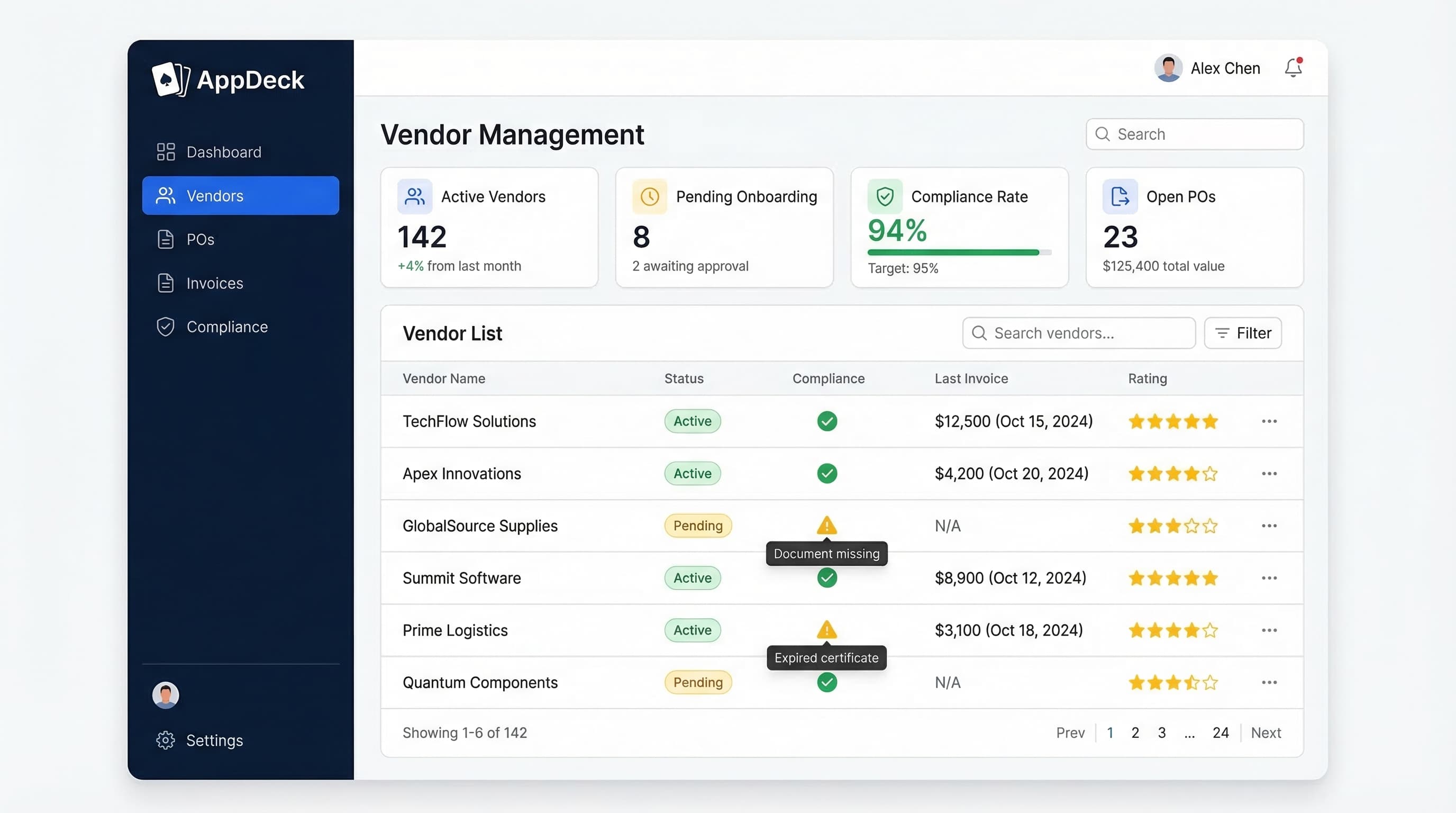
Managing vendors through spreadsheets, shared drives, and email threads creates information silos, compliance gaps, and wasted time. A dedicated vendor portal centralizes every aspect of the vendor lifecycle in one secure, branded platform.
Without a vendor portal
- Documents scattered across email and shared drives
- Expired certifications go unnoticed
- Manual onboarding takes weeks
- No visibility into vendor performance
With a vendor portal
- Everything centralized in one secure platform
- Automatic expiration alerts and renewal reminders
- Self-service onboarding in minutes
- Real-time scorecards and performance dashboards
Modern vendor portals like AppDeck Vendor Portal provide self-service onboarding, compliance tracking, performance scorecards, document management, and communication tools in a single branded experience. They replace fragmented processes with a unified system that benefits both your team and your vendors.
Related Guides
Go deeper with our in-depth guides
Ready to Transform Your Vendor Management?
Launch a modern vendor portal in 30 minutes. Streamline onboarding, automate compliance, and track performance -- all in one platform.
Free 14-day trial · now in beta · Enterprise-grade security