
B2B Partner Portal Software: 7 Best Platforms for Channel & Reseller Management
Compare the best B2B partner portal software and platforms for managing channel partners, resellers, and affiliates. Deal registration, co-marketing, training, and performance tracking.
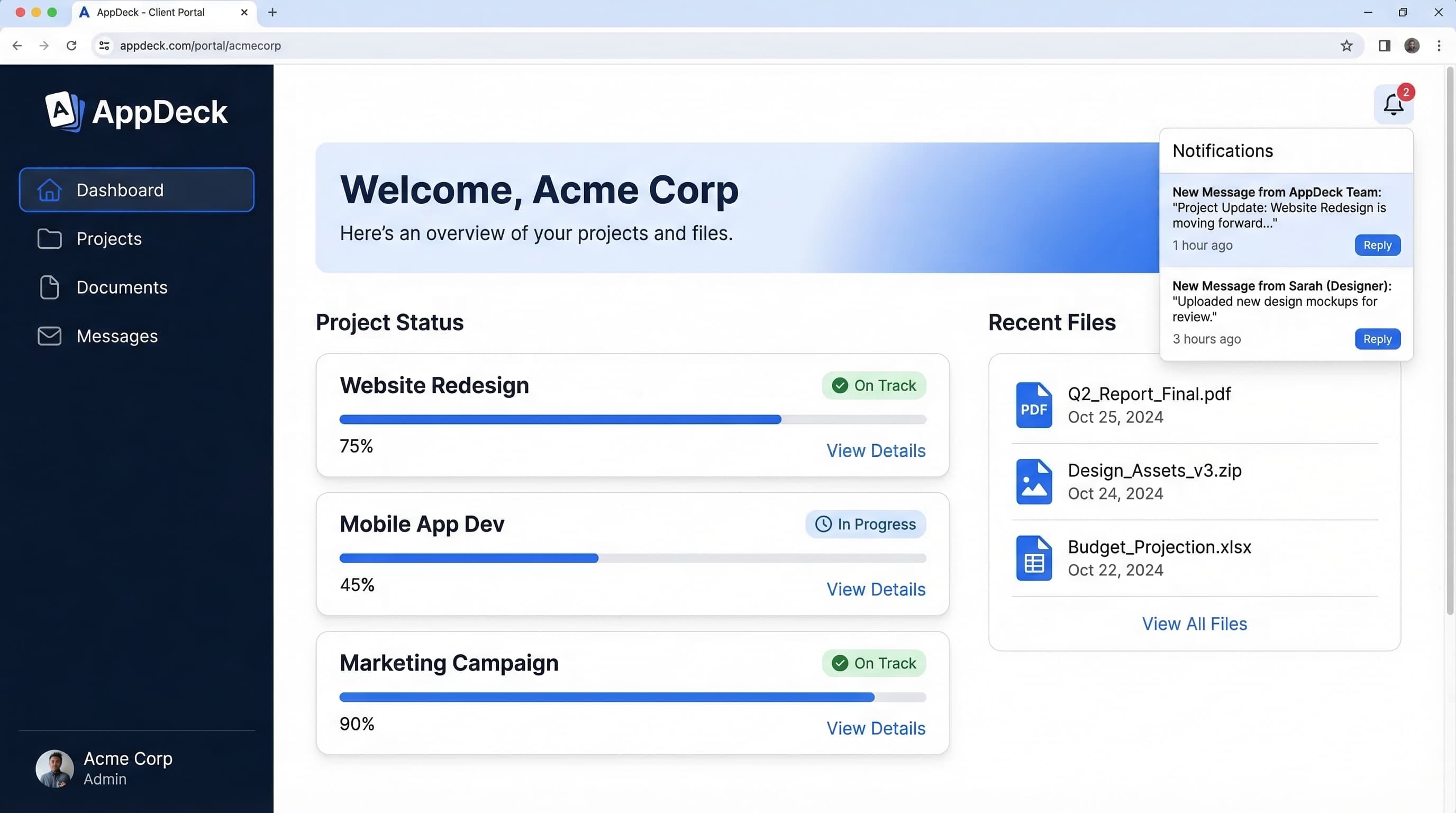
TL;DR: Updated September 2026. The best B2B partner portal platform depends on program size. Full PRM suites (Impartner, Channeltivity, Magentrix) fit programs with 50+ partners and deal registration. Lightweight PRMs (Kiflo, Allbound) fit first programs. PartnerStack fits SaaS affiliate programs. A branded portal (AppDeck, from $149/mo with unlimited partner users) fits programs built on content, dashboards, and communication. All seven are compared below on deal registration, MDF, training, white-labeling, and price.
Partner programs are one of the most powerful growth multipliers in B2B. A strong channel ecosystem can double or triple your reach without doubling your headcount. But here is the uncomfortable truth: most companies still manage their partner relationships through a mess of spreadsheets, shared Google Drives, and email threads that nobody can find six months later.
I have seen this firsthand. Companies with 20, 50, even 200 channel partners trying to coordinate deal registration over email, distribute marketing assets through Dropbox links, and track partner performance by manually updating a spreadsheet every quarter. It works until it does not. And it usually stops working right around the time your partner program starts to matter.
A partner portal centralizes everything. It gives your channel partners, resellers, distributors, and affiliates a single place to find what they need, register deals, access training, and see how they are performing. The right partner portal software removes friction from the relationship and lets both sides focus on selling.
In this guide, I will walk through what a B2B partner portal actually does, the features that matter, and seven partner portal platforms worth evaluating in 2026 — including where AppDeck fits and where it does not. If your needs skew toward serving clients rather than channel partners, our client portal guide is the better starting point.
What Is a B2B Partner Portal?
A B2B partner portal is a secure, branded hub where your channel partners can access everything they need to sell, market, and support your product. Instead of scattering resources across email, file shares, and disconnected tools, a partner portal brings it all together in one login.
Depending on the platform, a partner portal typically handles:
- Resource distribution — sales collateral, product documentation, pricing sheets, brand guidelines
- Deal registration — partners submit opportunities, you approve or reject them, everyone has visibility
- Performance tracking — dashboards showing pipeline, closed deals, commissions, and tier status
- Training and certification — onboarding modules, product training, certification programs
- Co-marketing coordination — MDF (Market Development Fund) requests, campaign assets, co-branded materials
- Communication — announcements, partner newsletters, direct messaging
The simplest partner portals are essentially branded content libraries with login access. The most complex are full Partner Relationship Management (PRM) platforms with deal registration workflows, automated tier management, incentive calculators, and CRM integrations.
Where you land on that spectrum depends on the size of your partner program, the complexity of your channel, and honestly, how much process you are ready to manage.
Partner portal software vs. partner portal platform vs. PRM. Vendors use these terms loosely, so here is how I use them in this guide. Partner portal software is the partner-facing login: the branded site partners visit. A partner portal platform is software you configure for several audiences at once (resellers, distributors, referral partners, sometimes clients and investors on the same system). A PRM (Partner Relationship Management) is the back-office layer that manages the partner lifecycle: recruitment, tiering, deal registration, MDF approvals, and payouts. Every PRM ships a portal; not every portal needs a PRM behind it. The comparison below covers all three.
Key Features to Look For in Partner Portal Software
Not every partner program needs every feature. But these six capabilities cover what most channel teams care about when evaluating partner portal software.
1. Deal Registration
Deal registration is the backbone of any indirect sales program. Partners submit opportunities, your channel team reviews and approves them, and the partner gets protection on that deal. Good deal registration workflows include approval routing, conflict detection (so two partners are not chasing the same account), expiration rules, and integration with your CRM so deals flow into your pipeline automatically.
2. Co-Marketing and MDF Management
If you allocate Market Development Funds to partners or run co-marketing campaigns, you need a way to manage requests, track spend, and measure results. The best platforms let partners submit MDF requests, upload proof-of-execution, and tie marketing spend back to pipeline.
3. Partner Training and Certification
Onboarding new partners is expensive. A built-in learning management system (LMS) or training module lets you create courses, track completion, issue certifications, and tie training milestones to tier requirements. This is especially important for technical products where partners need product knowledge to sell effectively.
4. Performance Dashboards
Partners want to know where they stand. Dashboards showing deal pipeline, closed revenue, commission payouts, tier progress, and certification status keep partners engaged and motivated. Your channel team gets aggregate views to identify top performers and partners who need attention.
5. Content and Resource Library
Every partner program has collateral — pitch decks, case studies, battle cards, pricing calculators, product sheets. A good partner portal makes these easy to find, keeps them up to date, and lets you control who sees what based on partner tier or region.
6. Partner Onboarding
The first 30 days of a partner relationship set the tone. Structured onboarding workflows — welcome sequences, required training, agreement signatures, profile completion — help new partners ramp faster and give your team visibility into where each partner is in the process.
7 Best Partner Portal Software Platforms
1. Impartner
Impartner is the enterprise-grade PRM platform that large channel programs gravitate toward. It is one of the most established names in partner management and powers partner programs for companies like Xerox, Honeywell, and Fortinet.
Key Strengths:
- Full PRM suite with deal registration, MDF management, and through-channel marketing automation
- Partner locator and co-branded microsites for partners
- Deep Salesforce integration with bi-directional sync
- Sophisticated tier management and incentive programs
- Partner journey automation with triggered workflows
Limitations:
- Significant implementation effort — plan for weeks, not days
- Pricing is enterprise-level and typically requires annual contracts
- The admin interface has a steep learning curve
- Overkill for partner programs with fewer than 50 partners
Pricing: Custom pricing only. Expect five figures annually for most deployments.
Best For: Enterprise companies with large, complex channel programs that need a full PRM platform with marketing automation and deep CRM integration.
2. Channeltivity
Channeltivity is a mid-market PRM platform that balances feature depth with usability. It is popular with companies that have outgrown spreadsheets but do not need (or want to pay for) an enterprise PRM.
Key Strengths:
- Clean deal registration workflow with CRM integration
- MDF management with request and approval tracking
- Partner training modules with completion tracking
- Strong Salesforce and HubSpot integrations
- Reasonable learning curve compared to enterprise PRMs
Limitations:
- The user interface feels dated compared to newer platforms
- Reporting and analytics could be more flexible
- Limited through-channel marketing automation
- Customization options are more constrained than Impartner
Pricing: Starts around $1,000 per month. Custom quotes for larger deployments.
Best For: Mid-market B2B companies with 20 to 200 partners that need core PRM functionality without enterprise complexity or pricing.
3. Allbound
Allbound takes a content-first approach to partner portals. It is built around the idea that partner engagement starts with making it easy for partners to find, customize, and share sales and marketing content.
Key Strengths:
- Excellent content management with partner-facing asset library
- Content co-branding so partners can customize materials
- Deal registration with a streamlined submission process
- Partner learning tracks with video support
- Clean, modern interface that partners actually enjoy using
Limitations:
- MDF management is not as robust as dedicated PRM platforms
- Reporting depth is adequate but not exceptional
- Fewer native CRM integrations than some competitors
- Less suited for highly complex tiered partner programs
Pricing: Custom pricing. Generally positions between mid-market and enterprise.
Best For: Companies that prioritize content distribution and partner enablement over heavy deal management workflows.
4. Kiflo
Kiflo is a newer entrant designed specifically for small and mid-sized companies launching or scaling their first partner program. It strips away the complexity of enterprise PRMs and focuses on the essentials.
Key Strengths:
- Purpose-built for SMBs launching partner programs
- Quick setup — most teams are live within a week
- Deal registration, partner onboarding, and basic training built in
- Affiliate and referral tracking alongside channel partnerships
- Transparent pricing that is accessible for smaller budgets
Limitations:
- Feature depth is intentionally limited compared to mature PRMs
- MDF management and co-marketing tools are basic
- Fewer integrations than established platforms
- May require migration as your program scales significantly
Pricing: Plans start around $500 per month with tiered pricing based on partners and features.
Best For: Startups and SMBs launching their first structured partner program who need something simple, fast, and affordable.
5. PartnerStack
PartnerStack focuses on SaaS partnerships — referral, affiliate, and reseller programs specifically for software companies. It is the go-to platform for SaaS companies that want to run partner programs with automated payouts.
Key Strengths:
- Built specifically for SaaS partnership models
- Automated partner payouts with support for multiple commission structures
- Marketplace network that helps partners discover your program
- Referral link tracking and attribution
- Strong API for custom integrations
Limitations:
- Less suited for traditional channel and distribution partnerships
- Deal registration workflows are more basic than dedicated PRMs
- Co-marketing and MDF management are not core strengths
- Marketplace fee structure adds cost on top of subscription
Pricing: Custom pricing based on program size. Marketplace transactions may carry additional fees.
Best For: SaaS companies running referral, affiliate, and reseller programs that need automated payouts and partner discovery.
6. AppDeck
I will be straightforward here — AppDeck is not a PRM platform. We do not have built-in deal registration workflows or MDF management. If you need those capabilities, look at Impartner, Channeltivity, or Allbound.
What AppDeck does well is give you a professional, white-labeled partner portal for content distribution, dashboards, and communication. If your partner program is more about sharing resources, providing performance visibility, and keeping partners informed — without the overhead of a full PRM — AppDeck is a strong fit.
Key Strengths:
- Fully white-labeled portals with your branding, domain, and colors
- Embedded dashboards for partner performance metrics
- Secure document sharing with granular access controls
- Clean, modern interface that is easy for partners to navigate
- Fast setup — you can have a portal live in a day, not a month
- Flexible enough to serve as a partner portal alongside client, investor, or board portals
Limitations:
- No built-in deal registration workflow
- No MDF or co-marketing management
- No partner training or LMS functionality
- Not a replacement for a full PRM if your channel program demands it
Pricing: Starts at $149 per month per workspace with unlimited partner users — no per-seat charges as your partner count grows. Significantly more affordable than PRM platforms.
Best For: Companies that want a simple, branded partner portal for content distribution, dashboards, and communication — without PRM complexity. Especially strong if you also need portals for clients, investors, or other stakeholders on the same platform. Learn more about AppDeck portals.
7. Magentrix
Magentrix is a PRM platform built on a flexible, customizable foundation. It appeals to companies that want partner management functionality with the ability to tailor workflows and interfaces to their specific needs.
Key Strengths:
- Highly customizable portal with drag-and-drop page builder
- Deal registration, onboarding, and training modules included
- Native Salesforce and Dynamics 365 integration
- Self-service partner support with knowledge base and ticketing
- Supports multiple portal types (partner, customer, employee) on one platform
Limitations:
- Customization power means a steeper initial setup
- The interface, while customizable, can feel less polished than purpose-built alternatives
- Pricing is not transparent — requires a sales conversation
- Some features require add-on modules
Pricing: Custom pricing only. Positioned in the mid-market to enterprise range.
Best For: Companies that need a customizable PRM with flexibility to adapt workflows, especially those already invested in Salesforce or Dynamics 365.
Partner Portal Software Comparison
| Platform | Deal Registration | MDF Management | Training/LMS | White Label | Starting Price |
|---|---|---|---|---|---|
| Impartner | Advanced | Advanced | Yes | Yes | Custom (enterprise) |
| Channeltivity | Yes | Yes | Yes | Limited | ~$1,000/mo |
| Allbound | Yes | Basic | Yes | Limited | Custom |
| Kiflo | Yes | Basic | Basic | Limited | ~$500/mo |
| PartnerStack | Basic | No | No | Limited | Custom |
| AppDeck | No | No | No | Full | $149/mo (unlimited users) |
| Magentrix | Yes | Yes | Yes | Yes | Custom |
How to Choose: A Decision Framework
The right partner portal software depends on where your partner program is today and where it is headed. Here is how I think about the decision.
Choose a full PRM (Impartner, Channeltivity, Magentrix) if:
- You have more than 50 active channel partners
- Deal registration and deal protection are critical to your program
- You allocate MDF or run co-marketing campaigns with partners
- You need deep CRM integration with Salesforce or HubSpot
- You have a dedicated channel team to manage the platform
Choose a lightweight PRM (Kiflo, Allbound) if:
- You are launching or scaling your first partner program
- You need deal registration but want faster setup and lower cost
- Your partner count is under 50 and growing
- You want good-enough functionality without enterprise overhead
Choose a SaaS partnership platform (PartnerStack) if:
- You are a software company running referral or affiliate programs
- Automated payouts and commission tracking are top priorities
- You want a marketplace to help recruit new partners
Choose a branded portal (AppDeck) if:
- Your partner program is centered on content sharing, dashboards, and communication
- You do not need deal registration or MDF management
- You want a professional, white-labeled experience at a fraction of PRM cost
- You also need portals for clients, investors, or other audiences
The most common mistake I see is companies buying an enterprise PRM when their partner program has 15 partners and no deal registration process. You end up paying for complexity you do not use, and your team spends more time configuring the tool than enabling partners. Start with what you need today and upgrade when the pain justifies it.
Frequently Asked Questions
What is a partner portal?
A partner portal is a secure web platform where channel partners — resellers, distributors, system integrators, referral partners, and affiliates — access sales collateral, register deals, view commissions, complete training, and communicate with the vendor. It centralizes everything a partner needs to sell, support, and grow with you, replacing scattered email threads, Dropbox folders, and tribal knowledge. Partner portals are the foundation of channel-led growth: they enable scale by letting partners self-serve on enablement materials and pipeline management while vendors track partner performance, revenue contribution, and program ROI.
How is a partner portal different from a CRM or PRM?
A CRM (Salesforce, HubSpot) is built for your internal sales team to track deals you own directly. A PRM (partner relationship management — Impartner, Channeltivity, Allbound) is built for managing the full partner lifecycle including deal registration, MDF requests, certification tracking, and tiered partner programs. A partner portal is the partner-facing surface — it can sit on top of a PRM, replace a lightweight PRM, or operate independently as a simple resource hub. If your program has fewer than 50 partners and no deal registration, a portal alone is often enough. If you have 200+ partners with tiering, MDF, and deal reg, you need a full PRM.
How much does partner portal software cost?
Branded portal software starts around $150-500/month (AppDeck and similar, typically flat-rate with unlimited partner users). Lightweight PRMs run $500-1,500/month (Kiflo, Magentrix Lite). Mid-market PRMs (Allbound, PartnerStack) typically cost $1,500-5,000/month depending on partner count and modules. Enterprise PRMs (Impartner, ZINFI, Channeltivity Enterprise) start at $25,000-100,000/year. Most vendors price by partner count or revenue tier, so model 3-year cost at projected partner growth. Hidden costs include implementation ($10K-50K), integrations with CRM and marketing automation, and dedicated channel ops headcount needed to operate the system regardless of which platform you choose.
Who should use a partner portal vs. just sharing files in Google Drive?
You need a partner portal once you cross roughly 15-25 active partners or once partners ask "where's the latest version of X?" more than once a month. Below that threshold, a well-organized Drive plus Slack channel works. Above it, file sprawl, version confusion, and inconsistent partner experience start hurting deals. Companies running formal channel programs, SaaS vendors with reseller networks, manufacturers selling through distribution, and franchisors managing franchisees all need portals at scale. The signal isn't partner count alone — it's whether you can answer "how is each partner performing?" without a manual spreadsheet exercise.
What is the best B2B partner portal platform?
There is no single best B2B partner portal platform; the right choice tracks the size and complexity of your channel. For programs with 50 or more active partners, formal deal registration, and MDF, Impartner and Channeltivity are the most complete, with Magentrix as a strong Salesforce-native alternative. For a first partner program under 50 partners, Kiflo and Allbound deliver deal registration and onboarding at a fraction of the cost. SaaS companies running affiliate or referral programs should look at PartnerStack for its automated payouts and marketplace. If your program runs on shared resources, performance dashboards, and communication rather than deal workflows, a branded portal such as AppDeck (from $149/mo, unlimited partner users) gives partners a professional experience without PRM overhead.
When should we upgrade from a basic portal to a full PRM?
Upgrade when three signals appear: (1) you've launched formal deal registration and need conflict resolution workflows, (2) you're running MDF (market development funds) and need approval workflows plus ROI tracking, or (3) you've introduced partner tiers (Silver/Gold/Platinum) with different commissions, requirements, and benefits that need to be enforced systematically. A basic portal becomes the bottleneck when channel ops teams start building spreadsheets to track what the system can't. Until those signals appear, a lightweight branded portal beats an over-engineered PRM that partners refuse to log into.
Conclusion
Partner portals solve a real problem — the chaos of managing channel relationships across scattered tools and email threads. The right platform depends on whether you need full PRM capabilities, a lightweight starting point, or simply a professional hub for partner content and communication.
If your program demands deal registration, MDF tracking, and training, platforms like Impartner, Channeltivity, and Magentrix have you covered. If you are earlier in your journey, Kiflo and Allbound offer a faster path to value. For SaaS-specific partnerships, PartnerStack is purpose-built.
And if what you really need is a clean, branded portal where partners can access resources, view dashboards, and stay informed — without the weight of a PRM — that is exactly what we built AppDeck to do.
Whatever you choose, the goal is the same: make it easier for your partners to work with you. Because the companies that win in channel are not the ones with the most partners. They are the ones whose partners actually stay engaged.
Related Reading

Founder & CEO, AppDeck
Serial entrepreneur with 20+ years building B2B software companies. Former executive managing 2,800+ employees across three continents. Vik reviews all AppDeck content for accuracy and practical relevance.
Share this article
Related Articles
B2B Portal: What It Is, Why You Need One, and How to Choose the Right Platform
Everything you need to know about B2B portals. Types of portals (client, vendor, partner, investor), key features, how to evaluate platforms, and implementation best practices.
How to Build a Portal Website: Step-by-Step Guide for Businesses
Learn how to build a portal website for your business. Step-by-step guide covering planning, features, design, build vs. buy decisions, launch, and measuring success.

Best Board Portal Software 2026: 12 Platforms Compared (Real Pricing, Pros & Cons)
12 board portals compared side-by-side with the real 2026 pricing vendors hide, from $79/mo to $30K+/yr. Diligent, OnBoard, Boardable, BoardPro, Aprio, Ansarada, AppDeck & more, with honest pros, cons, and reviews.