
Vendor Compliance Checklist: 30 Items Every Procurement Team Needs
Complete vendor compliance checklist for procurement teams. Track certifications, insurance, licenses, contracts, and regulatory requirements with automated reminders.
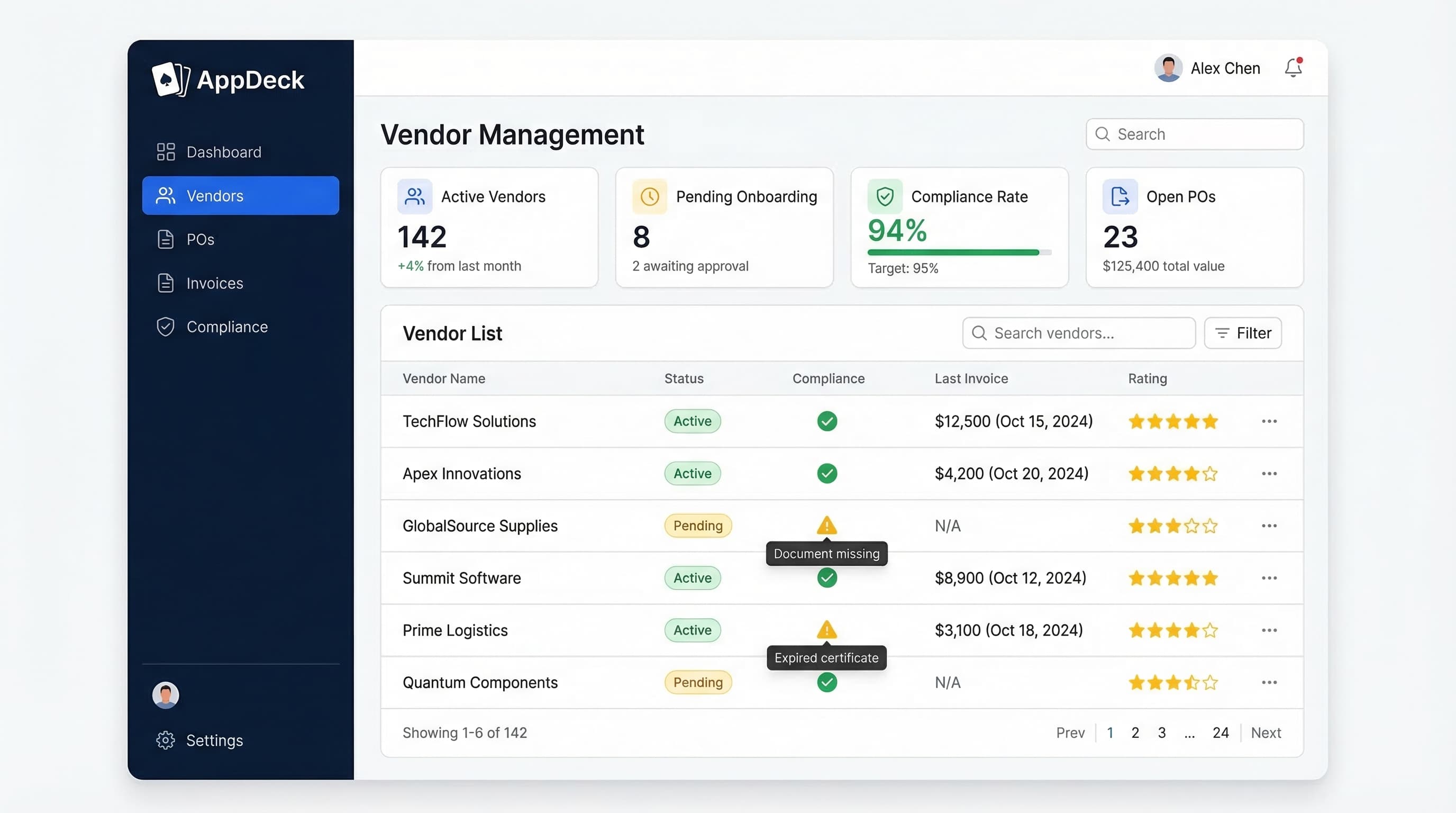
TL;DR: Complete vendor compliance checklist for procurement teams. Track certifications, insurance, licenses, contracts, and regulatory requirements with automated reminders.
Introduction
Vendor compliance failures don't announce themselves. They surface during audits, after incidents, or when a regulator comes knocking — and by then, the damage is done. An expired insurance certificate that nobody noticed. A lapsed industry certification that voids your contractual protections. A vendor operating without a required license that puts your organization on the wrong side of a regulation.
The root cause is almost always the same: no systematic way to track what's required, what's current, and what's overdue. Procurement teams manage dozens or hundreds of vendor relationships, each with its own set of compliance requirements. Spreadsheets fill up, emails get buried, and compliance gaps grow silently until they become problems.
After working with procurement teams across industries, I've compiled the definitive vendor compliance checklist — 30 items organized into six categories that cover every compliance dimension that matters. This isn't a theoretical framework. It's a practical, actionable list your team can implement immediately to close gaps and stay ahead of auditors.
What you'll get from this guide:
- Why vendor compliance tracking is a procurement imperative, not a nice-to-have
- A 30-item checklist organized by six compliance categories
- Clear guidance on what to collect, verify, and monitor for each item
- Strategies for automating compliance tracking with vendor portal technology
- A practical implementation roadmap for teams of any size
Why Vendor Compliance Matters
Vendor compliance isn't bureaucracy for its own sake. It's the mechanism that protects your organization from financial, legal, and operational exposure created by third-party relationships. When a vendor falls out of compliance, the consequences land on your desk — not theirs.
The Real Cost of Non-Compliance
Financial exposure is significant:
- The average cost of a compliance failure involving a third party exceeds $4 million when accounting for fines, remediation, and operational disruption
- Regulatory penalties for vendor-related violations have increased 45% over the past three years
- Organizations with automated compliance tracking spend 60% less on audit preparation than those using manual processes
Without systematic compliance tracking:
- ❌ An expired insurance certificate means you're unprotected if a vendor causes damage or injury on your behalf
- ❌ A lapsed certification invalidates your own compliance claims to customers and regulators
- ❌ An unlicensed vendor performing regulated work exposes you to fines and legal liability
- ❌ A missed contract renewal auto-renews on unfavorable terms or lapses entirely
- ❌ An incomplete tax document creates reporting obligations you can't fulfill
With systematic compliance tracking:
- ✅ Every requirement has an owner, a deadline, and an automated reminder
- ✅ Expired or missing documents are flagged before they become problems
- ✅ Audit preparation takes hours instead of weeks
- ✅ New vendors are onboarded with complete compliance documentation from day one
- ✅ Leadership has real-time visibility into portfolio-wide compliance status
Who Owns Vendor Compliance?
In most organizations, vendor compliance is a shared responsibility — and that's precisely why it falls through the cracks. Procurement initiates vendor relationships. Legal drafts contracts. Finance handles payment terms and tax documentation. IT evaluates security posture. Operations manages day-to-day performance.
The solution isn't to assign compliance to one team. It's to centralize tracking in one system while distributing responsibility to the right subject matter experts. A vendor portal serves as that central system, ensuring nothing is missed regardless of who owns each compliance element.
The 30-Item Vendor Compliance Checklist
This checklist is organized into six categories. Each item specifies what to collect, how to verify it, and how often it needs to be reviewed. Use it as a master template and customize it based on your industry, regulatory environment, and risk tolerance.
Category 1: Documentation and Registration (Items 1-5)
These are the foundational documents that verify a vendor is a legitimate, properly registered business entity. Without these, you have no basis for a compliant vendor relationship.
Item 1: Business Registration / Articles of Incorporation
- What to collect: Certificate of incorporation, articles of organization, or equivalent business registration documents
- How to verify: Cross-reference with the Secretary of State database in their state of incorporation
- Review frequency: At onboarding; re-verify annually or upon notification of ownership change
- Why it matters: Confirms the vendor is a legally registered entity and that you're contracting with the correct legal name
Item 2: Tax Identification Number (EIN/TIN) and W-9
- What to collect: Completed W-9 form (for US vendors) or W-8BEN/W-8BEN-E (for international vendors)
- How to verify: Validate the EIN through IRS TIN matching; confirm the name and TIN combination match
- Review frequency: At onboarding; update whenever there's a change in legal name, address, or tax classification
- Why it matters: Required for accurate 1099 reporting; incorrect information creates IRS compliance issues for your organization
Item 3: Business Licenses and Permits
- What to collect: All licenses and permits required for the vendor's specific line of work in the jurisdictions where they operate
- How to verify: Confirm license numbers with the issuing authority; verify active status and expiration dates
- Review frequency: Track expiration dates; verify renewal 30 days before expiration
- Why it matters: An unlicensed vendor performing regulated work can expose you to legal liability and void your insurance protections
Item 4: Diversity and Small Business Certifications
- What to collect: MBE, WBE, SDVOSB, HUBZone, 8(a), or other diversity certifications if claimed by the vendor
- How to verify: Validate certification numbers with the certifying body (SBA, NMSDC, WBENC, etc.)
- Review frequency: At onboarding; track expiration dates and verify renewals
- Why it matters: If you're counting a vendor toward diversity spend goals or government contract requirements, unverified or expired certifications create false reporting
Item 5: Authorized Signatory Documentation
- What to collect: Documentation confirming who has authority to sign contracts, amendments, and change orders on behalf of the vendor
- How to verify: Corporate resolution, power of attorney, or letter of authorization on company letterhead
- Review frequency: At onboarding; update when vendor notifies you of organizational changes
- Why it matters: Contracts signed by unauthorized individuals may be voidable, leaving you without enforceable agreements
Category 2: Insurance Requirements (Items 6-10)
Insurance is your safety net when things go wrong. Expired or inadequate coverage is one of the most common — and most dangerous — vendor compliance gaps.
Item 6: Certificate of Insurance (COI)
- What to collect: Current certificate of insurance naming your organization as an additional insured (if required by contract)
- How to verify: Confirm directly with the insurance broker or carrier; verify policy numbers, effective dates, and coverage limits
- Review frequency: Track expiration dates; require updated COI at least 30 days before policy expiration
- Why it matters: An expired COI means you have no proof of coverage — and if an incident occurs, you may have no protection
Item 7: General Liability Insurance
- What to collect: Proof of commercial general liability insurance with minimum coverage limits as specified in your contract
- How to verify: Review the COI for coverage amounts, effective dates, and any exclusions; confirm your organization is listed as additional insured
- Review frequency: Annually, at policy renewal
- Why it matters: Covers bodily injury and property damage claims; without it, you're exposed if a vendor's employee or product causes harm
Item 8: Professional Liability / Errors & Omissions Insurance
- What to collect: Proof of professional liability (E&O) insurance for vendors providing professional services, consulting, or technology
- How to verify: Review the COI for coverage limits, retroactive date, and any exclusions specific to the services being provided
- Review frequency: Annually, at policy renewal
- Why it matters: Covers claims arising from professional mistakes, omissions, or negligent advice; essential for consultants, technology vendors, and advisory firms
Item 9: Workers' Compensation Insurance
- What to collect: Proof of workers' compensation insurance in all states where the vendor has employees performing work for you
- How to verify: Confirm coverage with the insurance carrier; verify it covers all relevant jurisdictions
- Review frequency: Annually, at policy renewal
- Why it matters: Required by law in most states; without it, vendor employee injuries on your premises or projects could create liability for your organization
Item 10: Cyber Liability Insurance
- What to collect: Proof of cyber liability insurance for any vendor that handles, processes, or stores your data
- How to verify: Review the policy for coverage of data breaches, business interruption, regulatory fines, and notification costs
- Review frequency: Annually, at policy renewal
- Why it matters: Data breaches at vendors create costs for your organization — notification, remediation, legal defense, and regulatory fines; cyber insurance ensures the vendor can cover those costs
Category 3: Certifications and Standards (Items 11-16)
Industry certifications are independently verified proof that a vendor meets recognized standards. They're the most reliable form of compliance evidence because a third party has audited the vendor's practices.
Item 11: SOC 2 Type II Report
- What to collect: Current SOC 2 Type II report covering Trust Service Criteria relevant to your engagement (Security, Availability, Processing Integrity, Confidentiality, Privacy)
- How to verify: Review the report for the audit period, scope, any qualified opinions, and management response to exceptions
- Review frequency: Annually; request the updated report within 30 days of issuance
- Why it matters: Provides independent assurance of a vendor's security controls; often required by your own auditors and customers
Item 12: ISO 27001 Certification
- What to collect: Current ISO 27001 certificate and, if available, the Statement of Applicability
- How to verify: Confirm the certifying body is accredited; verify certificate number and validity dates
- Review frequency: Certificate validity is typically 3 years with annual surveillance audits; verify the latest surveillance audit is complete
- Why it matters: Demonstrates a systematic approach to information security management; widely recognized across industries and geographies
Item 13: Industry-Specific Certifications (HIPAA, PCI-DSS, FedRAMP, etc.)
- What to collect: Applicable certifications based on the data or services the vendor handles — HIPAA compliance attestation, PCI-DSS Attestation of Compliance, FedRAMP authorization, GxP compliance documentation
- How to verify: Confirm certification or authorization status with the relevant authority or registry
- Review frequency: Varies by standard; typically annual attestation or re-certification
- Why it matters: Your organization's compliance with industry regulations depends on your vendors meeting the same standards for the services and data they handle on your behalf
Item 14: Quality Management Certification (ISO 9001)
- What to collect: Current ISO 9001 certificate for vendors providing manufacturing, production, or quality-critical services
- How to verify: Confirm with the certifying body; verify scope covers the services provided to you
- Review frequency: Certificate validity is typically 3 years with annual surveillance audits
- Why it matters: Demonstrates documented, repeatable quality processes; reduces the risk of defects, rework, and delivery failures
Item 15: Environmental Certifications (ISO 14001, ESG Reports)
- What to collect: ISO 14001 certificate, published ESG report, or environmental compliance documentation
- How to verify: Confirm certification with the certifying body; review ESG reports for third-party verification
- Review frequency: Annually
- Why it matters: Increasingly required by regulations, customers, and investors; your Scope 3 emissions include your vendors' environmental impact
Item 16: Safety Certifications and Records (OSHA, EMR)
- What to collect: OSHA 300 log summary, Experience Modification Rate (EMR), safety training certifications, and any industry-specific safety credentials
- How to verify: Request the OSHA 300A summary directly; verify EMR through the vendor's workers' compensation carrier
- Review frequency: Annually
- Why it matters: Vendors with poor safety records create liability exposure, especially for on-site work; an EMR above 1.0 indicates worse-than-average safety performance
Category 4: Regulatory Compliance (Items 17-22)
Regulatory compliance items are non-negotiable. These are legal requirements, and failure to track them creates direct legal exposure for your organization.
Item 17: Anti-Corruption and Anti-Bribery Compliance
- What to collect: Written anti-corruption policy, FCPA/UK Bribery Act compliance program documentation, and annual compliance certification from the vendor
- How to verify: Review the policy for adequacy; for high-risk vendors (operating in high-corruption jurisdictions), require evidence of training and enforcement
- Review frequency: Annually; immediately upon learning of any investigation or allegation
- Why it matters: Under the FCPA and UK Bribery Act, your organization can be liable for corrupt acts committed by vendors acting on your behalf
Item 18: Sanctions and Export Control Compliance
- What to collect: Confirmation that the vendor, its principals, and its key subcontractors are not on OFAC SDN, BIS Entity List, or other restricted party lists
- How to verify: Screen against current sanctions lists using a screening tool or service; verify for all beneficial owners with 25%+ ownership
- Review frequency: At onboarding; re-screen quarterly for high-risk vendors and annually for all others
- Why it matters: Doing business with sanctioned entities carries severe criminal and civil penalties — ignorance is not a defense
Item 19: Data Privacy and Protection Compliance
- What to collect: Data Processing Agreement (DPA), privacy policy, data handling procedures, and evidence of compliance with applicable privacy laws (GDPR, CCPA, state privacy laws)
- How to verify: Have legal review the DPA for completeness; verify data processing practices align with the DPA; confirm subprocessor disclosures are current
- Review frequency: Annually; immediately upon any change in data processing scope or applicable regulations
- Why it matters: Privacy regulations hold data controllers responsible for their processors' compliance; inadequate DPAs or non-compliant practices create regulatory exposure
Item 20: Labor and Employment Law Compliance
- What to collect: Confirmation of compliance with Fair Labor Standards Act, equal employment opportunity laws, immigration law (I-9/E-Verify), and applicable state employment laws
- How to verify: Require signed compliance certifications; for staffing vendors, verify I-9 completion processes and E-Verify participation
- Review frequency: Annually; immediately upon any DOL investigation or employment lawsuit
- Why it matters: Joint employer liability means your organization can be held responsible for a vendor's labor law violations, particularly with staffing agencies and on-site service providers
Item 21: Environmental Regulatory Compliance
- What to collect: EPA compliance documentation, hazardous materials handling permits, waste disposal manifests, and air/water discharge permits as applicable
- How to verify: Cross-reference with EPA ECHO database for enforcement history; verify permit numbers with issuing agencies
- Review frequency: Annually; immediately upon any environmental incident or regulatory action
- Why it matters: Environmental liability can follow the chain of custody — if your vendor improperly disposes of waste generated from your contract, your organization faces potential Superfund liability
Item 22: Accessibility Compliance
- What to collect: VPAT (Voluntary Product Accessibility Template) or accessibility conformance report for technology vendors; ADA compliance documentation for service vendors
- How to verify: Review the VPAT for WCAG 2.1 AA conformance levels; for critical applications, conduct independent accessibility testing
- Review frequency: At onboarding and with each major product release or service change
- Why it matters: ADA lawsuits targeting digital accessibility have increased significantly; technology vendors' accessibility failures become your compliance problem when you deploy their products
Category 5: Contractual Compliance (Items 23-27)
Contractual compliance ensures that the legal and commercial framework governing the relationship is current, enforceable, and being honored.
Item 23: Master Service Agreement (MSA) or Contract
- What to collect: Fully executed MSA or contract with all amendments, exhibits, and schedules
- How to verify: Confirm all parties have signed; verify the correct legal entities are named; ensure the latest version is on file
- Review frequency: Track term dates and auto-renewal windows; review 90 days before expiration or renewal deadline
- Why it matters: An expired or improperly executed contract means you're operating without enforceable terms — no liability protections, no IP ownership clarity, no dispute resolution mechanisms
Item 24: Statement of Work (SOW) and Change Orders
- What to collect: All active SOWs and change orders, fully executed, with clear scope, deliverables, timelines, and pricing
- How to verify: Confirm SOWs are consistent with the MSA; verify pricing matches approved rates; confirm all change orders are properly authorized
- Review frequency: With each new SOW or change order; quarterly review of all active SOWs
- Why it matters: Scope creep without documented change orders creates billing disputes and removes your contractual protections for the undocumented work
Item 25: Service Level Agreements (SLAs)
- What to collect: Documented SLAs with specific, measurable performance metrics, measurement methodology, reporting frequency, and remedy provisions
- How to verify: Review SLA reports against contractual requirements; verify the vendor's measurement methodology matches the agreed approach
- Review frequency: Monthly or quarterly depending on the SLA reporting cycle; formal review at contract renewal
- Why it matters: SLAs without monitoring are meaningless — you need documented evidence of performance to enforce remedies, justify renewals or terminations, and hold vendors accountable
Item 26: Non-Disclosure Agreement (NDA)
- What to collect: Fully executed NDA covering all confidential information exchanged during the relationship
- How to verify: Confirm the NDA covers the appropriate scope of information, has adequate term length, and includes provisions for return or destruction of confidential information
- Review frequency: Track expiration dates; renew before expiration if the relationship is ongoing
- Why it matters: Without a current NDA, your confidential information shared with the vendor has no contractual protection — trade secrets, pricing strategies, customer data, and proprietary processes are all at risk
Item 27: Data Processing Agreement (DPA)
- What to collect: Executed DPA that meets requirements of applicable privacy regulations (GDPR Article 28, CCPA service provider provisions, etc.)
- How to verify: Legal review for completeness; verify Standard Contractual Clauses are current (for international transfers); confirm subprocessor notification obligations
- Review frequency: Annually; immediately upon changes in data processing scope or privacy regulations
- Why it matters: Processing personal data without a compliant DPA violates privacy regulations — GDPR fines alone can reach 4% of global annual revenue
Category 6: Cybersecurity Compliance (Items 28-30)
Cybersecurity compliance items specifically address the technical and procedural controls that protect your data and systems from vendor-related threats.
Item 28: Security Questionnaire / Assessment Results
- What to collect: Completed security questionnaire (SIG, CAIQ, or your custom questionnaire) with supporting documentation for critical responses
- How to verify: Cross-reference responses with SOC 2 reports, penetration test summaries, and other independent evidence; flag inconsistencies for follow-up
- Review frequency: At onboarding; annually for Tier 1 and Tier 2 vendors; every 2 years for Tier 3
- Why it matters: The security questionnaire is your primary tool for understanding a vendor's security posture beyond what certifications reveal — it covers implementation details, specific technologies, and organizational practices
Item 29: Incident Response and Breach Notification Procedures
- What to collect: Vendor's incident response plan, breach notification procedures, and contractual commitment to notification timelines (typically 24-72 hours)
- How to verify: Review the IRP for completeness (detection, containment, eradication, recovery, lessons learned); confirm the plan has been tested within the past 12 months
- Review frequency: Annually; immediately following any security incident
- Why it matters: When a vendor suffers a breach involving your data, your response timeline depends on theirs — late notification means late response, which means greater damage and regulatory exposure
Item 30: Access Control and Data Handling Documentation
- What to collect: Documentation of the vendor's access control policies, data classification scheme, encryption standards, data retention schedule, and data destruction procedures
- How to verify: Review for alignment with your security requirements; for critical vendors, request evidence of implementation (screenshots, configuration reports, or third-party audit findings)
- Review frequency: Annually; immediately upon any change in the vendor's access to your systems or data
- Why it matters: Understanding exactly how a vendor handles your data — who can access it, how it's protected, how long it's retained, and how it's destroyed — is fundamental to managing your data security risk
How to Automate Vendor Compliance Tracking
Tracking 30 compliance items across dozens or hundreds of vendors is not sustainable with manual processes. Spreadsheets become outdated the moment they're created. Email reminders get ignored. Shared drives fill with documents nobody can find when an auditor asks for them. The compliance checklist is only useful if you can actually maintain it at scale.
Why Manual Tracking Fails
Manual vendor compliance tracking breaks down in predictable ways:
- Expiration blindness — Insurance certificates, licenses, and certifications all have expiration dates. With 100 vendors averaging 5-6 tracked documents each, you're monitoring 500-600 expiration dates. Miss one, and you're exposed.
- Version chaos — Contracts get amended. Certificates get renewed. Policies get updated. Without a single source of truth, your team works from outdated documents and makes decisions based on stale information.
- Onboarding bottlenecks — Collecting all required compliance documents from a new vendor takes an average of 3-4 weeks with email-based processes. Critical projects wait while procurement chases paperwork.
- Audit scrambles — When auditors ask for proof of vendor compliance, manual tracking means assembling evidence from email inboxes, shared drives, filing cabinets, and individual team members' knowledge. This process typically takes days or weeks.
How a Vendor Portal Solves These Problems
A vendor portal centralizes every compliance document, deadline, and requirement in one system — accessible to your team and your vendors. Here's how it transforms each stage of the compliance lifecycle.
Self-service document collection. Vendors log into the portal and upload required documents directly. The system validates document types, flags incomplete submissions, and maintains a complete upload history. Your team reviews and approves rather than chasing and collecting.
Automated expiration tracking. Every document with an expiration date gets tracked automatically. The portal sends reminders to vendors 60, 30, and 7 days before expiration. Your team gets notified when deadlines are missed. No more surprise lapses.
Compliance status dashboards. Real-time visibility into compliance status across your entire vendor portfolio. See at a glance which vendors are fully compliant, which have pending items, and which are overdue. Filter by category, vendor tier, or specific requirement.
Standardized onboarding workflows. New vendor onboarding follows a defined checklist. The portal presents vendors with exactly what's required, tracks completion in real time, and prevents activation until all mandatory items are submitted and approved.
Audit-ready documentation. Every document upload, approval, expiration, and renewal is logged with timestamps and user attribution. When auditors need evidence, you generate a compliance report in minutes instead of assembling it over weeks.
Building Your Compliance Automation Roadmap
Moving from manual tracking to automated compliance management doesn't have to happen overnight. Here's a phased approach that delivers value at each stage.
Phase 1 — Centralize (Weeks 1-3). Set up your vendor portal and migrate existing compliance documents from spreadsheets, shared drives, and email. Focus on the six categories in this checklist. Establish the master requirements template.
Phase 2 — Activate Tracking (Weeks 4-6). Enter all expiration dates for current documents. Configure automated reminders. Invite your top 20 vendors to the portal and have them verify their document status. Address any gaps identified during migration.
Phase 3 — Standardize Onboarding (Weeks 7-10). Build the onboarding workflow using this 30-item checklist as the template. Route new vendors through the portal from day one. Establish approval workflows so the right subject matter experts review each compliance category.
Phase 4 — Scale and Report (Months 3-6). Extend to all active vendors. Build compliance dashboards for leadership reporting. Establish quarterly compliance review cadence. Refine requirements based on audit feedback and regulatory changes.
Compliance Tracking Best Practices
Beyond the checklist itself, these practices determine whether your compliance program actually works or just looks good on paper.
Tier Your Requirements
Not every vendor needs all 30 items. A strategic technology vendor handling sensitive data needs the full checklist. A commodity supplier providing office furniture needs a subset. Establish three tiers:
- Tier 1 (Strategic/High-Risk): All 30 items. Full documentation. Quarterly compliance reviews.
- Tier 2 (Important/Moderate-Risk): Items 1-10 (documentation and insurance) plus items relevant to the vendor's risk profile. Semi-annual reviews.
- Tier 3 (Commodity/Low-Risk): Items 1-5 (core documentation) plus basic insurance. Annual reviews.
Assign Clear Ownership
Each compliance category needs a designated owner within your organization:
- Documentation and Registration: Procurement
- Insurance Requirements: Risk management or procurement
- Certifications and Standards: Quality assurance or the relevant functional area (IT for security certs, operations for quality certs)
- Regulatory Compliance: Legal and compliance
- Contractual Compliance: Legal and procurement
- Cybersecurity Compliance: IT security
Build Compliance into Vendor Performance
Compliance status should be a factor in vendor performance reviews, renewal decisions, and spend allocation. Vendors that consistently maintain compliance earn preferred status. Vendors that repeatedly miss deadlines or resist requirements get flagged for enhanced monitoring or replacement.
Prepare for Audits Proactively
Don't wait for an audit to organize your compliance records. Conduct internal compliance audits quarterly. Run a mock external audit annually. The gaps you find proactively are far less expensive than the ones an auditor or regulator finds.
Common Compliance Tracking Mistakes
These mistakes undermine even well-intentioned compliance programs. Avoid them from the start.
Mistake #1: Collecting documents without verifying them. A vendor sends a COI, and your team files it without checking coverage limits, additional insured status, or expiration dates. Six months later, you discover the coverage was inadequate or the wrong entity was named. Fix: Every document gets reviewed against your specific requirements before it's marked as compliant.
Mistake #2: Tracking expiration dates but not acting on them. Your spreadsheet shows a license expires in 30 days, but nobody follows up. The license lapses, and the vendor continues performing regulated work without authorization. Fix: Automated reminders with escalation paths. If the vendor doesn't respond within the first reminder window, escalate to their account manager and your procurement lead.
Mistake #3: Treating compliance as a procurement-only function. Procurement collects the documents, but legal never reviews the contracts, IT never assesses the security questionnaires, and risk management never evaluates the insurance adequacy. Fix: Route each compliance category to the appropriate subject matter expert for review and approval.
Mistake #4: No consequences for non-compliance. Vendors learn quickly whether your compliance requirements are real or performative. If nothing happens when they miss a deadline, they'll keep missing deadlines. Fix: Define and enforce consequences — payment holds, work suspension, or removal from preferred vendor status for persistent non-compliance.
Mistake #5: Static checklists that don't evolve. Your compliance checklist was created three years ago and doesn't reflect new regulations, updated industry standards, or lessons learned from incidents. Fix: Review and update your compliance requirements annually. Incorporate regulatory changes, audit findings, and incident learnings.
Frequently Asked Questions
What is vendor compliance and why does it matter?
Vendor compliance is the practice of ensuring third-party vendors meet documented requirements across insurance, regulatory, contractual, cybersecurity, and operational categories before and during their engagement. It matters because vendors create financial, legal, reputational, and operational exposure when they fail to maintain required certifications, insurance limits, data protection standards, or regulatory licenses. A single uninsured incident with a non-compliant vendor can cost millions; a data breach from a vendor with expired SOC 2 attestation can trigger regulatory penalties under HIPAA, GDPR, or state privacy laws. Compliance tracking is the discipline that prevents those events.
How is vendor compliance different from vendor risk assessment?
Vendor risk assessment is the upfront evaluation that scores vendors across financial, operational, security, regulatory, and reputational dimensions to decide whether to engage and how to mitigate identified risks. Vendor compliance is the ongoing verification that vendors maintain the specific requirements you've documented — current insurance, valid licenses, signed contracts, completed security attestations, regulatory filings. Risk assessment happens during onboarding and annually; compliance tracking is continuous. A vendor can pass risk assessment and still fall out of compliance later if their COI expires, so you need both processes running in parallel.
How often should we audit vendor compliance documents?
Audit cadence depends on vendor tier. Strategic vendors (top spend, mission-critical, or high-risk) need quarterly reviews of all 30 compliance items. Tier 2 vendors need semiannual checks of the core 15 items (insurance, contracts, certifications). Commodity vendors need annual verification of basic compliance (W-9, insurance, contract). Beyond scheduled audits, set automated expiration alerts 60 days before any certificate, license, or insurance policy lapses — this catches the perishable items that cause most compliance failures. Real-time monitoring is overkill for most vendor portfolios; quarterly cycles with automated expiration tracking is the right rhythm for 90% of programs.
Who should use a vendor compliance checklist?
Procurement teams, vendor management offices, risk management, legal, and compliance officers all use vendor compliance checklists. The primary owner is usually procurement or a dedicated vendor risk team. Small companies under 50 vendors often handle compliance through a single spreadsheet maintained by office operations or finance. Mid-market companies with 50-500 vendors need dedicated software and a vendor manager. Enterprises with 500+ vendors need a full third-party risk management (TPRM) program with multiple specialists, GRC tooling, and integrated continuous monitoring. Match the program intensity to vendor count and risk profile.
When should we offboard a non-compliant vendor instead of remediation?
Offboard when a vendor fails to remediate documented gaps after two formal escalations, when they hide material compliance failures (expired insurance you discover months later), or when they refuse to provide required documentation. Remediation is the right response for first-time gaps with good-faith effort to fix — most compliance failures are administrative oversights, not bad actors. Offboarding before remediation is justified for hard-fail events: revoked licenses, terminated certifications, criminal proceedings, or sanctions list hits. Document the decision criteria in writing so termination decisions are consistent and defensible if challenged.
Conclusion
Vendor compliance tracking is one of those disciplines that feels tedious until it saves your organization from a significant financial, legal, or operational problem. The 30 items in this checklist represent the comprehensive set of compliance requirements that procurement teams need to monitor — documentation, insurance, certifications, regulatory, contractual, and cybersecurity.
Key takeaways:
- Cover all six categories — Gaps in any single category create exposure; a vendor with perfect insurance but expired certifications is still a compliance risk
- Tier your requirements — Apply the full 30-item checklist to strategic vendors and a focused subset to commodity vendors; one size does not fit all
- Verify, don't just collect — Filing a document is not the same as confirming it meets your requirements; review every item against your specific standards
- Track expiration dates relentlessly — Compliance is perishable; every certificate, license, insurance policy, and contract has an expiration date that must be monitored
- Assign clear ownership — Each compliance category needs a designated owner who reviews, approves, and follows up
- Automate the process — Manual tracking does not scale; a vendor portal makes compliance management sustainable across your entire vendor portfolio
Where to start: Pick your top 10 vendors by spend or risk level. Run them through this 30-item checklist. Document what you have, identify what's missing, and set deadlines for closing the gaps. That exercise alone will reveal how much exposure exists in your current program — and make the case for investing in proper compliance infrastructure.
For teams ready to move beyond spreadsheets, AppDeck Vendor Portal provides automated compliance tracking, self-service document collection, expiration reminders, and audit-ready reporting — everything you need to manage the 30 items in this checklist across your entire vendor portfolio. Setup takes less than an hour.
Related reading:
- The Complete Guide to Vendor Management
- Vendor Management Best Practices
- Vendor Risk Assessment Template: Free Checklist & Scoring Guide

Founder & CEO, AppDeck
Serial entrepreneur with 20+ years building B2B software companies. Former executive managing 2,800+ employees across three continents. Vik reviews all AppDeck content for accuracy and practical relevance.
Share this article
Explore Related Solutions
Related Articles
Vendor Risk Assessment Template: Free Checklist & Scoring Guide
Download a free vendor risk assessment template with scoring matrix. Covers financial, operational, compliance, cybersecurity, and reputational risk categories for procurement teams.
Vendor Management Best Practices: Complete Guide for 2026
15 vendor management best practices for procurement teams. Covers onboarding, compliance, performance tracking, risk management, and technology.
Vendor Onboarding Process: Step-by-Step Guide for 2026
Complete vendor onboarding process guide. 7-step framework from initial contact to active vendor status with checklists, timelines, and automation tips.