
Membership Website Software: 8 Best Platforms Compared (2026)
Compare the best membership website software for 2026. Member portals, payment processing, event management, and community features. Honest reviews with pricing.
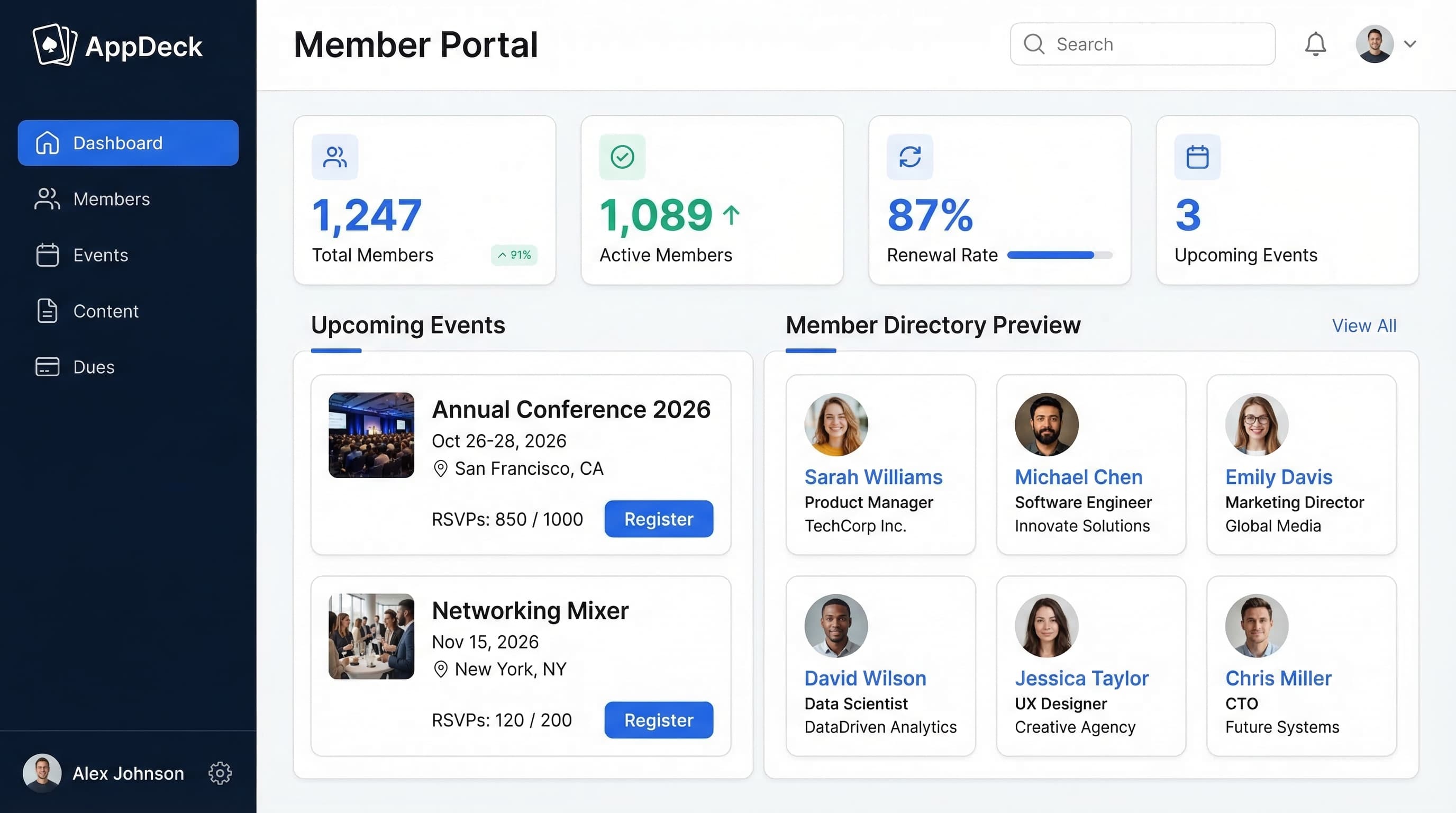
TL;DR: Compare the best membership website software for 2026. Member portals, payment processing, event management, and community features. Honest reviews with pricing.
Introduction
The membership website software market has never been more crowded -- or more confusing. Every platform claims to be the best membership site software for associations, clubs, and communities. But once you dig past the marketing pages, the differences are significant. Some tools are built for professional associations that need polished portals and secure document sharing. Others are designed for creators who want to sell courses and build online communities. Picking the wrong one means months of migration headaches.
I have spent the past two decades building B2B software and helping organizations launch member-facing platforms. In that time, I have evaluated dozens of membership website builders and watched organizations succeed (and fail) with nearly all of them. This comparison reflects what I have learned -- honest assessments, real pricing, and a clear framework for making the right choice.
Here is the short version: there is no single "best" membership website software. The right platform depends on whether you need a secure member portal, a community forum, a course platform, or an all-in-one association management system. This guide will help you figure out which category you fall into and which platform fits.
What to Look For in Membership Website Software
Before diving into individual platforms, here are the six capabilities that matter most when evaluating membership site software. Not every organization needs all six, but understanding where your priorities fall will narrow the field quickly.
1. Member Directory and Profiles
Your members need a place to manage their own information -- contact details, preferences, membership tier, renewal dates. A strong member directory also lets members find and connect with each other, which is critical for networking-focused organizations. Look for customizable profile fields, search and filtering, and privacy controls that let members decide what is visible.
2. Payment and Dues Management
Automated dues collection is table stakes in 2026. The platform should handle recurring billing, one-time payments, tiered pricing, and ideally support multiple payment gateways (Stripe, PayPal, or direct ACH). Bonus points for built-in invoicing, failed payment retries, and financial reporting that your treasurer can actually use.
3. Event Management
If your organization runs conferences, webinars, or local meetups, you need integrated event management -- not a third-party Eventbrite embed. Look for event creation, registration, ticketing (including member-only pricing), calendar views, and post-event follow-up tools. The best platforms tie event attendance data back to member profiles.
4. Content Gating and Member-Only Areas
Most membership websites need some form of restricted content -- documents, resources, training materials, or archives that are only accessible to logged-in members. The question is how granular the access controls are. Can you restrict by membership tier? By committee? By payment status? The more flexibility here, the fewer workarounds you will need later.
5. Communication Tools
Email is still the backbone of member communication, but the best membership website software goes further: announcements, in-app messaging, newsletter integrations, and automated workflows (welcome sequences, renewal reminders, lapsed member outreach). Some platforms include built-in community features like discussion forums or activity feeds.
6. Reporting and Analytics
You cannot improve what you do not measure. Look for dashboards that track membership growth, retention rates, renewal rates, event attendance, engagement scores, and revenue. The platforms that surface this data clearly -- without requiring you to export CSVs and build your own spreadsheets -- save hours every month.
8 Best Membership Website Platforms Compared
1. AppDeck
Overview: AppDeck is a portal software platform that lets organizations build branded, secure member portals with real-time dashboards, document sharing, and white-label customization. It is not a community platform and does not offer forums or course hosting. AppDeck is purpose-built for professional associations and organizations that need a polished, secure membership website rather than a social community experience.
Key strengths:
- Fully white-labeled portals with custom domains and branding
- Real-time dashboards and reporting for membership metrics
- Granular role-based access controls and content gating by tier
- Secure document sharing with version control
- Clean, modern UI that requires minimal training for members
- Flat-rate pricing with no per-member fees
Limitations:
- No built-in discussion forums or community feed
- No course hosting or LMS features
- Event management requires integration with third-party tools
- Smaller ecosystem compared to established AMS platforms
Pricing: Starting at $299/month (flat rate, unlimited members).
Best for: Professional associations, trade organizations, and businesses that need a branded, secure member portal with dashboards and document management -- not a social community.
2. Wild Apricot
Overview: Wild Apricot is one of the most established names in membership website software, particularly popular with small to mid-size nonprofits and associations. It offers a broad feature set covering member management, event registration, email campaigns, and basic website building. It has been around since 2006 and was acquired by Personify in 2018.
Key strengths:
- All-in-one platform: website builder, member database, events, and email
- Automated dues collection with Stripe and PayPal integration
- Built-in event registration with payment processing
- Member directory with searchable profiles
- Solid email marketing tools with templates
- Large knowledge base and active user community
Limitations:
- Website builder produces dated-looking sites without heavy customization
- Pricing scales with member count, which gets expensive at higher tiers
- Reporting is functional but not deeply customizable
- UI feels dated compared to newer platforms
- Limited white-labeling options
Pricing: Free for up to 50 contacts. Paid plans range from $60/month (100 contacts) to $600+/month (15,000+ contacts).
Best for: Small to mid-size nonprofits and associations that want an all-in-one membership website builder without hiring a developer.
3. MemberClicks
Overview: MemberClicks (now part of Personify) targets professional associations and chambers of commerce with a full association management system. It combines membership management, event tools, a website CMS, and job board functionality in one platform. It is heavier than Wild Apricot and designed for organizations with more complex operational needs.
Key strengths:
- Purpose-built for associations and chambers of commerce
- Integrated job board for member career services
- Committee and chapter management tools
- Advanced event management with exhibit and sponsor tracking
- Strong reporting and member engagement scoring
- Dedicated onboarding and account management support
Limitations:
- Pricing is not transparent -- requires a sales call
- Steeper learning curve than lighter platforms
- Can feel over-engineered for smaller organizations
- Website CMS is functional but not modern
- Longer implementation timelines (weeks, not days)
Pricing: Custom pricing based on organization size and modules. Expect $300-$800+/month for most associations.
Best for: Mid-size to large professional associations and chambers of commerce that need a full-featured AMS with event management and job boards.
4. MemberSpace
Overview: MemberSpace takes a different approach -- instead of replacing your existing website, it adds membership functionality on top of it. If you already have a site built on Squarespace, WordPress, Webflow, or another platform, MemberSpace lets you gate content, manage members, and process payments without migrating to a new CMS. It is lightweight and developer-friendly.
Key strengths:
- Works with your existing website (no migration required)
- Simple content gating by page, folder, or resource
- Stripe-powered payment processing with flexible pricing models
- Clean member management dashboard
- Fast setup -- can be running in hours, not weeks
- No coding required for basic setups
Limitations:
- No built-in event management
- No member directory or networking features
- Limited communication tools (no email campaigns or forums)
- Reporting is basic compared to full AMS platforms
- Not designed for complex multi-tier membership structures
Pricing: Plans start at $39/month plus 4% transaction fees. The Pro plan at $99/month reduces transaction fees to 2%.
Best for: Creators, small organizations, and businesses that already have a website and want to add membership functionality without starting over.
5. Memberful
Overview: Memberful is a membership monetization tool built for content creators, publishers, and media organizations. It integrates deeply with Stripe for payment processing and offers plugins for WordPress and custom websites. Like MemberSpace, it works alongside your existing site rather than replacing it. Memberful was acquired by Patreon in 2022, which adds some uncertainty about long-term direction.
Key strengths:
- Best-in-class Stripe integration for subscription management
- WordPress plugin for seamless content gating
- Custom branding on checkout and member account pages
- GraphQL API for custom integrations
- Podcast hosting with private RSS feeds
- Simple, predictable pricing
Limitations:
- Very limited member management features beyond payments
- No event management, directory, or community tools
- Minimal reporting beyond revenue metrics
- No built-in email or communication features
- Requires a separate website -- not a standalone membership site
Pricing: Free plan available (10% transaction fee). Pro plan at $49/month (4.9% transaction fee). Premium at $99/month (no transaction fees on Memberful side; Stripe fees still apply).
Best for: Content creators, newsletter writers, and podcast producers who need clean subscription billing and WordPress integration.
6. Mighty Networks
Overview: Mighty Networks is a community-first platform that combines membership sites, online courses, and community spaces under one roof. It positions itself as an alternative to Facebook Groups, offering branded spaces where members can post, discuss, attend events, and take courses. It has gained significant traction with creators and coaches since 2017.
Key strengths:
- Strong community features: activity feeds, discussion spaces, polls, and direct messaging
- Built-in course hosting and cohort-based learning
- Native mobile apps (iOS and Android) under your brand
- Event management with live streaming integration
- AI-powered community engagement features
- Flexible monetization options (subscriptions, bundles, one-time purchases)
Limitations:
- Not designed for traditional association management
- No advanced dues management or multi-tier billing complexity
- Limited document management and version control
- Reporting focuses on engagement, not operational membership metrics
- Can feel overwhelming for organizations that just need a simple portal
- Higher-tier plans are expensive
Pricing: Community plan at $41/month. Business plan at $119/month. Path-to-Pro at $360/month. Enterprise pricing is custom.
Best for: Creators, coaches, and community builders who want a branded community platform with courses, events, and social features.
7. Circle
Overview: Circle is a modern community platform that has quickly become a favorite among SaaS companies, creator businesses, and online educators. It offers discussion spaces, live events, member directories, and course hosting in a clean, well-designed interface. Circle acquired Teachable's community features and has been aggressively expanding its platform.
Key strengths:
- Modern, intuitive UI that members actually enjoy using
- Flexible spaces for discussions, events, courses, and resources
- Native live rooms for audio and video events
- Rich member profiles and directory
- Strong API and integration ecosystem (Zapier, webhooks, custom)
- Headless options for custom front-end builds
Limitations:
- No traditional dues management or association billing workflows
- Limited financial reporting for treasurers and finance teams
- Not built for organizations with complex membership tier structures
- No document management with version control
- Pricing scales with member count
Pricing: Professional plan at $89/month (up to 100 members on some features). Business plan at $199/month. Enterprise plan at $399+/month.
Best for: SaaS companies, online educators, and creator businesses that want a modern community platform with courses and live events.
8. Hivebrite
Overview: Hivebrite is an enterprise community management platform used by alumni networks, professional associations, and corporate communities worldwide. It offers a comprehensive feature set including member management, events, mentoring programs, job boards, and fundraising tools. It sits at the higher end of the market in both capabilities and price.
Key strengths:
- Enterprise-grade feature set covering the full membership lifecycle
- Mentoring and networking matching programs
- Advanced event management with virtual and hybrid support
- Job board and career services
- Fundraising and donation management
- Strong data privacy and GDPR compliance tools
- Custom branding and white-labeling
Limitations:
- Premium pricing puts it out of reach for smaller organizations
- Implementation requires significant time and planning
- Can be complex to configure without dedicated admin resources
- Sales process is enterprise-style (demos, proposals, contracts)
- Overkill for organizations with straightforward membership needs
Pricing: Custom pricing only. Expect $10,000-$30,000+/year depending on modules and member count.
Best for: Large alumni networks, enterprise associations, and professional communities that need a comprehensive, enterprise-grade membership platform with mentoring and career services.
Comparison Table
| Platform | Type | Member Directory | Payments/Dues | Events | Content Gating | Community | Starting Price |
|---|---|---|---|---|---|---|---|
| AppDeck | Member Portal | Yes | Via integration | Via integration | Yes (granular) | No | $299/mo flat |
| Wild Apricot | All-in-One AMS | Yes | Built-in | Built-in | Yes | Basic | $60/mo |
| MemberClicks | Full AMS | Yes | Built-in | Advanced | Yes | Basic | ~$300/mo |
| MemberSpace | Add-on Layer | No | Built-in | No | Yes | No | $39/mo + fees |
| Memberful | Payment Layer | No | Built-in | No | Yes | No | Free (10% fee) |
| Mighty Networks | Community | Yes | Built-in | Built-in | Yes | Yes (core) | $41/mo |
| Circle | Community | Yes | Basic | Built-in | Yes | Yes (core) | $89/mo |
| Hivebrite | Enterprise AMS | Yes | Built-in | Advanced | Yes | Yes | ~$10K/yr |
Decision Framework: Which Platform Is Right for You?
The membership website software market breaks down into four distinct categories. Knowing which category fits your organization eliminates most of the confusion.
You need a secure, branded member portal
If your priority is giving members a professional, white-labeled login experience with dashboards, document sharing, and role-based access -- and you do not need forums or course hosting -- AppDeck is the strongest fit. This is the right choice for professional associations, trade organizations, and businesses where security, branding, and data presentation matter more than social features.
You need an all-in-one association management system
If you run a traditional association or chamber of commerce and need everything under one roof -- member database, dues, events, email, and a basic website -- Wild Apricot (for smaller orgs) or MemberClicks (for larger ones) will cover the most ground. These are not the most modern platforms, but they are battle-tested and purpose-built for association operations.
You need to add memberships to an existing website
If you already have a website you are happy with and just need to add member logins, content gating, and payment processing, MemberSpace or Memberful are the fastest paths. MemberSpace is better for organizations; Memberful is better for individual creators and publishers.
You need a community and course platform
If engagement, discussion, and online learning are the core of your membership value proposition, Mighty Networks or Circle are designed exactly for this. Mighty Networks is better for creators building branded mobile apps; Circle is better for SaaS companies and educators who want a modern, flexible community space.
You need an enterprise-grade platform
If you are a large alumni network, university, or global association with complex needs around mentoring, career services, and fundraising, Hivebrite is the enterprise option worth evaluating -- provided your budget supports it.
Frequently Asked Questions
What is membership website software?
Membership website software is a platform that lets organizations build a website with gated content, paid access, and member management features. It typically combines content hosting, payment processing, member directory, login authentication, and engagement tools in one product. The category spans simple WordPress plugins (MemberPress, MemberMouse), all-in-one builders (Mighty Networks, Circle), course platforms with membership add-ons (Kajabi, Podia), and full association management systems (Wild Apricot, Hivebrite). The right choice depends on what kind of member experience you're building — gated content, community, courses, or association services each suit a different platform category.
How is membership website software different from a community platform or LMS?
A community platform (Circle, Mighty Networks, Discourse) prioritizes peer-to-peer interaction and discussion. A learning management system (Thinkific, Teachable, Kajabi) prioritizes structured courses and lesson completion. Membership website software sits between them — it gates access, handles recurring billing, and provides member-specific dashboards, but treats community and courses as features rather than the core product. If 80% of your value is discussion, use a community platform. If 80% is structured learning, use an LMS. If you need a portal that handles dues, directories, events, and documents, use membership website software.
How much does membership website software cost?
Pricing ranges widely. WordPress plugins like MemberPress cost $179-399/year flat. SaaS community platforms like Circle and Mighty Networks run $39-360/month. Course-membership hybrids like Kajabi cost $149-399/month. Association-focused platforms like Wild Apricot price per member ($60-720/month depending on member count). Enterprise platforms like Hivebrite start at $15,000-50,000/year. Always model 3-year cost including transaction fees (2.9%+ on most platforms), payment processing, and add-ons — the "starter" price rarely matches your actual spend at 500+ members.
Who should use membership website software vs. a custom-built portal?
Use off-the-shelf software if you're under 5,000 members, your needs match one of the standard categories (community, courses, association, gated content), and you have less than $50K in budget for the build. Build custom only when you have specific workflows no platform supports (unusual integrations, regulated industries, complex member hierarchies), engineering resources to maintain it for 5+ years, and a budget exceeding $150K for initial development. Most organizations who think they need custom actually need a properly configured off-the-shelf platform. The buy-vs-build decision favors buying 90% of the time at small and mid-market scale.
When should we switch from one membership platform to another?
Switch when member adoption falls below 40%, when your platform can't support a new revenue stream you want to launch, or when staff time on workarounds exceeds 10 hours/week. Don't switch for cosmetic reasons or because a competitor announced a flashy feature. Migrations are expensive — budget 3-6 months and expect to lose 5-10% of members in transition due to login friction and data cleanup. The right time to switch is when the cost of staying clearly exceeds the cost of moving, not when the new platform looks marginally better in a demo.
Conclusion
Choosing membership website software is not about finding the platform with the longest feature list. It is about understanding what your members actually need and matching that to a platform built for your use case.
If you need a polished, secure member portal with dashboards and document management, that is a fundamentally different product than a community forum or a course platform. I have watched too many organizations buy community software when they needed a portal, or buy an enterprise AMS when they needed something simple. The result is always the same: wasted budget, frustrated teams, and a membership experience that falls short.
Take the time to define your requirements, trial two or three platforms from the right category, and involve your members in the evaluation. The best membership website is the one your members actually log into.
Related Reading

Founder & CEO, AppDeck
Serial entrepreneur with 20+ years building B2B software companies. Former executive managing 2,800+ employees across three continents. Vik reviews all AppDeck content for accuracy and practical relevance.
Share this article
Explore Related Solutions
Related Articles
Membership Portal Software Comparison 2026: 10 Best Platforms Reviewed
Comprehensive comparison of the best membership portal software for 2026. Compare Wild Apricot, MemberClicks, Glue Up, AppDeck, and 6 others. Features, pricing, and real user reviews.
Association Management Best Practices: 12 Strategies for Modern Associations
12 association management best practices for 2026. Covers member portals, dues automation, event management, board governance, communication, and technology modernization.
How to Build a Membership Portal: Complete Guide for 2026
Step-by-step guide to building a membership portal for your association, club, or organization. Learn features, best practices, and platform options.