
Association Management Best Practices: 12 Strategies for Modern Associations
12 association management best practices for 2026. Covers member portals, dues automation, event management, board governance, communication, and technology modernization.
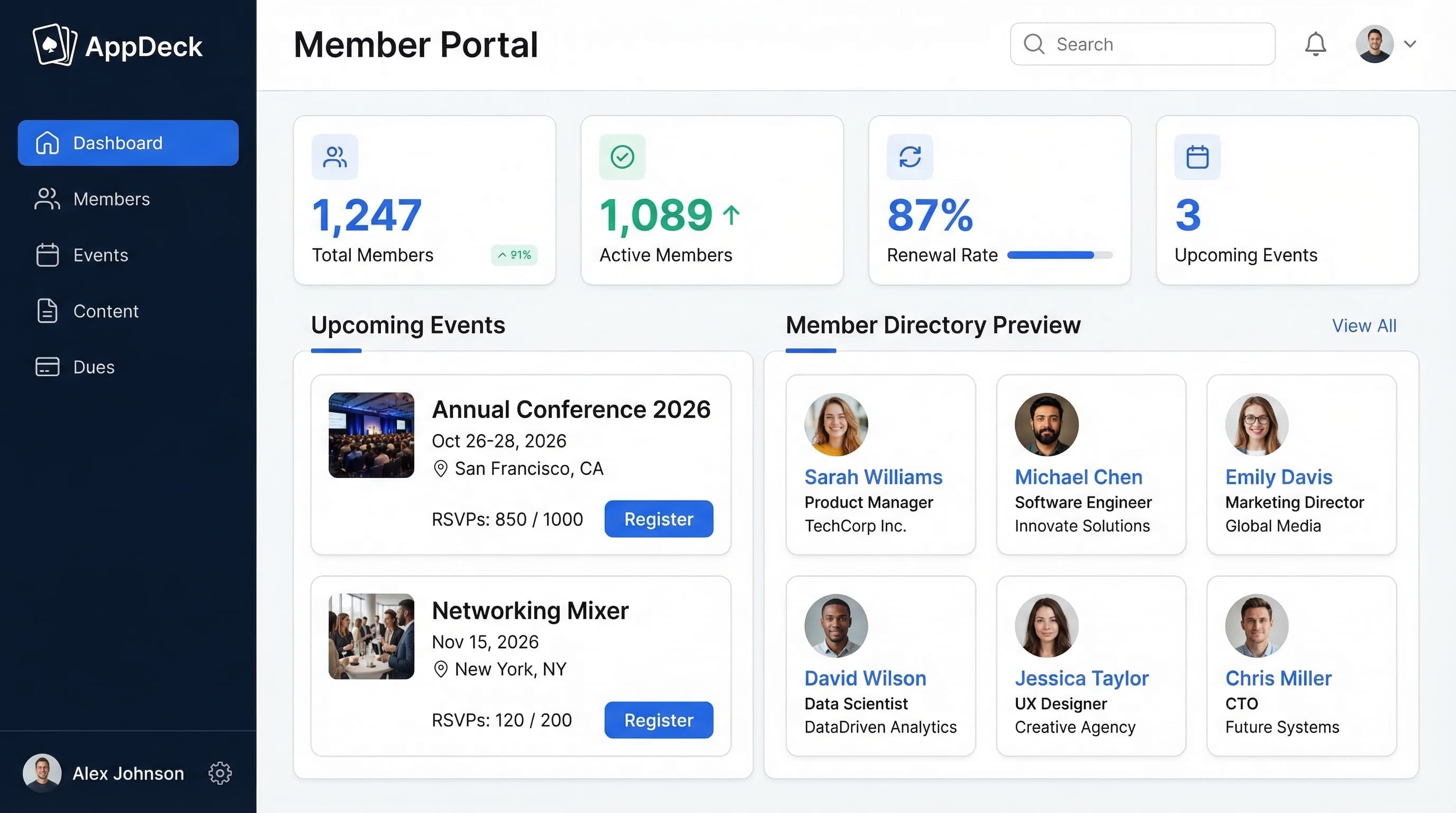
TL;DR: 12 association management best practices for 2026. Covers member portals, dues automation, event management, board governance, communication, and technology modernization.
Introduction
Running an association in 2026 looks nothing like it did a decade ago. Member expectations have shifted. Younger professionals demand digital-first experiences. Boards want real-time visibility. Sponsors expect measurable ROI. And your staff is stretched thinner than ever, managing more programs with fewer resources.
After working with associations, professional societies, and membership organizations for over a decade, I've seen what separates thriving organizations from those that slowly lose relevance. It isn't size, budget, or industry. It's operational discipline — having clear systems for the things that matter most and the technology to execute them at scale.
This guide covers 12 association management best practices that modern organizations should adopt in 2026. These aren't theoretical frameworks. They're operational strategies that associations of every size can implement to improve member retention, streamline operations, strengthen governance, and grow sustainably.
What you'll learn:
- How to centralize member engagement through a purpose-built portal
- Why automating dues and renewals is the highest-ROI operational change you can make
- Best practices for event management, board governance, and volunteer programs
- How data-driven decision-making transforms retention and programming
- Technology modernization strategies that reduce staff burden while improving the member experience
See also: Alumni Engagement Strategies — 15 tactics for universities and schools that translate to associations.
Why Association Management Practices Matter
Associations operate in a competitive landscape. Members have more choices than ever — competing organizations, online communities, LinkedIn groups, and independent learning platforms all vie for the same attention and budget. The organizations that retain members and attract new ones are those that run well: responsive, organized, data-informed, and member-centric.
When associations invest in best practices:
- ✅ Retention rates above 85%, with first-year retention above 75%
- ✅ Staff time shifts from administration to strategy and member engagement
- ✅ Board governance is structured, transparent, and efficient
- ✅ Events generate both engagement and non-dues revenue
- ✅ Volunteer programs feed a healthy leadership pipeline
When they don't:
- ❌ Staff spends 60-70% of their time on manual administrative tasks
- ❌ Board members lack visibility into organizational performance
- ❌ Communication is sporadic and one-size-fits-all
- ❌ Volunteer burnout leads to leadership pipeline gaps
- ❌ Members leave for organizations that deliver a better experience
What Modern Members Expect
| Expectation | Old Model | Modern Standard |
|---|---|---|
| Access to information | Annual directory mailed in print | Searchable online portal, updated in real time |
| Dues payment | Paper invoice, check by mail | Online payment, auto-renewal, multiple methods |
| Event registration | Phone call or fax | One-click registration from any device |
| Communication | Quarterly newsletter | Personalized, segmented, multi-channel |
| Governance transparency | Annual report at conference | Real-time dashboards and board portal access |
| Self-service | Call the office during business hours | 24/7 portal access for profile, payments, resources |
If your association still operates on the old model, you're losing members to organizations that don't.
12 Association Management Best Practices
1. Launch a Centralized Member Portal
The problem: Member resources, communications, event information, and documents are scattered across your website, email, social media, and shared drives. Members don't know where to find things. Staff wastes hours answering questions that should be self-service.
The solution: Deploy a centralized membership portal that serves as the digital headquarters for your association.
What your member portal should include:
- ✅ Searchable member directory with filters for location, industry, and expertise
- ✅ Event calendar with online registration and RSVP tracking
- ✅ Resource library for documents, recordings, templates, and guides
- ✅ Member profile management with self-service updates
- ✅ Engagement dashboard showing login frequency, event attendance, and content usage
- ✅ Mobile-responsive design with custom branding
Why a portal is the foundation: Every other best practice in this guide works better when you have a centralized platform. Dues automation needs a payment hub. Events need a registration system. Communication needs a delivery channel beyond email. The portal ties everything together.
Start with directory, events, and resource library, then expand. AppDeck Membership Portal provides all of these capabilities with setup in under a day. For a detailed comparison of portal options, see our membership portal software comparison.
Key metric: Target 60%+ portal adoption within six months and 40%+ monthly active users within the first year.
2. Automate Dues Collection and Renewals
The problem: Your staff spends weeks every year chasing renewals — sending paper invoices, following up on unpaid dues, manually processing checks. Members who intend to renew forget or get frustrated by a clunky payment process. You lose 5-10% of renewals to friction alone.
The solution: Automate the entire dues lifecycle from invoicing to payment to receipt.
Automation components:
- Online payment via credit card, ACH, and digital wallets
- Auto-renewal with stored payment methods (opt-in)
- Automated renewal reminders at 90, 60, 30, 15, and 7 days before expiration
- Real-time revenue dashboards for staff and board
- Integration with your accounting system
The ROI of automation:
- ✅ Auto-renewal members renew at 95%+ compared to 75-80% for manual renewals
- ✅ Staff time on dues processing drops by 60-80%
- ✅ Cash flow becomes predictable with monthly reporting and forecasting
Key metric: Track renewal rate by payment method, average days to payment after invoice, and staff hours spent on dues processing. Every percentage point of renewal improvement directly impacts your bottom line.
3. Build a Strategic Event Management Program
The problem: Your association hosts an annual conference and a handful of chapter events. Between those, there's little structured engagement. Events are planned ad hoc with inconsistent promotion and minimal post-event data.
The solution: Treat events as a year-round program with diverse formats, consistent execution, and data-driven improvement.
Year-round event calendar:
- Monthly: Educational webinars, virtual roundtables, chapter meetups, new member orientations
- Quarterly: Professional development workshops, industry panels, networking mixers, volunteer appreciation events
- Annually: Conference with hybrid attendance, awards ceremony, strategic planning retreat
Event management best practices:
- ✅ Centralize all registration through your member portal
- ✅ Record virtual events and archive them in your resource library
- ✅ Send post-event surveys within 24 hours
- ✅ Track attendance patterns to identify engagement trends
- ❌ Don't limit events to one format — virtual options increase participation by 40-60%
- ❌ Don't treat every event as a revenue opportunity — some should be free engagement drivers
Key metric: Members who attend at least one event per year renew at 3x the rate of those who attend none.
4. Establish a Board Governance Portal
The problem: Board materials arrive via email attachments days before meetings. Directors struggle to find past minutes, financial reports, and committee updates. Sensitive documents circulate without version control or access restrictions. Between meetings, communication defaults to scattered email threads.
The solution: Give your board a secure, dedicated governance portal that centralizes every document, discussion, and decision.
Board portal capabilities:
- Board book builder with drag-and-drop assembly and version control
- Agenda builder with time allocations and presenter assignments
- Action item tracking with assignments and deadlines
- Electronic voting for resolutions between meetings
- Committee workspaces with separate document libraries
- Director onboarding resources and governance policies
Security requirements:
- ✅ Role-based access controls and two-factor authentication
- ✅ Encryption in transit and at rest
- ✅ Audit logs showing who accessed what and when
- ✅ Remote wipe capability for lost or stolen devices
Key metric: High-functioning boards achieve 90%+ material review rates and 85%+ action item completion.
5. Implement Member Segmentation
The problem: You treat all members the same — same communications, same event promotions, same renewal messaging. But a first-year student member and a 20-year executive member have fundamentally different needs.
The solution: Segment your membership base and tailor experiences to each segment.
Segmentation dimensions:
- Demographic: Membership tier, career stage, industry, geographic region
- Behavioral: Engagement level, event attendance patterns, portal usage, volunteer activity
- Interest-based: Self-reported interests, committee membership, content engagement by topic
How to use segmentation:
| Segment | Programming Focus | Renewal Approach |
|---|---|---|
| New members (0-12 months) | Onboarding, benefit activation | Early renewal incentive, value highlights |
| Active mid-career | Professional development, networking | Auto-renewal, leadership invitations |
| Senior leaders | Governance, mentorship, strategic influence | Multi-year commitment, recognition |
| At-risk members | Re-engagement, barrier identification | Personal outreach, flexible payment |
Start with three segments — new, active, and at-risk — then expand as you collect behavioral data. For more on personalized engagement approaches, see our guide on member engagement strategies.
Key metric: Segmented approaches typically improve renewal rates by 10-15% compared to one-size-fits-all communication.
6. Develop a Content Strategy
The problem: Your association publishes content sporadically — a quarterly newsletter, occasional blog posts, conference proceedings once a year. Members find industry content everywhere else and see no content-based reason to maintain membership.
The solution: Position your association as the authoritative source in your field with exclusive, high-value content.
Content pillars:
- Research and data: Annual industry survey reports, salary benchmarks, regulatory guides
- Professional development: Certification materials, skill-building webinars, templates and toolkits
- Community-generated: Member spotlights, expert Q&A, committee best practices
- News and analysis: Weekly industry digest, legislative tracking, executive interviews
Content distribution framework:
- Gate premium content behind member login in your portal
- Publish previews publicly to attract prospective members
- Email monthly content highlights to drive portal visits
- Track content engagement to inform future editorial decisions
Key metric: Members who engage with exclusive content monthly renew at 20-30% higher rates than those who don't.
7. Build a Volunteer Management Program
The problem: Your association relies on a small core of dedicated volunteers for everything. They're burning out while dozens of willing members don't know how to get involved.
The solution: Create a structured program with tiered commitment levels.
Volunteer tiers:
- Micro (1-3 hours/quarter): Welcome calls, social media sharing, feedback collection
- Standard (5-15 hours/quarter): Committee membership, webinar panelist, mentorship, blog contributor
- Leadership (15+ hours/quarter): Committee chair, chapter leader, conference track chair, board task force
Management infrastructure:
- ✅ Clear role descriptions with time commitments
- ✅ Online sign-up through your member portal
- ✅ Staff liaison assigned to each volunteer group
- ✅ Quarterly check-ins to prevent burnout
- ✅ Recognition at every tier — not just leadership roles
- ❌ Don't rely on the same 10% of members for everything
- ❌ Don't let volunteer terms run indefinitely — rotate to build your pipeline
Key metric: Target 15-20% of membership in active volunteer roles. Organizations with structured volunteer programs report 10-15% higher overall retention.
8. Make Data-Driven Decisions
The problem: Your association makes decisions based on anecdotes and board preferences. You don't know which benefits members use, which events drive retention, or which segments are at risk. By the time you see declining renewals, the damage is done.
The solution: Build an engagement scoring model that captures member activity across every touchpoint.
Engagement scoring dimensions:
| Dimension | Data Points | Weight |
|---|---|---|
| Portal activity | Logins, page views, resource access | 20% |
| Event participation | Registrations, attendance, satisfaction | 20% |
| Communication | Email opens, clicks, content views | 15% |
| Community | Directory activity, forum posts, connections | 15% |
| Volunteerism | Roles, hours, committee participation | 15% |
| Financial | Dues currency, non-dues spending, donations | 15% |
Using scores operationally:
- ✅ Flag at-risk members (score declining over two quarters) for proactive outreach
- ✅ Identify champions for leadership recruitment and testimonials
- ✅ Segment renewal messaging based on engagement tier
- ✅ Evaluate program ROI by measuring impact on engagement scores
Key metric: Associations that implement engagement scoring reduce involuntary churn by 20-30%.
9. Establish a Communication Cadence
The problem: Communication is feast or famine. Members hear nothing for weeks, then get bombarded during conference season. No editorial calendar, no channel strategy, no coordination between committees and headquarters.
The solution: A predictable, multi-channel cadence that keeps members informed without overwhelming them.
Communication calendar:
- Weekly: Industry news digest, social media posts, portal content updates
- Bi-weekly: Member newsletter, targeted segment emails
- Monthly: Executive director message, event recaps, member recognition highlights
- Quarterly: Program update with metrics, feedback survey, strategic initiative updates
- Annually: Annual report, year-in-review, strategic plan update
Channel strategy:
| Channel | Best For | Frequency Limit |
|---|---|---|
| Announcements, campaigns, newsletters | 2-3 per week max | |
| Portal | Resources, events, community, self-service | Always available |
| Social media | Awareness, content promotion | Daily |
| SMS | Urgent updates, event reminders | 1-2 per month max |
Communication governance:
- ✅ Central editorial calendar visible to all teams
- ✅ Approval workflow for member-facing communications
- ✅ Suppression rules to prevent over-communication
- ❌ Don't let committees and chapters email members without coordination
Key metric: Target 30%+ open rates for segmented communications and less than 0.5% unsubscribe rate per send.
10. Develop a Sponsorship Management Program
The problem: Your sponsorship program hasn't evolved beyond logo placement and conference booths. Sponsors want measurable outcomes — leads, visibility, and access to your member audience. Without data and structured packages, you're leaving revenue on the table.
The solution: Build tiered sponsorship packages that deliver measurable value.
Sponsorship opportunities:
- Digital: Portal placements, sponsored newsletter content, webinar series co-branding
- Events: Title sponsorship, track sponsorship, networking event sponsorship
- Content: Sponsored research reports, thought leadership articles, podcast co-production
Management best practices:
- ✅ Tiered packages (Platinum, Gold, Silver) with clear deliverables and pricing
- ✅ Measurable outcomes for every element (impressions, clicks, leads, attendance)
- ✅ Post-campaign reports delivered within 30 days
- ✅ Annual review meeting to discuss ROI and renewal
- ❌ Don't sell sponsorships that compromise member trust
- ❌ Don't promise member contact lists without explicit opt-in
Key metric: Target 70%+ annual sponsor retention and 15-20% year-over-year sponsorship revenue growth.
11. Create Advocacy and Public Affairs Programs
The problem: Your members are affected by legislation and regulation, but your advocacy efforts are reactive or nonexistent. Members don't see your organization as a voice for their interests. Competing organizations that advocate effectively attract members who want representation.
The solution: Build an advocacy program that amplifies your members' collective voice.
Advocacy components:
- Policy monitoring: Track legislation, publish impact briefs, maintain a position library in your portal
- Grassroots engagement: One-click action alerts, letter templates, coordinate member participation in public comment periods
- Thought leadership: Official position statements, media engagement, testimony and regulatory comments, coalition building
Member engagement in advocacy:
- ✅ Make participation easy — pre-written templates, one-click tools
- ✅ Report outcomes: "Your letters helped pass/block this legislation"
- ✅ Recognize advocacy champions publicly
- ❌ Don't make advocacy partisan — focus on professional issues
- ❌ Don't ask members to act without explaining why the issue matters
Why it matters: In member surveys across industries, advocacy consistently ranks among the top three reasons members join and renew.
Key metric: Target 10-15% participation in action alerts and quarterly reporting on policy wins.
12. Modernize Your Technology Stack
The problem: Your association runs on a patchwork of aging systems — an AMS from 2012, a separate email platform, a basic website with no login, spreadsheets for event tracking. Nothing integrates. Data lives in silos. Staff spends hours on manual workarounds.
The solution: Audit your stack and modernize with integrated, purpose-built tools.
Modern association technology stack:
| Function | Legacy Approach | Modern Approach |
|---|---|---|
| Member database | On-premise AMS | Cloud-based AMS with real-time access |
| Member experience | Static website, no login | Interactive portal with self-service |
| Communication | Batch emails, no segmentation | Segmented, automated, multi-channel |
| Events | Manual registration, paper check-in | Online registration, QR check-in, hybrid |
| Governance | Email attachments | Board portal with secure document management |
| Dues | Paper invoices | Automated billing, online payment, auto-renewal |
Modernization priorities (in order):
- Member portal — Highest-impact investment. See our complete guide to membership portals.
- Dues automation — Immediate ROI through higher renewals and reduced staff time
- Communication platform — Enables segmentation and engagement tracking
- Event management — Streamlines registration and follow-up
- Board governance portal — Improves decisions and attracts better candidates
- Analytics — Turns data into actionable insights
Key metric: Target a 40-60% reduction in administrative time within the first year of modernization.
Putting It All Together
These 12 best practices reinforce each other. A member portal (1) makes dues automation (2) and event management (3) more effective. Segmentation (5) improves your content strategy (6) and communication cadence (9). Data-driven decisions (8) inform your volunteer program (7), sponsorship management (10), and advocacy efforts (11). Technology modernization (12) enables everything else.
Implementation roadmap:
- Phase 1 (months 1-3): Launch member portal, automate dues, establish communication cadence
- Phase 2 (months 4-6): Build year-round event calendar, implement segmentation, launch content strategy, create volunteer opportunities
- Phase 3 (months 7-12): Deploy board governance portal, build sponsorship program, launch advocacy capabilities, implement engagement scoring
- Phase 4 (ongoing): Modernize remaining systems, refine segmentation, expand programming based on data
Frequently Asked Questions
What is association management?
Association management is the discipline of running a membership organization -- a professional society, trade association, alumni group, or industry body -- as an operational business. It covers member acquisition and retention, dues and finance, governance, events, content, advocacy, and the technology stack that ties everything together. Done well, it turns a loose collection of members into a community that delivers measurable career value, drives renewals, and attracts sponsors. The 12 practices in this guide are the operating system that successful associations run on in 2026.
Is an Association Management System (AMS) the same as a member portal?
No. An AMS is the back-office system of record -- it stores member data, processes dues, and tracks renewals for your staff. A member portal is the front-door experience your members log into for the directory, events, resources, and community. Many legacy AMS platforms include a bolted-on member portal that feels dated and underused. Modern associations pair a cloud AMS with a purpose-built portal that integrates with it. If you have to choose one investment first, the portal usually drives higher member-facing ROI than another AMS upgrade.
How long does it take to implement a modern association tech stack?
A focused 12-month roadmap is realistic for most mid-sized associations. Months 1-3: launch the member portal, automate dues, fix communication cadence. Months 4-6: build year-round programming, implement segmentation, launch content. Months 7-12: add board governance portal, sponsorship program, and engagement scoring. Expect 40-60% reduction in administrative time within the first year if you sequence in this order. Trying to modernize everything simultaneously is the single most common cause of failed transformations -- staff burns out before any system stabilizes.
Which associations get the biggest lift from these practices?
Mid-sized associations between 500 and 25,000 members see the fastest impact. They have enough complexity to justify modern tools but small enough staff that legacy workflows are genuinely painful. Sub-500-member groups can often run on a CRM, Mailchimp, and event software for years before needing a full stack. Large 50,000+ member associations need most of these practices but require deeper enterprise integrations (Salesforce, NetSuite, dedicated learning management systems) layered on top. The framework applies; the tool choices change.
When does it make sense to outsource to a professional association management company?
When your volunteer board is spending more time on operations than strategy, or when you cannot justify a full-time executive director. Association Management Companies (AMCs) take over staffing, finance, events, and member services for a fixed annual fee -- typically $80K-$250K depending on scope. They work best for small associations under 2,000 members or new associations still finding their footing. Once you have a dedicated executive director and a strong staff, bringing operations in-house and investing in software usually delivers better long-term value.
Conclusion
Association management in 2026 demands operational discipline, modern technology, and a relentless focus on member value. The 12 best practices in this guide provide a framework for building an association that members want to belong to, sponsors want to support, and leaders want to serve.
Key takeaways:
- Start with the portal — A centralized membership portal is the foundation for everything else
- Automate what you can — Dues collection and routine communications should run on autopilot
- Segment and personalize — One-size-fits-all is the fastest way to lose relevance
- Govern well — A secure board portal builds trust, improves decisions, and attracts better leaders
- Measure and act — Engagement scoring catches problems early and directs investment to what works
- Modernize deliberately — Prioritize by impact and choose integrated platforms
Where to start: Focus on the first three practices — member portal, dues automation, and event management. These deliver the highest immediate impact on member experience and operational efficiency.
If you're ready to give your association a modern digital home, AppDeck Membership Portal provides the directory, events, resource library, and engagement analytics you need — with setup in under a day.
Related reading:
- The Complete Guide to Membership Portals
- Member Engagement Strategies: 12 Proven Tactics to Boost Retention
- Membership Portal Software Comparison 2026
- AppDeck Membership Portal

Founder & CEO, AppDeck
Serial entrepreneur with 20+ years building B2B software companies. Former executive managing 2,800+ employees across three continents. Vik reviews all AppDeck content for accuracy and practical relevance.
Share this article
Explore Related Solutions
Related Articles
How to Build a Membership Portal: Complete Guide for 2026
Step-by-step guide to building a membership portal for your association, club, or organization. Learn features, best practices, and platform options.
Member Engagement Strategies: 12 Proven Tactics to Boost Retention
12 member engagement strategies for associations, clubs, and organizations. Covers onboarding, events, content, communication, recognition, and portal technology to boost retention rates.
Membership Portal Software Comparison 2026: 10 Best Platforms Reviewed
Comprehensive comparison of the best membership portal software for 2026. Compare Wild Apricot, MemberClicks, Glue Up, AppDeck, and 6 others. Features, pricing, and real user reviews.