
Member Engagement Strategies: 12 Proven Tactics to Boost Retention
12 member engagement strategies for associations, clubs, and organizations. Covers onboarding, events, content, communication, recognition, and portal technology to boost retention rates.
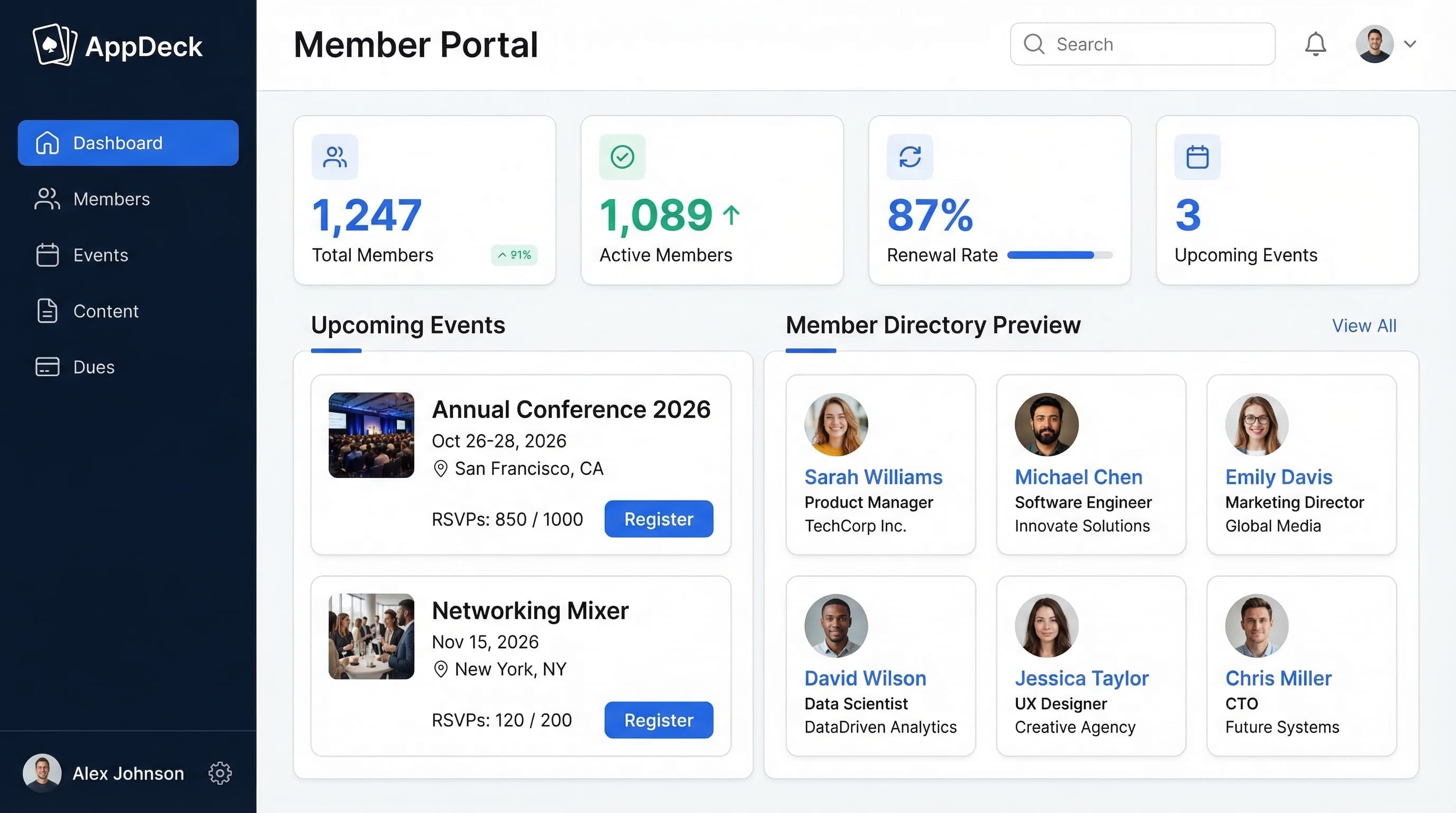
TL;DR: 12 member engagement strategies for associations, clubs, and organizations. Covers onboarding, events, content, communication, recognition, and portal technology to boost retention rates.
Introduction
Member engagement is the single biggest predictor of whether your organization thrives or declines. Associations, clubs, professional societies, and membership organizations all face the same challenge: attracting new members is expensive, but keeping existing ones engaged is what sustains your mission and revenue long-term.
After 10+ years helping membership organizations build engagement platforms, I've seen a clear pattern. Organizations that invest in structured engagement strategies consistently achieve retention rates above 85%, while those that treat membership as a passive transaction — pay dues, receive a card — watch their numbers erode year after year. The difference isn't budget or staff size. It's intentionality.
In this guide, I'll walk through 12 proven member engagement strategies that associations, clubs, and membership organizations should implement in 2026, along with the technology and metrics you need to make them work.
What you'll learn:
- Why member engagement directly drives retention and revenue
- 12 strategies that increase participation, satisfaction, and renewal rates
- How to measure engagement beyond dues payments
- Why purpose-built member portals outperform email and social media
- Technology decisions that make or break your engagement program
Why Member Engagement Matters
Member engagement isn't a nice-to-have — it's the economic engine of your organization. Engaged members renew, participate, volunteer, refer others, and advocate for your mission. Disengaged members quietly lapse, taking their dues and their network with them.
Retention Is Revenue
The economics of retention:
- Acquiring a new member costs 5-7x more than retaining an existing one
- A 5% increase in retention can increase lifetime revenue by 25-40%
- Organizations with engagement scores above 70% report 90%+ renewal rates
- Disengaged members renew at less than 40% — and rarely come back once lapsed
The participation connection:
- ✅ Members who attend at least one event per year are 3x more likely to renew
- ✅ Members who log into a member portal monthly renew at 92% compared to 65% for non-users
- ✅ Members who volunteer are 4x more likely to refer new members
- ✅ Members who use two or more benefits renew at 2x the rate of those who use one or none
The cost of disengagement:
- ❌ Average association retention rate: 80% (meaning 20% of your base churns every year)
- ❌ Most organizations don't know a member is disengaged until they fail to renew
- ❌ Lapsed members cost you dues revenue, event attendance, volunteer hours, and referrals
- ❌ Re-engaging a lapsed member costs 3-5x more than keeping an active member engaged
What Good Member Engagement Looks Like
Before (transactional): Members pay dues and receive a card. Communication is limited to renewal notices. No way for members to connect with each other. Benefits are unclear or underutilized. No visibility into who's at risk of lapsing.
After (relational): Structured onboarding from day one. Year-round engagement through a centralized member portal. Personalized communication. Active member directory and peer networking. Recognition programs. Real-time engagement data driving proactive retention.
Result: Higher retention rates, increased non-dues revenue, stronger community, and members who actively promote your organization to their peers.
12 Member Engagement Strategies
1. Build a Structured Onboarding Program
The problem: Most organizations collect a new member's dues and send a welcome email — then nothing. The new member is left to figure out what's available, how to get involved, and why their membership matters. Within 90 days, many new members have already decided whether they'll renew, and most haven't engaged with a single benefit.
The solution: Create a structured onboarding sequence that introduces new members to your community, benefits, and engagement opportunities over their first 90 days.
Onboarding timeline:
Week 1: Welcome and orientation
- Personalized welcome email from the executive director or president
- Quick-start guide: top 3 things to do as a new member
- Invitation to set up their member portal profile
- Introduction to their regional chapter or interest group
Week 2-3: Benefit activation
- Guided tour of member benefits (discounts, resources, tools)
- Invitation to an upcoming event (virtual or in-person)
- Introduction to the member directory and how to connect with peers
- Access to the new member resource library
Month 2: Deeper engagement
- Invitation to join a committee, working group, or volunteer opportunity
- Personalized content recommendations based on their profile and interests
- Check-in email: "How's your experience so far?" with a quick survey link
- Introduction to mentorship opportunities
Month 3: Connection and commitment
- Invitation to a new member meetup (virtual or in-person)
- Highlight of upcoming events and programs for the quarter
- Story featuring a member who found value through engagement
- Early renewal incentive or multi-year membership offer
Why onboarding matters: Members who complete an onboarding sequence are 2.5x more likely to renew in their first year than those who receive only a welcome email. The first 90 days set the tone for the entire membership relationship.
Key metric: Track onboarding completion rate (percentage of new members who complete all onboarding steps) and first-year renewal rate segmented by onboarding completion.
2. Launch a Member Portal
The problem: Member information, resources, and communication are scattered across your website, email lists, social media groups, and third-party tools. There's no single place where members can access benefits, connect with peers, or manage their membership. Your staff has no centralized view of engagement.
The solution: Launch a centralized membership portal that serves as the digital home for your member community.
What your member portal should include:
- ✅ Searchable member directory (by location, industry, interests, expertise)
- ✅ Event calendar with registration and RSVP tracking
- ✅ Resource library (documents, guides, templates, recordings)
- ✅ Discussion forums or community spaces
- ✅ Member profile management and self-service tools
- ✅ Announcement and communication center
- ✅ Engagement dashboard showing activity and participation
- ✅ Mobile-responsive design for on-the-go access
Why a portal beats scattered tools:
- Single login for everything membership-related
- Centralized engagement data for your team
- Professional, branded environment (vs. social media noise)
- Members control their own profiles and preferences
- Self-service reduces administrative burden on staff
- Privacy controls that members trust
Implementation tip: AppDeck Membership Portal provides all of these capabilities with setup in under a day. Start with the core features — directory, events, and resource library — then expand based on member feedback. For a detailed comparison of portal options, see our membership portal software comparison.
3. Host Regular Events (Virtual & In-Person)
The problem: Your organization hosts an annual conference and maybe a few chapter events per year. Between events, there's no structured opportunity for members to connect, learn, or engage. Members who can't attend the annual conference — due to travel costs, scheduling, or location — go an entire year without meaningful interaction.
The solution: Host monthly events in multiple formats to give every member regular opportunities to participate.
Event format options:
In-person events:
- Chapter meetups and networking mixers
- Industry-specific workshops and training sessions
- Member appreciation dinners or social gatherings
- Facility tours and site visits hosted by member organizations
Virtual events:
- Webinars featuring member experts and industry speakers
- Virtual roundtables on trending topics (30-45 minutes, discussion-based)
- Online workshops with hands-on exercises
- Virtual coffee chats for informal networking
Hybrid events:
- Annual conference with virtual attendance option
- Chapter meetings with remote dial-in for traveling members
- Panel discussions with both in-room and online audiences
Event planning best practices:
- ✅ Monthly cadence — predictable and sustainable
- ✅ Vary formats: educational, networking, social, and professional development
- ✅ Record virtual events and archive them in your member portal
- ✅ Survey attendees after every event to improve future programming
- ✅ Promote events 3-4 weeks in advance through portal, email, and social media
- ❌ Don't make every event a sales pitch for sponsorships or dues
- ❌ Don't limit events to one format — variety reaches different member segments
Key metric: Track total event attendance, unique member attendees per quarter, and repeat attendance rate (members attending 2+ events per quarter). Virtual options typically increase overall event participation by 40-60%.
4. Create Exclusive Content
The problem: Members can find generic industry content anywhere — blogs, podcasts, LinkedIn posts, YouTube videos. If your organization's content isn't meaningfully different from what's freely available, members see no content-based reason to maintain their membership.
The solution: Produce exclusive, high-value content that members can't get anywhere else — content that justifies the membership fee on its own.
Exclusive content types:
Research and data:
- Annual industry reports with proprietary survey data
- Salary and compensation benchmarks by role, region, and experience level
- Market trend analyses with member-only insights
- Regulatory and compliance updates with practical guidance
Professional development:
- Member-only webinar recordings and course libraries
- Certification study guides and practice exams
- Templates, checklists, and toolkits for common professional tasks
- Best practice guides written by member subject matter experts
Community-generated content:
- Case studies featuring member organizations
- Member spotlight interviews and success stories
- Peer-reviewed articles and white papers
- Forum discussions and Q&A threads with expert contributors
News and analysis:
- Weekly industry digest curated by your editorial team
- Legislative and regulatory tracking with impact analysis
- Early access to conference presentations and keynote recordings
- Behind-the-scenes interviews with industry leaders
Content distribution strategy: Gate premium content behind member login in your portal. Email monthly content highlights to drive portal visits. Offer content previews publicly to attract prospective members. Track which content drives the most engagement and portal logins.
Why exclusive content works: When members say "I can't get this anywhere else," you've created a tangible reason to renew that goes beyond networking and events. Content is the benefit that delivers value 365 days a year.
Key metric: Track content downloads, video views, and portal logins driven by content. Correlate content engagement with renewal rates to identify your highest-value content types.
5. Build a Member Directory
The problem: Members join your organization partly to connect with peers in their field. But there's no easy way to find each other. Your internal database isn't accessible to members. LinkedIn is noisy and not specific to your community. Members who want to network are left searching on their own.
The solution: Create a searchable, opt-in member directory within your portal that lets members find and connect with peers.
Directory search and filter options:
- Industry, sector, or specialty area
- Geographic location (city, state, country)
- Job title and organizational role
- Years of experience and career stage
- Skills, certifications, and areas of expertise
- Willingness to mentor, collaborate, or consult
- Committee and working group membership
Privacy controls are essential:
- Let members choose what information is visible to other members
- Provide opt-in/opt-out at the field level
- Require authentication — no public access to directory data
- Clear privacy policies explaining how data is used
- Easy tools for members to update or remove their information
Why the directory drives engagement: A well-built directory gives members a practical reason to log into the portal regularly. When members can find peers in their specialty or city, they form connections that deepen their commitment to the community. The directory transforms your membership from a list of individuals into a living network.
Key metric: Track directory profile completion rate, directory search usage, and member-to-member connections initiated. Target 60%+ of members with complete profiles within the first year.
6. Implement Recognition Programs
The problem: Members contribute in countless ways — volunteering, mentoring, serving on committees, referring new members, sharing expertise, attending events. But most organizations only recognize two things: years of membership and financial contributions. Members who give their time and talent feel invisible.
The solution: Create a multi-dimensional recognition program that celebrates all forms of member contribution.
Recognition dimensions:
Engagement-based: Event attendance milestones, content contribution badges (authors, speakers, panelists), community participation awards, portal power user recognition.
Service-based: Volunteer of the Year awards by chapter or committee, mentor recognition, leadership awards for committee chairs and board members, service milestone certificates (5, 10, 15, 20+ years).
Tenure-based: Membership anniversary acknowledgments (5, 10, 15, 20, 25+ years), founding member recognition, legacy member status, hall of fame or lifetime achievement awards.
Recognition delivery methods:
- ✅ Public acknowledgment at events and conferences
- ✅ Featured profiles on the member portal and newsletter
- ✅ Digital badges displayed on member portal profiles
- ✅ Personal notes from organizational leadership
- ✅ Social media spotlights with member permission
- ✅ Annual recognition event (in-person or virtual)
- ✅ Tangible awards for significant milestones (plaques, pins, certificates)
Why recognition drives engagement: Recognized members become your most vocal advocates. They refer new members, volunteer for leadership roles, and renew at near-100% rates. Recognition also creates aspiration — when members see peers celebrated, they increase their own participation.
Key metric: Track engagement levels and renewal rates for recognized members vs. non-recognized members. Recognized members typically renew at 95%+ and refer 2-3x more new members.
7. Conduct Regular Feedback Surveys
The problem: Your organization makes decisions about programming, benefits, and strategy based on board preferences and staff assumptions — not member data. You survey members once a year (maybe), and by the time you analyze the results and act on them, months have passed. Members feel unheard, and your offerings drift away from what they actually want.
The solution: Implement a regular feedback cadence that captures member sentiment and preferences throughout the year.
Survey types and timing:
Ongoing feedback: Post-event satisfaction surveys (within 24 hours), new member experience surveys (at 30, 60, and 90 days), content feedback ratings, and portal usability feedback widgets.
Quarterly pulse surveys (5-7 questions max): Net Promoter Score, benefit satisfaction ("Which benefits do you use most?"), engagement barriers ("What prevents you from participating more?"), and one open-ended question.
Annual comprehensive survey: Deep dive into satisfaction across all benefit areas, strategic priorities, competitive landscape ("What other organizations do you belong to?"), communication preferences, and renewal intent.
Closing the feedback loop:
- ✅ Share survey results with members within 30 days
- ✅ Identify the top 3 actionable items from each survey
- ✅ Communicate what you're changing based on feedback
- ✅ Follow up 6 months later to show progress
- ❌ Don't survey if you're not prepared to act on the results
- ❌ Don't send surveys longer than 10 minutes to complete
Why feedback drives engagement: Members who feel heard stay. When you ask for input and visibly act on it, you build trust and ownership. Members become co-creators of the organization, not just consumers. And survey data gives you early warning signals about disengagement before members lapse.
Key metric: Track survey response rates, NPS trends over time, and the correlation between feedback participation and renewal rates. Members who complete surveys renew at 15-20% higher rates than non-respondents.
8. Personalize Communication
The problem: Your organization sends the same newsletter to every member — whether they joined last month or 20 years ago, whether they're in healthcare or technology, whether they're a CEO or an early-career professional. The result: declining open rates, rising unsubscribes, and members who feel like just another name on a list.
The solution: Segment your member database and personalize communications based on who members are and how they engage.
Segmentation dimensions:
Demographic:
- Membership type and tier
- Industry, sector, or practice area
- Geographic location (chapter, region, country)
- Career stage (student, early-career, mid-career, senior, retired)
Behavioral:
- Engagement level (highly active, moderately active, at-risk, lapsed)
- Event attendance patterns
- Content consumption habits (topics, formats)
- Portal login frequency
- Volunteer and committee activity
Interest-based:
- Self-reported interests from profile or survey
- Committee and working group membership
- Event history by topic
- Content engagement by category
Communication personalization examples:
| Segment | Message Focus | Tone | Frequency |
|---|---|---|---|
| New members (0-6 months) | Onboarding, benefit activation, first events | Welcoming, guiding | Bi-weekly |
| Active members | Events, content, leadership opportunities | Collegial, value-adding | Bi-weekly |
| At-risk members | Re-engagement, value reminder, low-commitment options | Supportive, no-pressure | Monthly |
| Senior members (10+ years) | Leadership, recognition, legacy | Appreciative, strategic | Monthly |
| Lapsed members | Win-back, updated benefits, peer testimonials | Welcoming, fresh-start | Quarterly |
Key principle: The right message to the right member at the right time. An early-career professional needs different content than a retired executive. A highly active volunteer needs different messaging than someone who hasn't logged in for six months. Personalization shows members you understand and value them as individuals.
Key metric: Track open rates, click rates, and unsubscribe rates by segment. Personalized communications typically achieve 2-3x higher engagement than mass emails.
9. Create Volunteer Opportunities
The problem: Your most engaged members want to contribute beyond paying dues and attending events. They want to lead, teach, mentor, and build. But volunteering is limited to board service and annual conference planning — high-commitment roles that only a few members can fill. The rest are left without a way to give back.
The solution: Create a tiered volunteer program with opportunities at every commitment level.
Volunteer opportunity tiers:
Low commitment (2-5 hours/quarter): Event greeters, social media ambassadors, new member welcome callers, content reviewers, survey distribution helpers.
Medium commitment (5-15 hours/quarter): Committee members, webinar panelists and guest speakers, mentors, chapter event organizers, content authors for the newsletter or blog.
High commitment (15+ hours/quarter): Committee chairs and working group leaders, board members, conference track chairs, chapter or regional leaders, ambassador program leaders.
Volunteer management best practices:
- ✅ Clear role descriptions with time commitments and expectations
- ✅ Training and resources for every volunteer role
- ✅ Regular check-ins and support from staff liaisons
- ✅ Recognition at every level (not just leadership roles)
- ✅ Easy sign-up through the member portal
- ✅ Volunteer hour tracking and impact reporting
- ❌ Don't rely on the same small group for everything — actively recruit new volunteers
- ❌ Don't let volunteers burn out — set term limits and rotate responsibilities
Why volunteering drives engagement: Volunteers are your stickiest members. They've invested their time and expertise, not just their dues. They have personal relationships with staff and other volunteers. They feel ownership over the organization's success. Volunteer retention rates typically exceed 90%.
Key metric: Track active volunteer count, volunteer retention rate, new volunteer recruitment, and volunteer-to-renewal correlation. Organizations with robust volunteer programs report 10-15% higher overall retention rates.
10. Build a Mentorship Program
The problem: New and early-career members need guidance, connections, and professional development support. Experienced members want to give back and share their expertise. But without a structured program, mentorship happens informally — benefiting only members who already have strong networks within the organization.
The solution: Build a formal mentorship program that matches experienced members with those seeking guidance.
Mentorship program structure:
Matching criteria:
- Mentee's goals aligned with mentor's expertise and experience
- Industry or specialty area alignment
- Geographic proximity (for in-person meetings) or virtual preference
- Personality and communication style compatibility
- Mentor's availability and commitment level
Program format options:
- 1:1 mentorship: 6-month pairings with monthly meetings
- Group mentorship: One mentor with 3-5 mentees meeting bi-weekly
- Flash mentorship: One-time 30-minute conversations (low commitment, high volume)
- Reverse mentorship: Early-career members mentoring senior members on technology, trends, or emerging practices
- Peer mentorship circles: Groups of 4-6 members at similar career stages meeting regularly
Program logistics:
- Application process for both mentors and mentees
- Orientation session covering expectations, communication norms, and goal-setting
- Mid-program check-in to identify and resolve issues
- End-of-program evaluation from both parties
- Recognition event celebrating mentor contributions
Impact metrics:
- ✅ Mentored members report 40% higher satisfaction with their membership
- ✅ Mentors renew at 95%+ — among the highest of any engagement activity
- ✅ Members who participate in mentorship programs refer 2x more new members
- ✅ Mentorship programs consistently rank as the top-rated member benefit in satisfaction surveys
Implementation tip: Start with flash mentorship to build your mentor pool and demonstrate value quickly. Then invite active flash mentors into longer-term pairings. This approach lowers the barrier to entry and helps you identify your most committed mentors before asking for a 6-month commitment.
For more on building a membership portal that supports mentorship matching and tracking, see our guide to building a membership portal.
11. Provide Mobile Access
The problem: Your website isn't optimized for mobile. Your event registration forms are clunky on phones. Your member directory is unusable on small screens. But 70% of members check emails and browse on their phones — and that number rises to 85% for members under 40. If your digital experience doesn't work on mobile, it doesn't work.
The solution: Design every member touchpoint for mobile first, desktop second.
Mobile-first priorities:
Portal experience:
- Responsive design that works seamlessly on phones and tablets
- Touch-friendly navigation, buttons, and form fields
- Fast-loading pages (under 3 seconds on cellular)
- Mobile-optimized directory search with location-aware features
- One-tap event registration and RSVP
Email design:
- Single-column layouts that render cleanly on any screen size
- Large, tappable buttons for calls to action
- Short subject lines (40 characters or fewer)
- Preview text optimized for mobile email clients
- Images that load quickly on cellular connections
Event communication:
- Mobile-friendly event pages with maps, directions, and calendar integration
- QR codes for check-in at in-person events
- SMS reminders for registered attendees
- Post-event surveys optimized for mobile completion
Self-service on mobile: Membership renewal and payment from any device, profile updates, resource downloads, and member directory search and messaging.
Key statistic: Organizations that optimize their renewal forms for mobile see a 20-30% increase in online renewals. Every extra field or confusing layout on a mobile form costs you renewals.
Key metric: Track mobile vs. desktop engagement across email, portal, and renewals. If mobile engagement is below 50%, your mobile experience needs improvement.
12. Make Data-Driven Decisions
The problem: Most organizations measure member engagement by one metric: dues revenue. But dues are a lagging indicator. By the time a member doesn't renew, you've already lost them — and the warning signs were visible months earlier in their declining engagement. Organizations that only track revenue are always reacting, never anticipating.
The solution: Implement a comprehensive member engagement scoring model that captures multiple dimensions of engagement and drives proactive retention.
Engagement scoring dimensions:
| Dimension | Metrics | Weight |
|---|---|---|
| Participation | Portal logins, email opens, content views | 20% |
| Events | Event registration, attendance (virtual + in-person) | 20% |
| Volunteerism | Volunteer roles, hours, committee participation | 20% |
| Community | Directory activity, forum posts, member connections | 15% |
| Content | Downloads, webinar views, resource usage | 15% |
| Advocacy | Referrals, testimonials, social media engagement | 10% |
Engagement score tiers:
- 5 — Champion: Active across 4+ dimensions; high-frequency engagement
- 4 — Engaged: Active across 2-3 dimensions; regular participation
- 3 — Connected: Occasional participation; opens emails, attends 1-2 events per year
- 2 — At-risk: Declining interaction; engagement dropped from previous period
- 1 — Disengaged: No meaningful interaction in 90+ days
How to use engagement scores:
Champions (5): Invite to leadership roles, advisory boards, and speaking opportunities. Feature in spotlights. Ask them to recruit and mentor.
Engaged (4): Deepen involvement with committee roles and volunteer leadership. Offer early access to new programs. Request testimonials.
Connected (3): Increase touchpoints with personalized content. Invite to low-commitment activities. Highlight unused benefits.
At-risk (2): Proactive outreach from staff or volunteer leaders. Survey to understand barriers. Re-engagement campaign with value-first messaging. Personal phone call before renewal.
Disengaged (1): Fix data issues (wrong email, outdated contact info). Peer-to-peer outreach from members they know. Win-back campaign. Direct invitation to a specific upcoming event.
Key principle: Measure what matters. When you measure only dues revenue, you optimize only for revenue. When you measure participation, events, volunteerism, community engagement, and content usage alongside revenue, you build a holistic strategy that strengthens every dimension — and catches at-risk members before they lapse.
Key metric: Track the distribution of members across engagement tiers over time. Success looks like the percentage in tiers 3-5 growing quarter over quarter, and the percentage in tiers 1-2 shrinking.
Measuring Member Engagement
Beyond individual engagement scores, your team needs program-level metrics to evaluate whether your strategies are working.
Key Performance Indicators
Retention metrics: Overall retention rate, first-year retention rate (typically lower), multi-year retention rate (3+ consecutive years), and revenue retention rate.
Participation metrics: Portal adoption rate, active portal users (logged in within 90 days), email engagement rate, and content engagement rate.
Event metrics: Total event attendance (in-person + virtual), unique member attendees per quarter, event satisfaction scores, and repeat attendance rate.
Community metrics: Directory profile completion rate, member-to-member connections, forum participation rate, and mentorship program participation.
Volunteer metrics: Active volunteer count, volunteer retention rate, new volunteer recruitment rate, and volunteer satisfaction scores.
Reporting Cadence
| Report | Frequency | Audience |
|---|---|---|
| Engagement dashboard | Real-time | Membership staff |
| Monthly engagement summary | Monthly | Executive team |
| Quarterly board report | Quarterly | Board of directors |
| Annual engagement report | Annually | Full organization, members |
Key principle: Data without action is just noise. Every metric should have a target, and every target should trigger a specific strategy when it's above or below expectations. If your first-year retention rate drops below 70%, that should automatically trigger an onboarding program review. If event attendance declines, that should trigger a programming survey. Connect your data to your decisions.
Technology for Member Engagement
The biggest barrier to effective member engagement isn't strategy — it's execution. Membership teams know what they should be doing. They just don't have the tools to do it efficiently at scale.
Member Portals vs. Social Media vs. Email
Social media (Facebook groups, LinkedIn):
- ✅ Low barrier to entry, familiar interface
- ❌ You don't own the platform, audience, or data
- ❌ Algorithm changes can destroy your reach overnight
- ❌ Limited functionality (no directory, events, resource library, or engagement tracking)
- ❌ Unprofessional environment for organizational engagement
- Best for: Awareness, casual interaction, content distribution
Email:
- ✅ Direct communication channel you control
- ✅ Good for announcements and specific calls to action
- ❌ One-way communication (no community building)
- ❌ Declining open rates (average: 20-25% for associations)
- ❌ No self-service capabilities for members
- Best for: Announcements, campaigns, driving traffic to portal
Purpose-built member portal:
- ✅ You own the platform, data, and member experience
- ✅ Full functionality: directory, events, content, mentorship, engagement tracking
- ✅ Engagement data captured and actionable
- ✅ Organizational branding and professional environment
- ✅ Privacy controls that members trust
- ✅ Self-service capabilities that reduce staff workload
- Best for: Core engagement hub, community building, data-driven retention
The right approach: Use all three — but treat your member portal as the hub. Social media drives awareness and casual traffic. Email drives action and specific campaigns. The portal delivers the experience and captures the data.
What to Look for in a Member Portal
Must-have capabilities:
- Searchable member directory with robust filtering
- Event management and registration
- Resource library and content management
- Communication tools (messaging, announcements, newsletters)
- Engagement analytics and reporting
- Mobile-responsive design
- Custom branding (your organization's identity, not the vendor's)
- Self-service member profile and account management
Nice-to-have capabilities: Mentorship matching and tracking, discussion forums, committee management tools, AMS/CRM integration, volunteer management, survey tools, and automated engagement workflows.
AppDeck Membership Portal covers all the must-haves with a modern, intuitive interface that members actually want to use. Setup takes less than a day, and pricing works for organizations of any size — from small professional societies to large national associations.
For a deeper dive into portal capabilities and selection criteria, see our Complete Guide to Membership Portals.
Frequently Asked Questions
What is member engagement and why does it matter?
Member engagement is the active participation, emotional investment, and behavioral commitment members show toward your organization beyond simply paying dues. It encompasses event attendance, content consumption, community participation, volunteering, peer interaction, and advocacy. Engagement matters because it directly predicts retention: highly engaged members renew at 90%+ rates while disengaged members lapse at 50%+ rates. Engaged members also refer new members, attend paid events, purchase additional products, and provide volunteer leadership. Treating engagement as a measurable, managed function (not a vibe) is what separates associations that grow from those that slowly decline.
How is engagement different from satisfaction or retention?
Satisfaction is a feeling, retention is an outcome, and engagement is the behavior that connects them. A satisfied member might still lapse if they never log in, attend, or contribute — passive satisfaction doesn't drive renewal. Retention measures whether someone renewed, but it's a lagging indicator you only see once a year. Engagement is the leading indicator: portal logins, event registrations, content downloads, and community posts happen continuously and predict renewal 60-90 days before a lapse decision. Track engagement scores monthly to intervene with at-risk members long before renewal season.
How often should we measure and act on member engagement scores?
Score every member monthly and review the distribution weekly. Set automatic triggers: when a member's score drops below a threshold (for example, no portal login in 60 days plus no event attendance in 6 months), route them to a re-engagement workflow with personal outreach from staff or a member ambassador. Run quarterly cohort reviews to spot patterns — are new members from a specific chapter disengaging faster? Are mid-career members underserved? Engagement data is only valuable when it triggers action, so build the workflow before you build the dashboard.
Which member engagement strategies should small organizations start with first?
If you have limited staff and budget, prioritize the three highest-leverage strategies: structured onboarding for new members (a 30-60-90 day welcome sequence), a centralized member portal so people have a single place to find everything, and personalized communication segmented by member type and tenure. These three compound: onboarding feeds portal adoption, portal usage generates the behavioral data needed for segmentation, and segmented communication keeps members engaged enough to attend events and join committees. Add chapters, mentorship, and advanced analytics once the foundation is producing measurable retention lift.
When should we stop investing in re-engaging a lapsed or disengaged member?
If a member has not logged in, opened email, or attended an event in 12+ months and has ignored three re-engagement attempts, treat them as lapsed and stop spending staff time on individual outreach. Move them to a low-cost automated win-back sequence (one email per quarter) and reallocate effort toward retaining currently engaged members, where the ROI is much higher. The exception: high-value historical members (long tenure, past board service, major donors) deserve a personal call from leadership before you write them off — relationship history is worth more than recent activity data.
Conclusion
Member engagement is too important to leave to renewal notices and annual conferences. The 12 strategies in this guide provide a framework that builds genuine, lasting connections between your organization and your members — connections that drive retention, participation, revenue, and mission impact.
Key takeaways:
- Start with onboarding — The first 90 days determine whether a new member becomes a lifelong advocate or a first-year lapse
- Build a centralized hub — A membership portal gives your community a home and your team the data to make smart decisions
- Make it about them — Events, content, mentorship, and networking give members reasons to engage beyond a membership card
- Personalize everything — An early-career professional and a 20-year veteran need completely different experiences
- Listen and act — Regular feedback surveys build trust when you visibly respond to what members tell you
- Measure holistically — Engagement scoring across multiple dimensions catches at-risk members before they lapse
Where to start: If you're implementing none of these today, start with strategies #1 (structured onboarding), #2 (member portal), and #8 (personalized communication). These three deliver the highest immediate impact on retention and set the foundation for everything else.
If you're ready to give your member community a modern, centralized home, AppDeck Membership Portal provides the directory, events, content library, mentorship tools, and engagement analytics you need — with setup in under a day.
Related reading:
- AppDeck Membership Portal
- How to Build a Membership Portal
- Membership Portal Software Comparison 2026
- The Complete Guide to Membership Portals

Founder & CEO, AppDeck
Serial entrepreneur with 20+ years building B2B software companies. Former executive managing 2,800+ employees across three continents. Vik reviews all AppDeck content for accuracy and practical relevance.
Share this article
Explore Related Solutions
Related Articles
Association Management Best Practices: 12 Strategies for Modern Associations
12 association management best practices for 2026. Covers member portals, dues automation, event management, board governance, communication, and technology modernization.
How to Build a Membership Portal: Complete Guide for 2026
Step-by-step guide to building a membership portal for your association, club, or organization. Learn features, best practices, and platform options.
Membership Renewal Email Templates: 10 Templates That Boost Retention
10 membership renewal email templates for associations, clubs, and organizations. Includes early reminder, final notice, lapsed member, and win-back sequences with subject lines.