
Conflict of Interest Policy Template
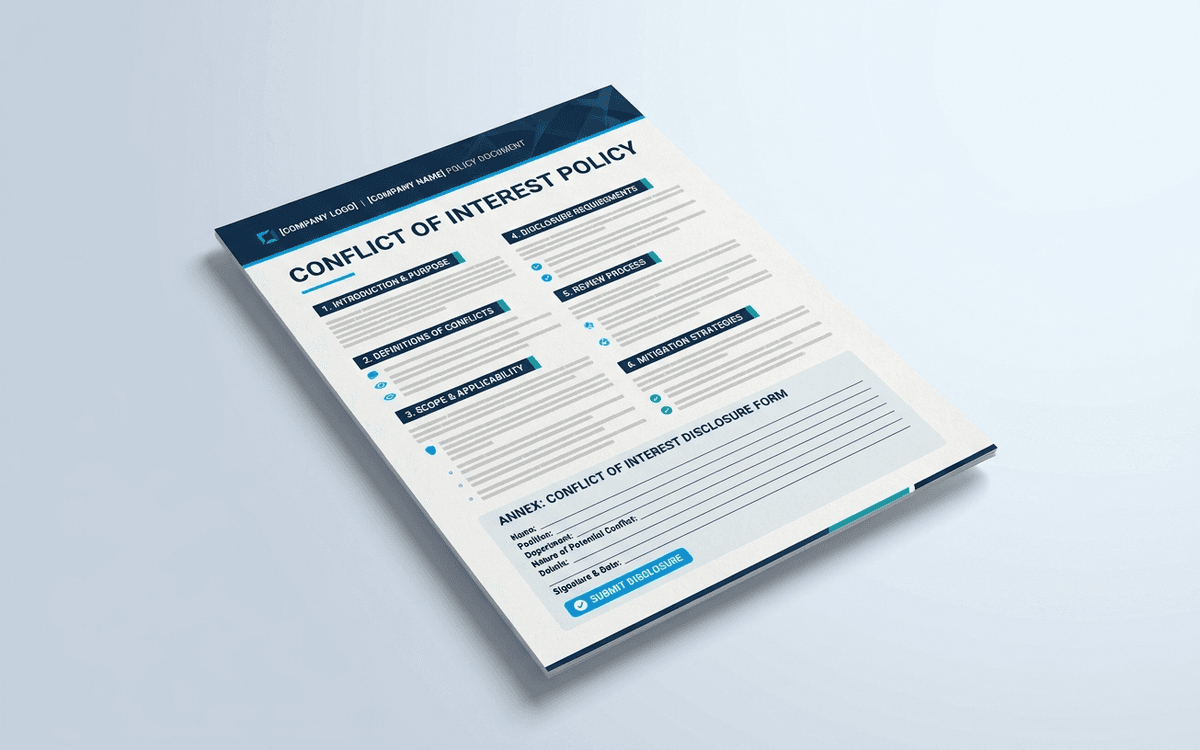
A conflict of interest policy template aligned to IRS Form 990 expectations — annual director disclosure, recusal process, and the documentation trail your auditor will ask for. Works for both nonprofit and small-corporate boards.
- Format:
- Word (.docx) (40 KB)
- Price:
- Free, no paywall
- Published May 2026
Download this template — free
Tell us where to send the link. We'll never share your email.
What's included
- Policy statement and scope
- Definition of "conflict of interest" (financial, family, organizational)
- Directors and officers covered
- Annual disclosure requirement
- Disclosure form for each director to complete
- Procedures for managing disclosed conflicts
- Recusal process during conflicted votes
- Documentation requirements (what gets recorded in minutes)
- Annual review of policy and disclosures
- IRS 990 Schedule L alignment notes
How to use this template
1. Adopt the policy AT a board meeting, with a vote
The policy itself requires board adoption to be effective. Adopt it via formal resolution at a board meeting; record the vote in the minutes. Self-imposed by the ED doesn't count — board governance instruments require board approval.
2. Distribute disclosure forms annually
Every director and officer fills out a fresh disclosure form each year, typically at the start of the fiscal year. Don't skip a year — gaps in the disclosure record show up on the 990 and can trigger questions from regulators or major donors.
3. Record disclosed conflicts at the START of relevant meetings
When an agenda item touches a known director conflict, that director discloses at the start of the discussion and recuses for the vote. Record both in the minutes: "Director X disclosed conflict re: item Y, recused from discussion and vote." Without this trail, the policy is decorative.
4. Include both ACTUAL and APPEARANCE conflicts
Many policies only catch actual financial conflicts. Best practice catches APPEARANCE conflicts too — relationships that look like conflicts even if they aren't. Disclosure is cheap; non-disclosure of an appearance issue is expensive when it surfaces later.
5. Review the policy annually
Set an annual policy review on the board calendar. Most policies need only minor tweaks year-over-year, but the discipline of reviewing surfaces drift (new business lines, new director profiles, regulatory changes). Annual review is also a Form 990 expectation for nonprofits.
Who it's for
- Nonprofit boards (required by IRS 990 to have this policy)
- Small-corporate boards formalizing governance for first time
- Boards preparing for an audit or capital raise
- New corporate secretaries inheriting weak governance
Frequently asked questions
- Is a conflict of interest policy required for nonprofits?
- IRS Form 990 Part VI asks whether the organization has a written conflict of interest policy. Saying "no" is technically allowed but functionally a red flag for donors, grantors, and the IRS. Best practice: every nonprofit has one. For 501(c)(3)s the IRS strongly encourages adoption.
- What counts as a conflict of interest?
- Any situation where a director's personal, financial, or organizational interest could (or could appear to) influence their board decisions. Examples: voting on a contract with a director's own business, hiring a family member, approving compensation that benefits a director's spouse. Appearance matters as much as actuality.
- How is a conflict different from a related-party transaction?
- Related-party transactions are a SUBSET of conflicts of interest — specifically, transactions between the organization and an entity in which a board member has a financial interest. All related-party transactions are conflicts; not all conflicts are related-party transactions. Form 990 Schedule L tracks the former.
- What happens if a director refuses to disclose?
- The policy should address this explicitly: failure to disclose is grounds for removal from the board, and any decision tainted by a non-disclosed conflict can be voided. Boards rarely have to invoke this, but the policy mechanism needs to exist.
- Can a conflicted director participate in the discussion?
- Depends on the policy and the specific situation. Common pattern: the director can present factual information about the matter, then leaves the room for board deliberation and the vote. Some policies are stricter (no participation at all). The template defaults to the common pattern.
More board templates
Board Meeting Minutes Template
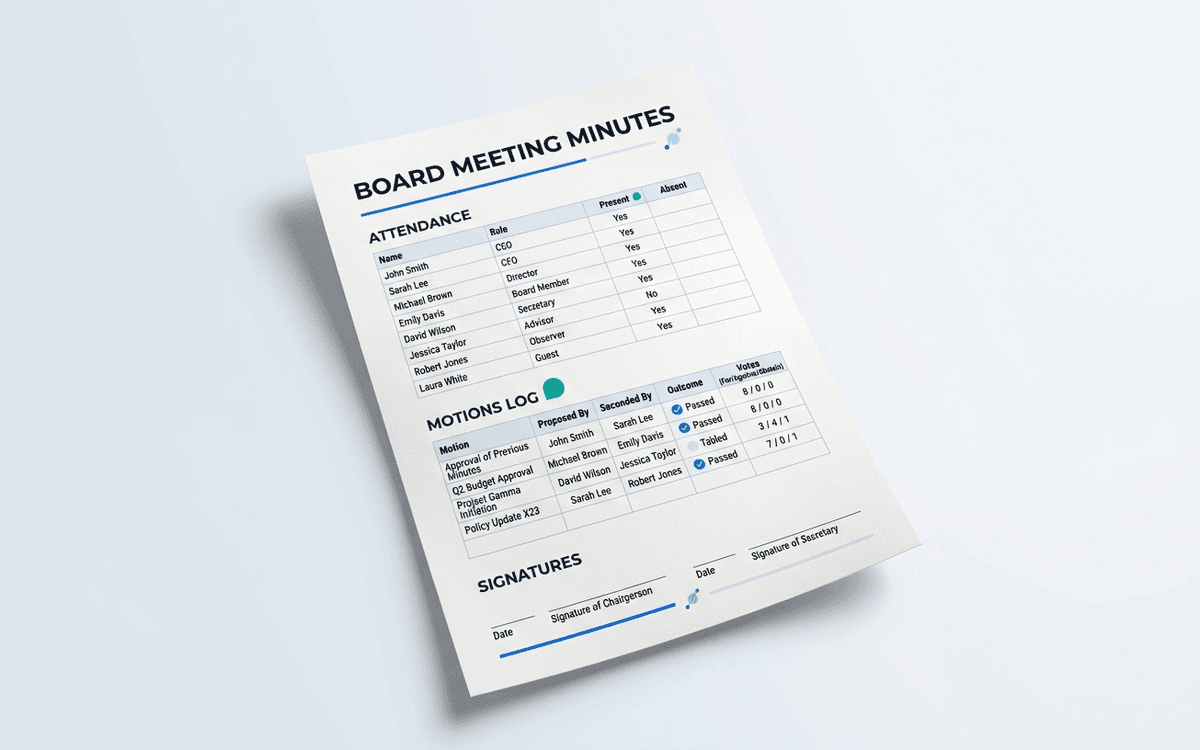
A board meeting minutes template gives you a tested structure for capturing attendance, motions, votes, and action items — so your minutes hold up to legal review, satisfy your corporate secretary, and don't take three hours to write up after the meeting.
Board Resolution Template
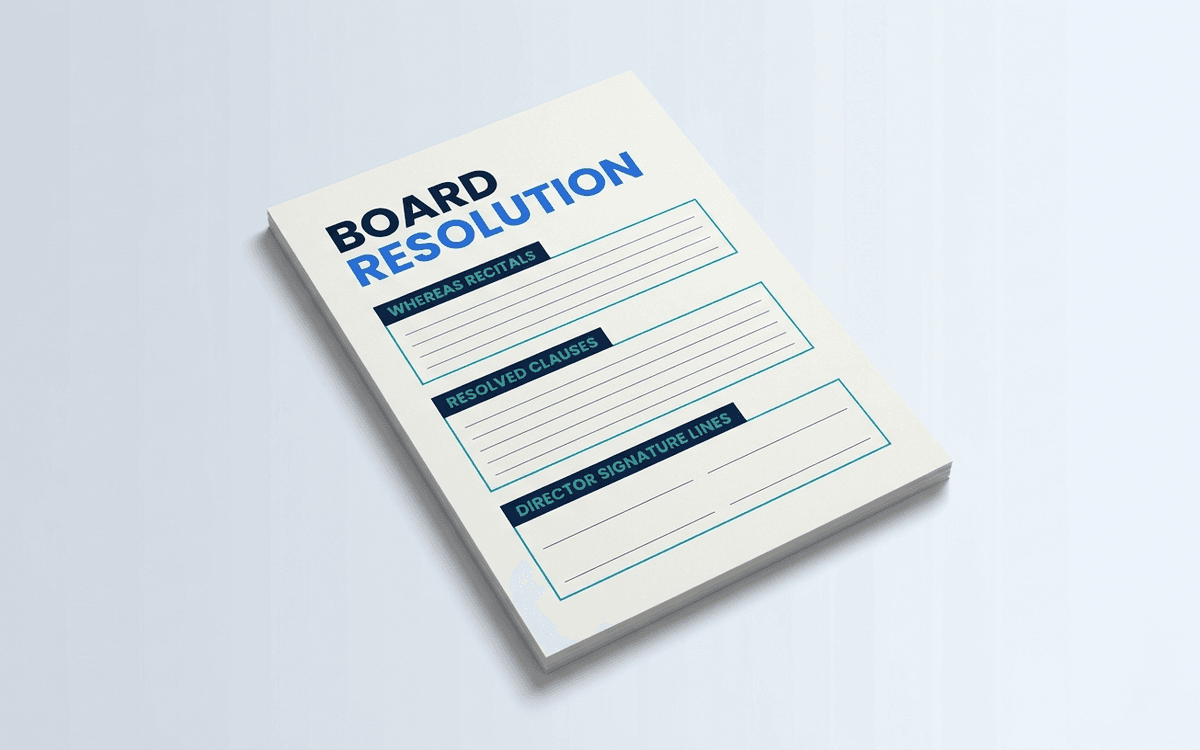
A board resolution template gives you the format directors and corporate counsel expect — a recital block that explains why the resolution is being taken, the resolved language itself, and signature lines for written consent — so corporate actions between meetings hold up to legal review.
Nonprofit Board Meeting Agenda Template
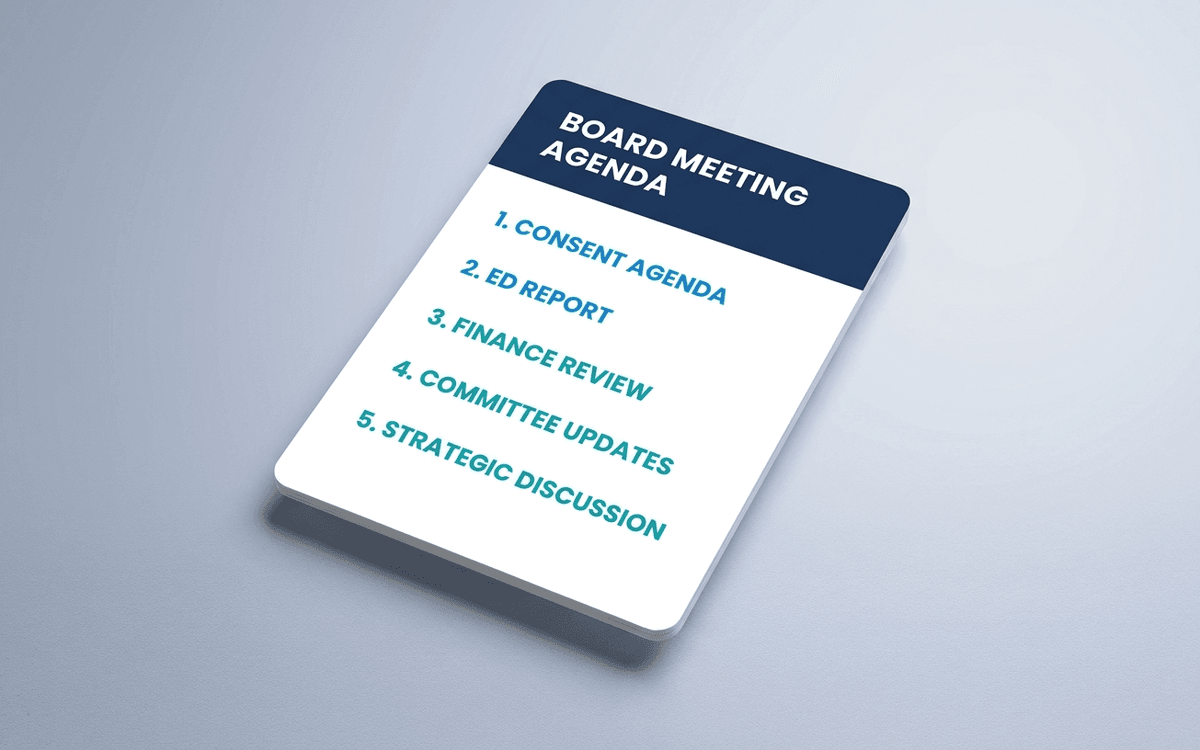
A nonprofit board meeting agenda template built around the actual cadence of nonprofit governance — ED report, finance review, committee updates, strategic discussion — with a consent agenda that gets routine items out of the way in one vote.
When the template isn't enough
AppDeck's board portal turns this template into a live workspace — version control, permissions, signatures, and analytics built in.