
Cap Table Template
A cap table template that tracks founders, employees, SAFEs, convertible notes, and priced rounds — and calculates fully-diluted ownership automatically. Built for founders raising pre-seed through Series A.
- Format:
- Excel (.xlsx) (11 KB)
- Price:
- Free, no paywall
- Updated July 2026
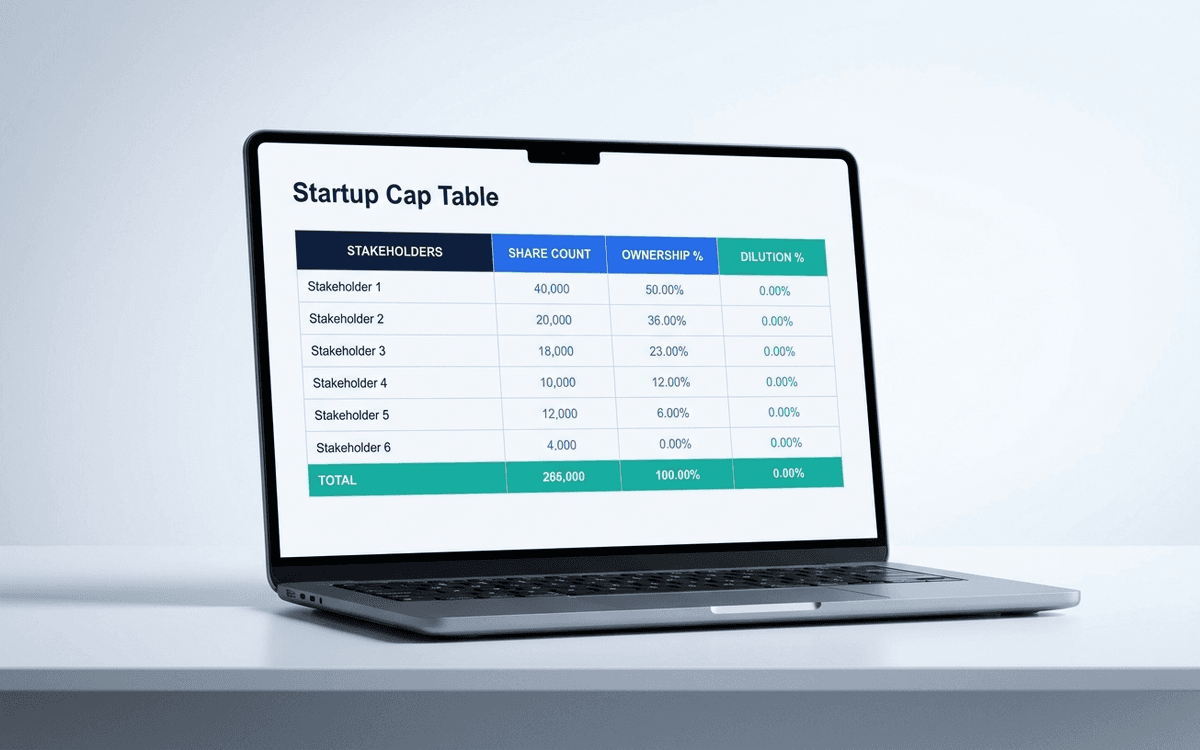
Download this template — free
Tell us where to send the link. We'll never share your email.
What's included
- Stakeholders sheet (founders, employees, advisors, ESOP pool)
- Common stock issuance log
- SAFE log with valuation cap and discount
- Convertible note log with cap, discount, and interest accrual
- Priced round modeler (pre-money, investment amount, ESOP top-up)
- Pro-forma cap table showing fully-diluted ownership
- Dilution waterfall by round
- Quick-reference cell map for the formulas
How to use this template
1. Enter the founding cap table first
On the Stakeholders sheet, list each founder, the share count, and the issuance date. The defaults assume 10,000,000 common shares — adjust if your initial authorization is different. Common practice: founders get common stock at a nominal price, vesting over 4 years with a 1-year cliff.
2. Add SAFEs and notes as you raise them
Each row on the SAFE log is one note. Enter amount, valuation cap, discount, and whether it's pre-money or post-money. The template shows the implied conversion shares at any subsequent priced round price; the dilution doesn't hit the founder until the priced round closes.
3. Use the Priced Round modeler before signing a term sheet
Enter the proposed pre-money, the investment amount, and whether the round requires an ESOP top-up to a target percentage. The modeler shows: post-money valuation, new investor ownership, ESOP top-up shares, and resulting founder dilution — including the effect of converting existing SAFEs/notes at the round price.
4. Don't forget ESOP refresh logic
New investors typically require the option pool to be sized to 10–15% of post-money, BEFORE their investment closes. That means the ESOP top-up comes out of existing shareholders' ownership, not the new investor's. The modeler handles this automatically — note where it's pulling the top-up from.
5. Graduate to a real cap table tool by Series A
Excel cap tables are great for the first 1–3 rounds. By Series A you'll need 409A valuations, option grant tracking, and audit-ready records — that's when Carta, Pulley, or Capboard pay for themselves. Use this template to learn how the math works, not to run a public company.
Who it's for
- Pre-seed and seed founders before signing up for Carta
- Operators modeling a hypothetical round
- Angel investors keeping a personal portfolio cap table
- Founders re-checking what their cap-table tool is telling them
Frequently asked questions
- When do I need to start tracking a cap table?
- Day one of incorporation. Even pre-product, pre-funding, your cap table tracks founder ownership and any common stock issued. Add to it as you bring on advisors, raise on SAFEs/notes, or hire your first employees with equity. The hard work is staying current — a stale cap table is a real problem when you start fundraising.
- What's the difference between fully-diluted and outstanding shares?
- Outstanding shares are the shares actually issued today. Fully-diluted includes: outstanding shares + unexercised options + warrants + the conversion shares from outstanding SAFEs/notes assuming a priced round at the cap price. Investors look at fully-diluted ownership because that's the post-conversion picture. Founders care about both, but mostly fully-diluted.
- How are SAFEs different from convertible notes?
- A SAFE is simpler: no interest, no maturity date, no debt classification. A convertible note is a loan that converts to equity at a future priced round — accrues interest, has a maturity date, and is debt on your balance sheet until it converts. Both convert at a valuation cap and/or discount. SAFEs are now more common in the U.S. for pre-seed and seed; notes are more common internationally and in larger pre-priced rounds.
- What's the difference between pre-money and post-money SAFEs?
- Pre-money SAFEs (the original YC structure) compute ownership BEFORE other SAFEs from the same round convert — meaning the founder bore the dilution from multiple SAFEs converting against each other. Post-money SAFEs (the current YC standard) lock in the investor's ownership percentage AFTER the SAFE converts, regardless of other SAFEs. Most SAFEs since 2018 are post-money. Read your SAFE — it matters a lot in the math.
- When should I move off Excel to a real cap table tool?
- Two triggers: (1) you're about to close a priced round and need a clean stakeholder ledger for the closing book, or (2) you've issued options to 5+ employees and need 409A valuations to set strike prices. Both typically arrive at the same time. Carta, Pulley, Capboard, and AngelList are the common choices.
More fundraising templates
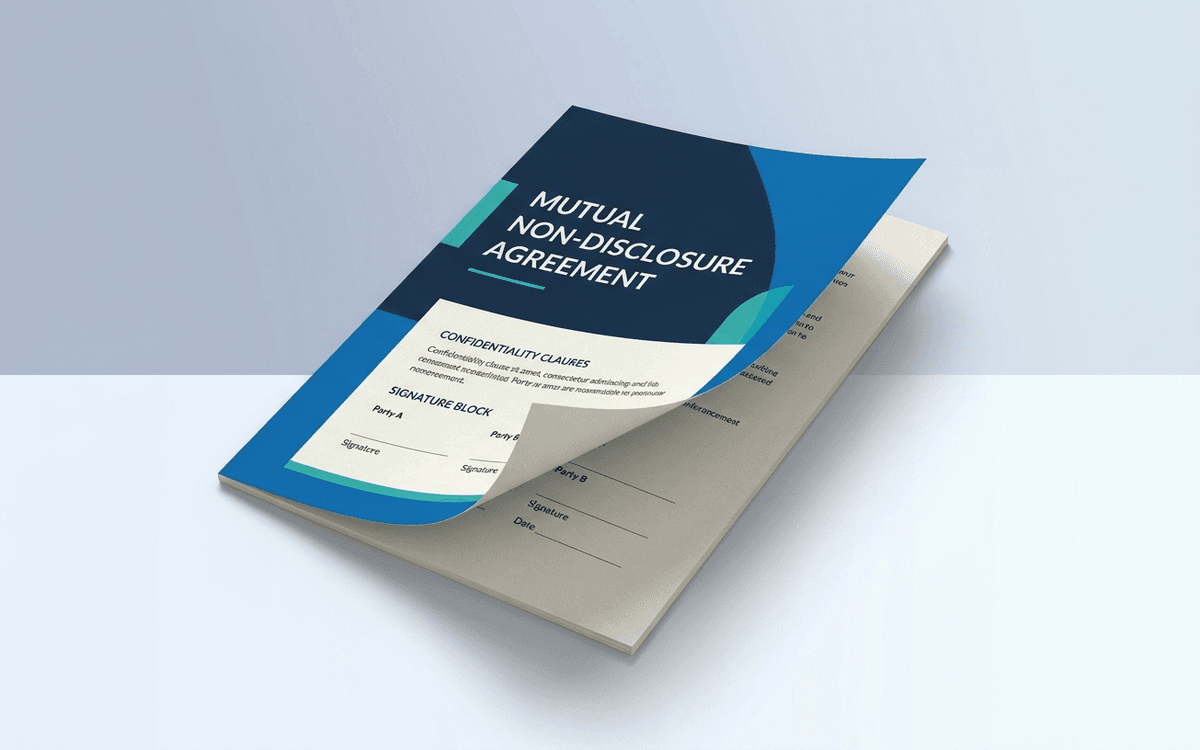
Mutual NDA Template
A mutual NDA template you can send to a prospective investor, partner, or vendor in under 60 seconds — balanced two-way confidentiality, standard term, standard exceptions, and no clever clauses that make the other side run it past their lawyer.
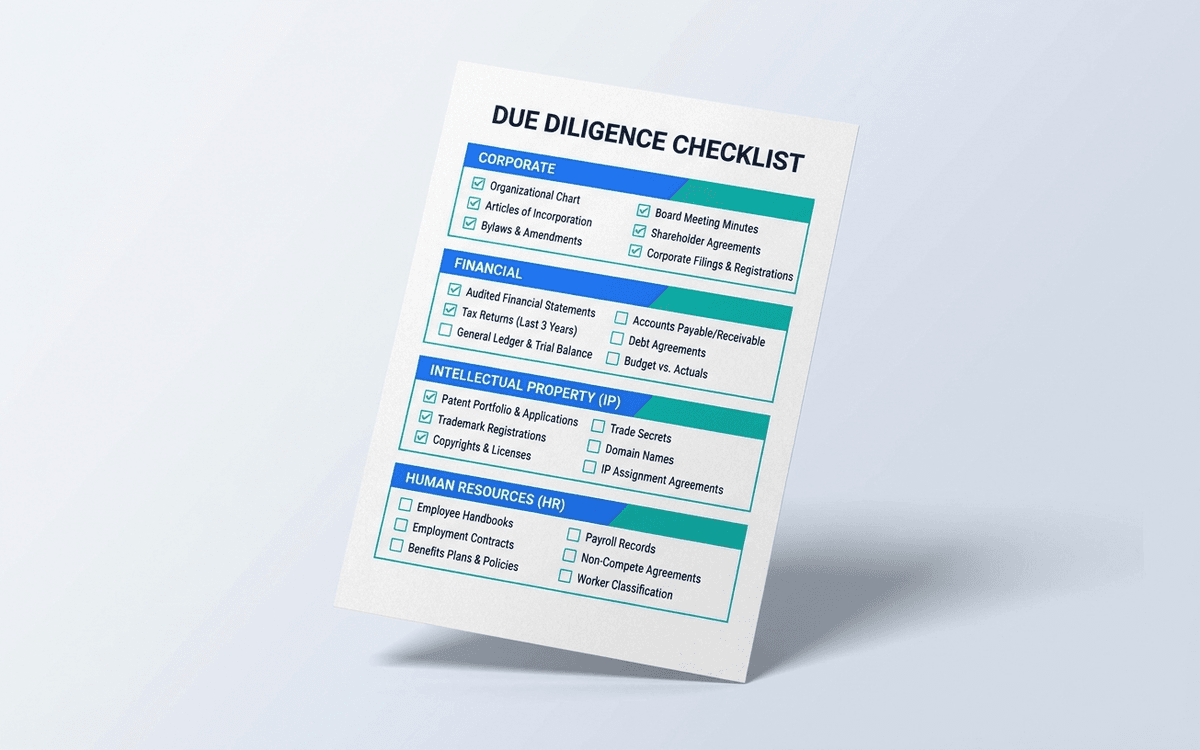
Due Diligence Checklist Template
A due diligence checklist gives founders the punch list investors and acquirers actually run — corporate, financial, IP, HR, commercial, and tech — so you can stage the data room before a term sheet lands instead of during.
When the template isn't enough
AppDeck's fundraising portal turns this template into a live workspace — version control, permissions, signatures, and analytics built in.
Related Articles
Learn more about this topic from our expert guides and resources.
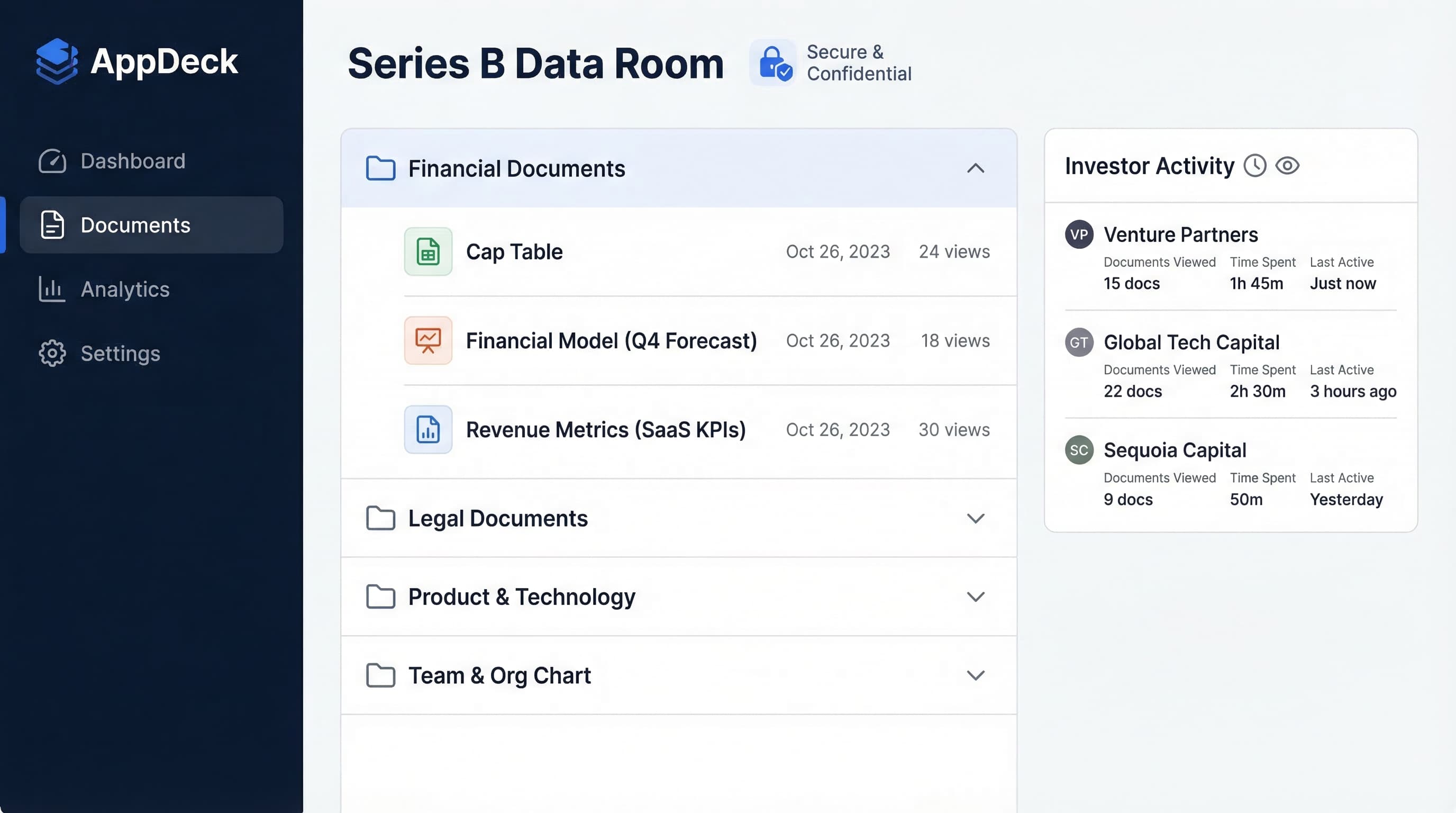
Investor Data Room Best Practices: A CFO's Complete Guide for 2026
Learn the essential best practices for creating and managing investor data rooms. Complete guide with checklist, templates, and real-world examples from successful fundraising rounds.
Read Article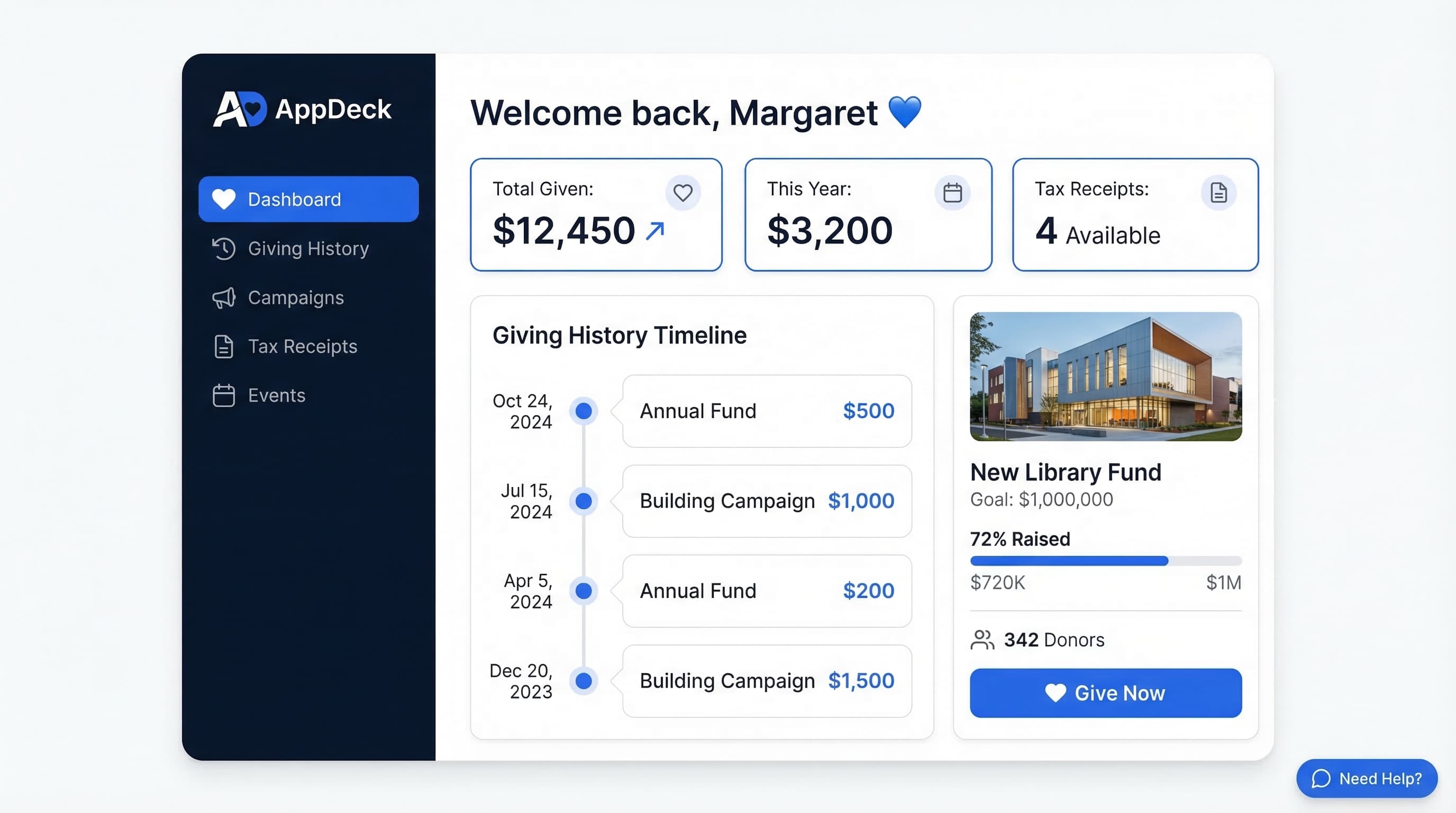
Donor Portal Software: 7 Best Platforms for Nonprofits (2026)
Compare the best donor portal software for nonprofits. Online giving, donation history, tax receipts, communication tools, and volunteer management. Honest reviews and pricing.
Read ArticleDue Diligence Checklist: Complete Guide for M&A, Fundraising & Investors
The definitive due diligence checklist for fundraising, M&A, and investor review. 100+ items organized by category with templates and data room setup tips.
Read Article