
Board Report Template
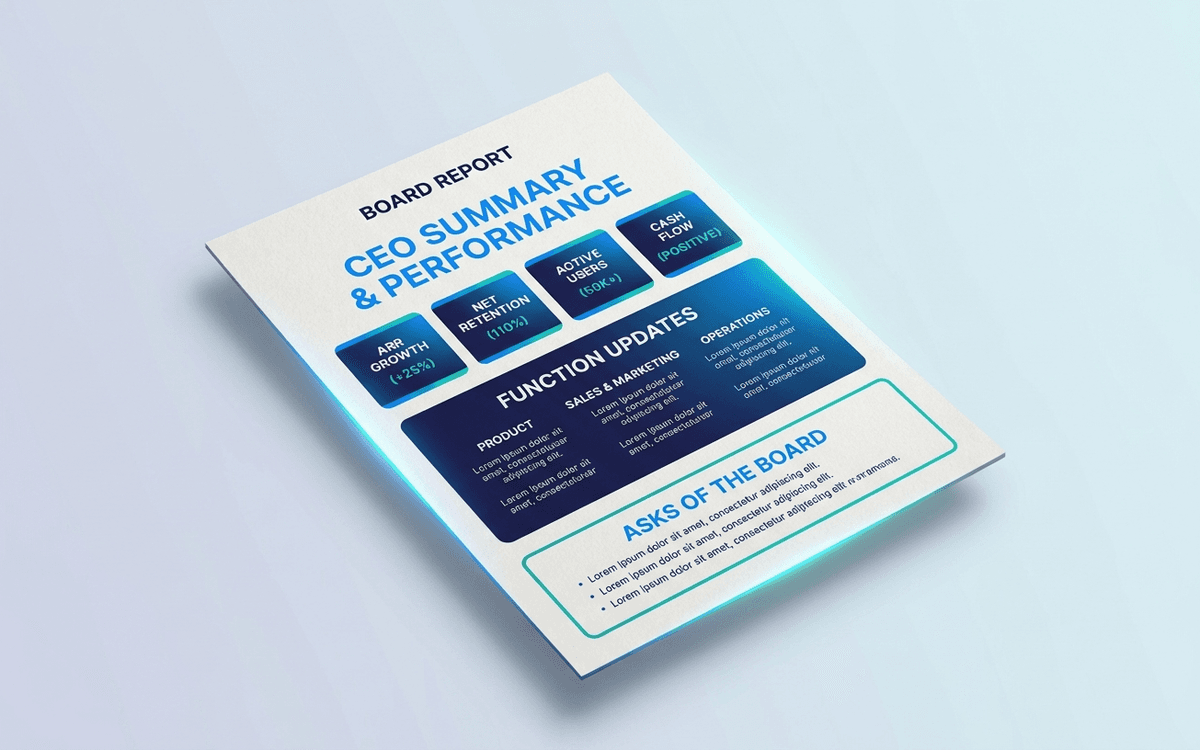
A board report template structured around what directors actually want to read in the meeting — headline metrics on a single page, a narrative section per function, the specific asks of the board, and a forward-look — instead of the 40-page slide deck nobody pre-reads.
- Format:
- Word (.docx) (38 KB)
- Price:
- Free, no paywall
- Published May 2026
Download this template — free
Tell us where to send the link. We'll never share your email.
What's included
- CEO summary block (state of the business in 3 paragraphs)
- Headline metrics dashboard (revenue, growth, burn, runway, headcount, customer count)
- Variance to plan narrative
- Function-level updates (Sales, Product, Engineering, People, Finance)
- Key wins and losses since the last meeting
- Top 3 risks with mitigation status
- Asks of the board (decisions needed, advice sought, intros requested)
- Forward-look: next 90 days commitments
- Appendix pointer for detailed financials and dashboards
How to use this template
1. Write the CEO summary LAST
The CEO summary is the first thing directors read and the last thing you should write. Draft the rest of the report, then distill the summary from it. A summary written first inevitably overpromises; a summary written last reflects what the report actually says.
2. Lead every section with the number
Each section opens with the headline metric or fact ("Q2 revenue: $1.4M, +18% QoQ, $200K below plan"). Narrative explains, contextualizes, and proposes — but the number leads. Directors who scan should be able to read just the first lines and have the picture.
3. Be explicit about asks
The single most-skipped section in board reports is "asks of the board." Be explicit: what decisions do you need a vote on, what advice are you seeking, who do you want introductions to? Directors arrive with no agenda about how to help unless you tell them.
4. Disclose bad news in the report, not in the meeting
Directors hate surprises. If something went wrong since the last meeting, it goes in the report — clearly labeled, with what happened, what you did, what you learned. Surfaced in writing it becomes a conversation; surfaced in the meeting it becomes a crisis.
5. Cap the main report at 6 pages
Six pages forces ruthless editing. Anything beyond goes in the appendix (financials, detailed dashboards, deep-dive memos). Directors who want depth click through; directors who skim hit only what matters. Reports beyond 10 pages get skimmed regardless of how good they are.
Who it's for
- Founders/CEOs writing the report ahead of the board meeting
- COOs and CFOs producing the operating-side narrative
- Chiefs of staff who own the board pack process
- Boards demanding more structured, scannable reports
Frequently asked questions
- What's the difference between a board report and a board pack?
- The board pack is the full package distributed before the meeting (report + financials + dashboards + supporting memos + agenda). The board report is the narrative one-document piece inside the pack that summarizes the business and frames the discussion. Some companies use the terms interchangeably; the distinction matters when you have ten directors who only have time to read one document.
- How long should a board report be?
- 6 pages or fewer for the main body. Appendix can be unlimited — financial detail, KPI dashboards, deep-dive memos. Directors who want depth click through; directors who skim hit only the main body. Reports longer than 10 pages get skimmed regardless of quality.
- When should the board report be sent?
- 5–7 calendar days before the meeting, along with the agenda. Anything tighter than 48 hours and the report is functionally not pre-read. The single biggest unlock for board meeting quality is sending materials early — the meeting then becomes about discussion, not catch-up.
- Who writes the board report?
- Typically the CEO with input from each function head. CFO writes the financials section; COO writes operations; CRO writes go-to-market; each direct report owns their narrative. The CEO writes the summary and the asks. At very early stage, the CEO writes most of it; by Series B it should be a multi-author document.
- Should the board report include forecasts and projections?
- Yes, in a forward-look section — typically the next 90 days. Avoid showing 5-year projections in routine board reports; they're not actionable and dilute attention. Save long-horizon projections for annual planning meetings.
More board templates
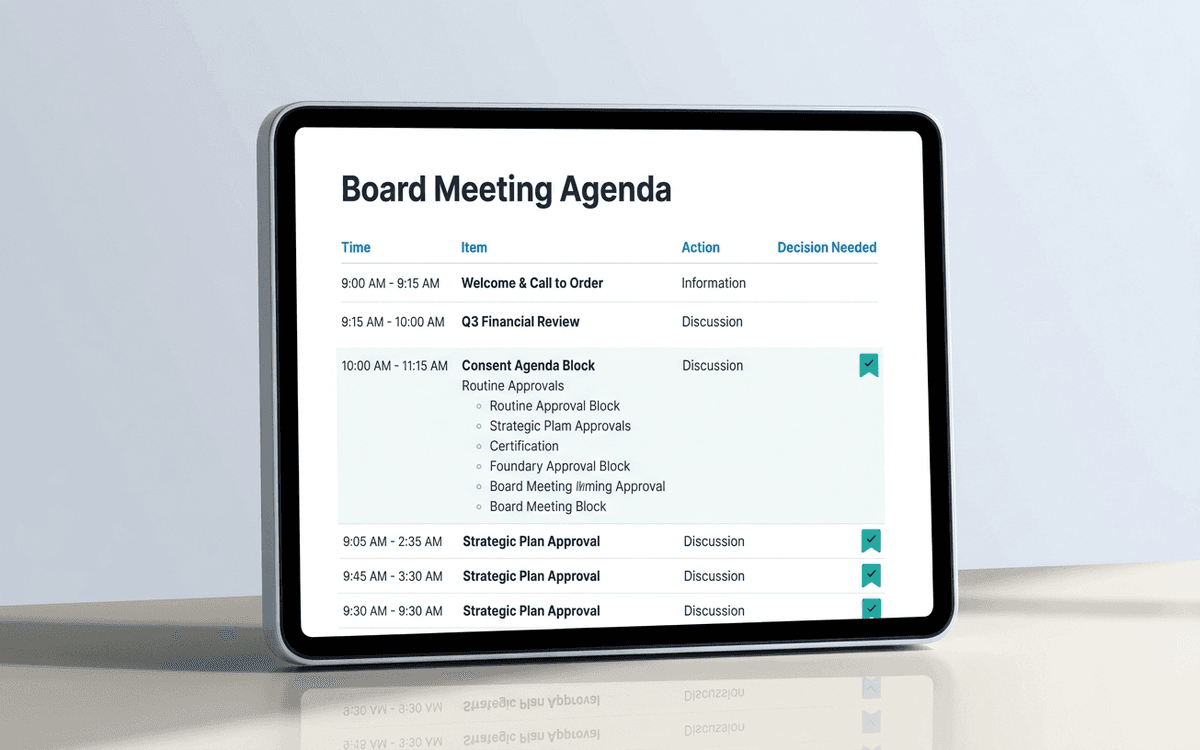
Board Meeting Agenda Template
A board meeting agenda template gives you a fight-tested running order — timing, owners, decision flags, and a consent agenda — so the meeting runs to the clock, decisions get made, and directors leave knowing exactly what they approved.
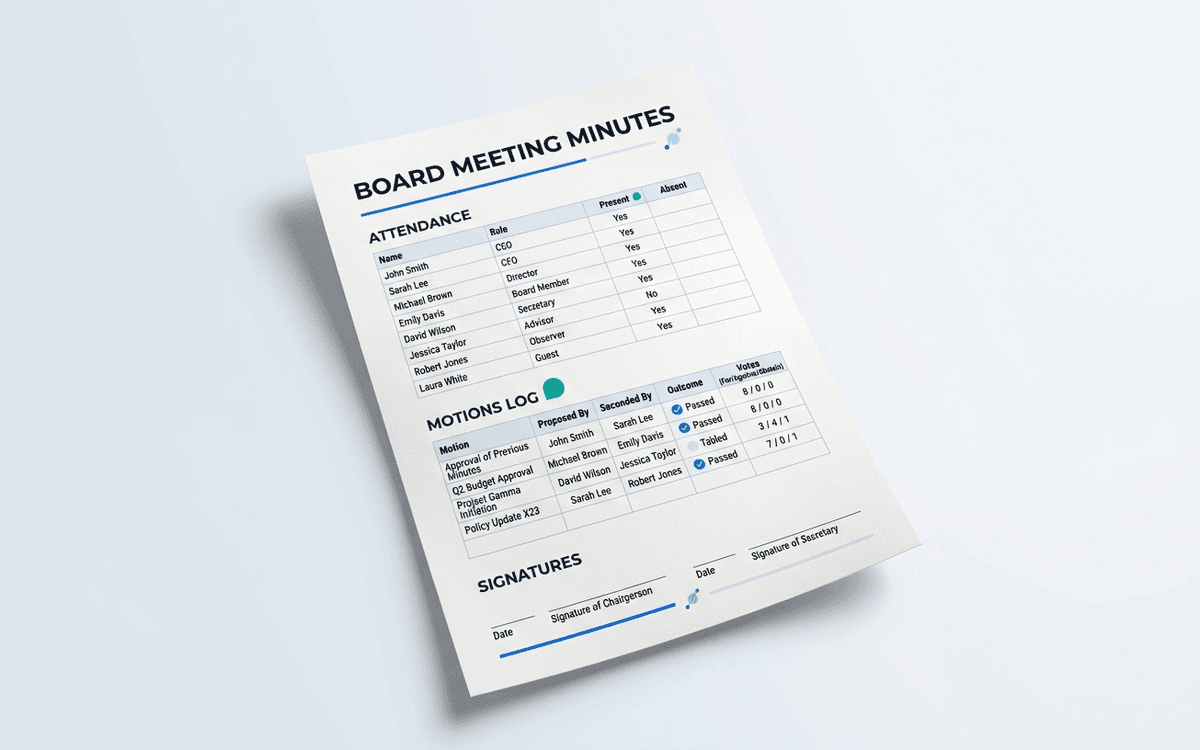
Board Meeting Minutes Template
A board meeting minutes template gives you a tested structure for capturing attendance, motions, votes, and action items — so your minutes hold up to legal review, satisfy your corporate secretary, and don't take three hours to write up after the meeting.
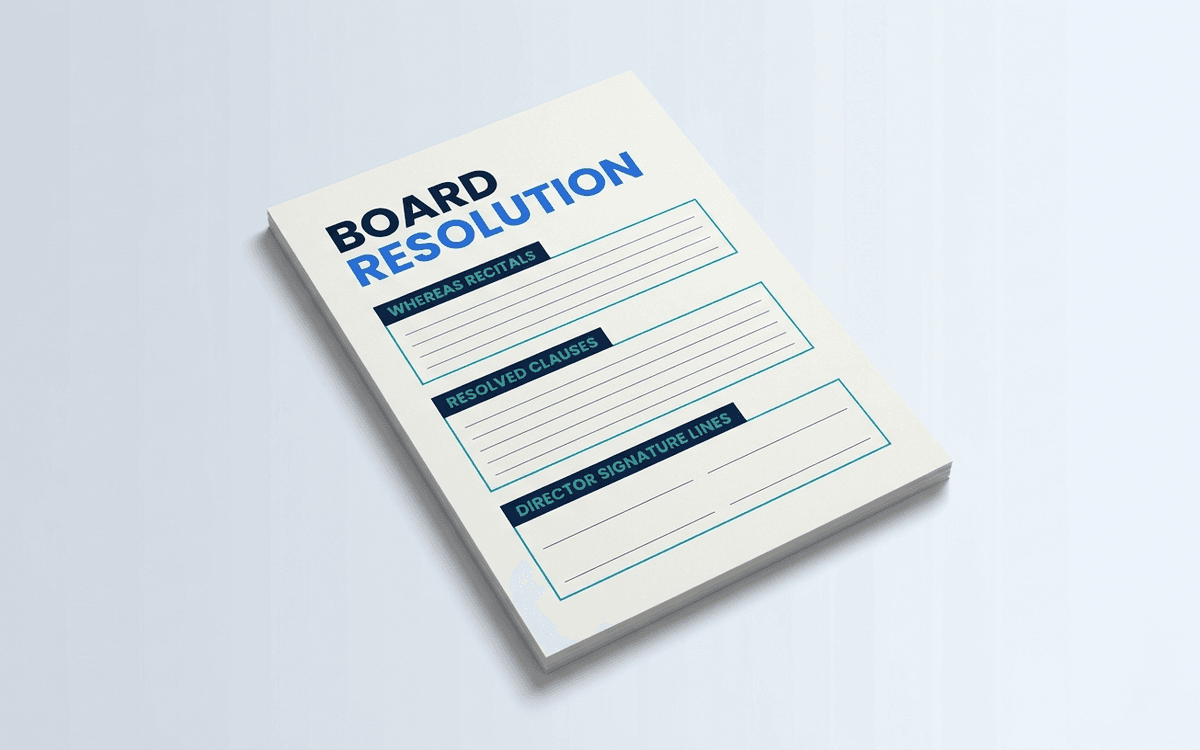
Board Resolution Template
A board resolution template gives you the format directors and corporate counsel expect — a recital block that explains why the resolution is being taken, the resolved language itself, and signature lines for written consent — so corporate actions between meetings hold up to legal review.
When the template isn't enough
AppDeck's board portal turns this template into a live workspace — version control, permissions, signatures, and analytics built in.