
Shareholder Communications Guide: Best Practices for IR Teams
Complete guide to shareholder communications for investor relations teams. Covers shareholder portals, proxy voting, annual reports, dividend communications, and SEC compliance.
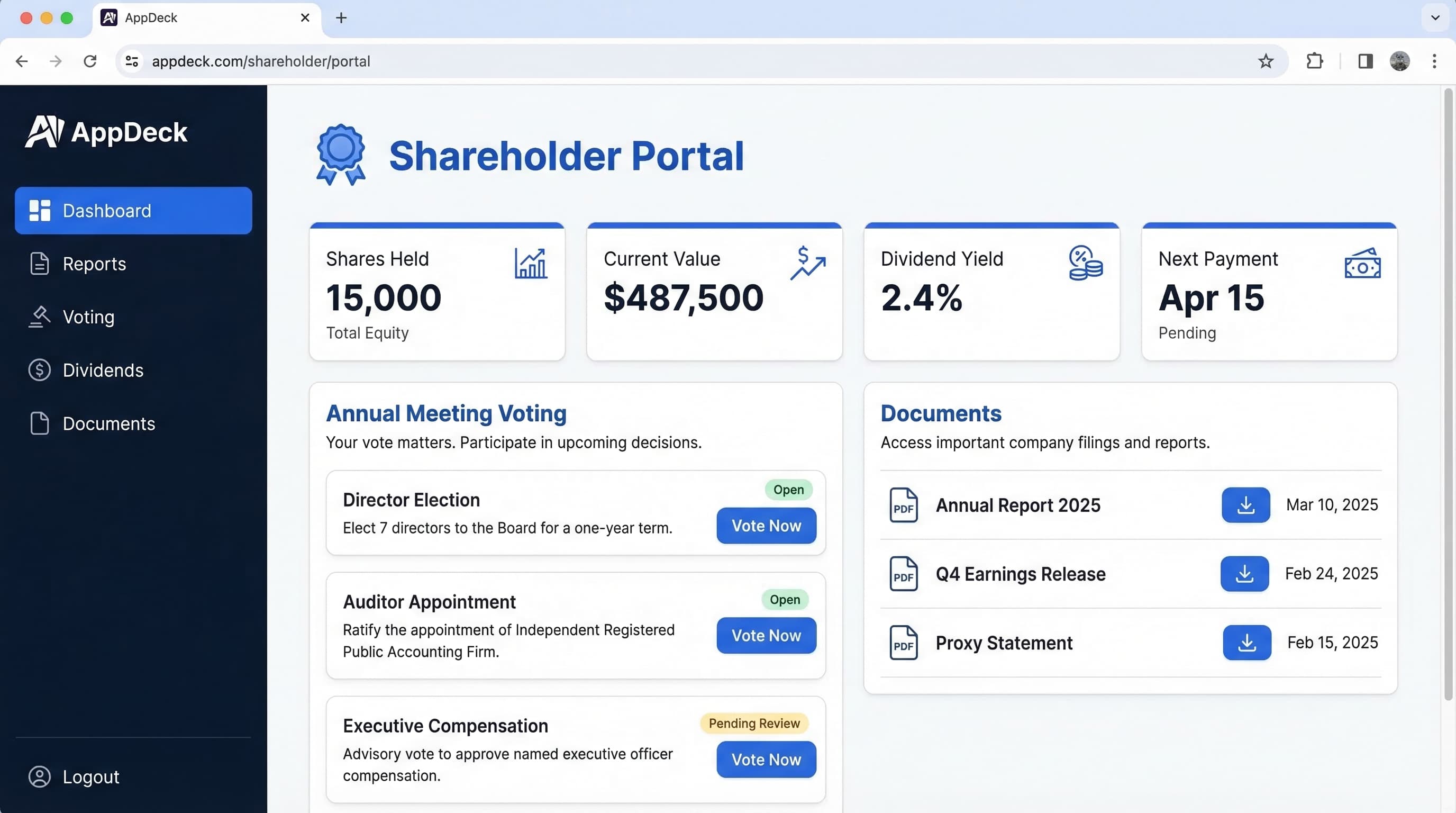
TL;DR: Complete guide to shareholder communications for investor relations teams. Covers shareholder portals, proxy voting, annual reports, dividend communications, and SEC compliance.
Introduction
Shareholder communications build trust, ensure regulatory compliance, and directly influence stock performance. They are the connective tissue between a company and its owners — and when done well, they create informed, engaged shareholders who support management through market cycles.
Yet many investor relations teams still rely on outdated methods: bulk-mailed proxy materials, static PDF annual reports, and one-way communications that provide zero insight into whether shareholders actually received, read, or understood the information. The result? Low proxy voting participation, shareholder confusion about dividends and corporate actions, and an IR team that spends more time fielding basic inquiries than building strategic relationships.
After 12+ years managing shareholder communications for public and private companies, I've seen the difference between organizations that treat IR as a strategic function and those that treat it as a compliance checkbox. The companies that communicate proactively, transparently, and through modern channels consistently earn higher valuations, stronger shareholder loyalty, and smoother proxy seasons.
In this guide, I'll walk through everything IR teams need to know about shareholder communications in 2026 — the types of communications you're responsible for, 10 best practices to implement immediately, and the technology that makes it all scalable.
What you'll learn:
- The full landscape of shareholder communications (mandatory and voluntary)
- 10 best practices that improve engagement, compliance, and efficiency
- How to compare traditional vs. modern communication methods
- The technology stack that leading IR teams use today
- How shareholder portals reduce IR workload by 50%+
See also: Annual Shareholder Meeting Guide — the full agenda, timeline, and best practices for running the AGM.
What Are Shareholder Communications?
Shareholder communications encompass every interaction between a company and its shareholders — from legally mandated SEC filings to voluntary updates that build trust and transparency.
Definition
Shareholder communications are the information, documents, and interactions that a company provides to its equity holders. They serve three core purposes:
- Compliance — Meeting regulatory requirements under SEC rules, stock exchange listing standards, and state corporate law
- Transparency — Keeping shareholders informed about financial performance, strategy, and corporate actions
- Engagement — Building relationships that support long-term shareholder loyalty and governance participation
Mandatory vs. Voluntary Communications
Mandatory communications are required by law or regulation. Missing deadlines or providing inadequate disclosures creates legal liability and regulatory risk.
- Annual reports (10-K)
- Quarterly reports (10-Q)
- Proxy statements (DEF 14A)
- Current reports (8-K) for material events
- Beneficial ownership reports
- Dividend and distribution notices
- Annual meeting notices and materials
Voluntary communications are not legally required but are critical for building shareholder trust and engagement.
- CEO/Chairman shareholder letters
- Investor presentations and fact sheets
- ESG and sustainability reports
- Investor day materials
- Earnings call transcripts and replays
- Shareholder newsletters
- FAQ documents and educational content
Key Audiences
Effective IR teams segment communications by audience:
- Institutional investors — Pension funds, mutual funds, hedge funds. They want detailed financial data, management access, and governance information.
- Retail investors — Individual shareholders. They want clear, jargon-free communication, easy dividend access, and simple proxy voting.
- Activist shareholders — Investors seeking to influence strategy or governance. Requires coordination with legal counsel.
- Prospective investors — Not yet shareholders. They need easy access to financial data and the company narrative.
Key principle: The same information needs to be communicated differently depending on the audience. An institutional investor reads a 10-K filing directly. A retail investor needs a summary that highlights what matters to them.
Types of Shareholder Communications
Understanding the full landscape of shareholder communications is essential for building a comprehensive IR program. Here are the eight major categories.
1. Annual Reports & 10-K Filings
The annual report is the cornerstone of shareholder communications — a comprehensive overview of financial performance, strategy, risks, and outlook.
What's included: Audited financial statements, MD&A, business overview, risk factors, executive compensation, governance information, and auditor's report.
SEC requirements: 10-K filing due within 60 days of fiscal year end (large accelerated filers) or 90 days (non-accelerated filers). Must be filed via EDGAR. Material misstatements carry civil and criminal liability.
Best practice: Don't just file the 10-K and call it done. Create a shareholder-friendly annual report — a designed, readable summary with interactive digital elements, not a 200-page PDF.
2. Proxy Statements & Voting
Proxy statements (DEF 14A) are among the most operationally complex shareholder communications. They inform shareholders about matters to be voted on at the annual meeting and solicit their votes.
Common proxy voting matters:
- Election of directors
- Executive compensation ("say on pay")
- Ratification of auditors
- Shareholder proposals
- Stock plan approvals
- Mergers and acquisitions
- Charter and bylaw amendments
The participation challenge:
- Average proxy voting participation for retail shareholders: 28-32%
- Average proxy voting participation for institutional shareholders: 85-90%
- The gap represents millions of unvoted shares and potential governance issues
Why it matters: Low participation rates can lead to contested votes, failed proposals, and governance concerns from proxy advisory firms like ISS and Glass Lewis. Every percentage point of participation improvement strengthens governance legitimacy.
3. Quarterly Earnings Releases
Quarterly earnings communicate financial results and management's commentary on performance and outlook. Components include the press release, earnings call (live webcast with Q&A), supplemental data and slides, updated guidance, and call transcript.
Timing: 10-Q filing due within 40 days of quarter end (large accelerated filers). Earnings press release typically issued 2-4 weeks before 10-Q filing. Regulation FD requires simultaneous disclosure — no selective briefings.
4. Dividend Announcements
For dividend-paying companies, dividend communications are among the most scrutinized by retail shareholders.
Key information shareholders need:
- Declaration date, record date, ex-dividend date, payment date
- Dividend amount per share (and any changes from prior period)
- Qualified vs. ordinary dividend classification (tax implications)
- Dividend reinvestment plan (DRIP) details and enrollment
- Special dividend announcements
- Dividend suspension or reduction explanations
Common shareholder questions about dividends:
- "When will I receive my dividend payment?"
- "How do I enroll in the dividend reinvestment plan?"
- "What are the tax implications of my dividends?"
- "Why was the dividend reduced?"
- "How do I update my direct deposit information?"
Pro tip: Most IR teams underestimate the volume of dividend-related inquiries from retail shareholders. Proactive communication — clear payment schedules, tax guides, and DRIP enrollment instructions published in advance — reduces inquiry volume by 40-60%.
5. Press Releases & 8-K Filings
Current reports on Form 8-K disclose material events between regular reporting periods. Triggering events include material agreements, acquisitions or dispositions, executive changes, bylaw amendments, restructuring charges, and cybersecurity incidents (as of 2024 SEC rules).
Filing deadline: Generally within 4 business days of the triggering event.
Communication challenge: 8-K events are often unexpected and time-sensitive. IR teams need a protocol that activates quickly — draft press release, legal review, board notification, filing, and shareholder notification — all within hours, not days.
6. Shareholder Letters (CEO/Chairman)
The shareholder letter is a voluntary communication that carries outsized influence on shareholder sentiment. Effective letters are candid (acknowledging challenges, not just wins), strategically clear, performance-contextualized, and written in a personal voice — not by committee.
Example of excellence: Warren Buffett's annual letters to Berkshire Hathaway shareholders are the gold standard — candid, educational, and consistently shareholder-focused. They build trust by treating shareholders as partners.
7. Annual Meeting Materials
The annual shareholder meeting (ASM) is the one formal venue each year for shareholders to engage with the board and management. Materials include meeting notice, proxy statement, voting instructions, rules of conduct, shareholder proposals with board responses, presentation materials, and minutes.
Trend: Virtual and hybrid meetings are now the norm — approximately 70% of S&P 500 companies offered virtual attendance in 2025. This broadens participation but requires thoughtful technology choices for accessibility and meaningful interaction.
8. ESG & Sustainability Reports
ESG reporting has moved from "nice to have" to "expected" for most public companies. Shareholders want environmental metrics (emissions, energy, waste), social metrics (diversity, engagement, community impact), governance metrics (board composition, compensation alignment), alignment with frameworks (SASB, GRI, TCFD, ISSB), and measurable targets with progress tracking.
Why it matters: 85% of institutional investors now consider ESG factors in investment decisions. Proxy advisory firms incorporate ESG ratings into voting recommendations. Poor ESG performance increasingly correlates with activist campaigns.
Best practice: Integrate ESG information into your shareholder portal alongside financial data — shareholders don't want to hunt for a sustainability PDF on your corporate website.
Shareholder Communications Best Practices
These 10 best practices are drawn from working with IR teams across public and private companies. Implement them and you'll see measurable improvements in shareholder engagement, compliance efficiency, and IR team productivity.
1. Launch a Shareholder Portal
The problem: Shareholder communications are scattered across your corporate website, SEC filings, transfer agent platforms, email distributions, and physical mailings. Shareholders have to visit 3-5 different sources to find the information they need. Your IR team fields repetitive inquiries because information isn't easy to find.
The solution: Centralize all shareholder communications in a single, secure portal that serves as the hub for your entire IR program.
What a shareholder portal should include:
- ✅ All SEC filings (10-K, 10-Q, 8-K, DEF 14A) with search functionality
- ✅ Annual reports and shareholder letters
- ✅ Proxy voting access (electronic voting directly through the portal)
- ✅ Dividend information (schedules, history, tax documents, DRIP enrollment)
- ✅ Earnings releases, call recordings, and transcripts
- ✅ Investor presentations and fact sheets
- ✅ ESG/sustainability reports
- ✅ Shareholder FAQ and educational content
- ✅ Secure messaging with the IR team
- ✅ Meeting notices and materials (annual and special meetings)
Impact of a shareholder portal:
- 50% reduction in routine IR inquiries (shareholders find answers themselves)
- 40% increase in proxy voting participation (electronic voting is frictionless)
- Real-time engagement tracking — know which shareholders read which documents
- Instant distribution — new filings and announcements available immediately
- Compliance confidence — audit trail for all communications
Implementation tip: AppDeck Shareholder Portal provides all of these capabilities with a modern, shareholder-friendly interface. Setup takes less than an hour, and your shareholders get a single destination for everything they need — no more hunting across multiple websites and platforms.
2. Digitize Proxy Voting
The problem: Traditional proxy voting relies on mailed proxy cards that shareholders must complete, sign, and return. The result is predictable: retail shareholders don't vote. Cards get lost, forgotten, or thrown away. Participation rates for retail shareholders hover around 28-32% — meaning two-thirds of retail shares go unvoted.
The solution: Implement electronic proxy voting through your shareholder portal, making it as easy to vote your shares as it is to shop online.
How digital proxy voting works:
- Shareholders receive notice (email + portal notification) that proxy materials are available
- They log into the portal and review materials alongside plain-language summaries
- Voting is a simple click — approve, reject, or abstain on each proposal
- Confirmation is instant, and shareholders can change their vote until the meeting
- Results are tabulated automatically and reported to the inspector of elections
The results speak for themselves:
- Electronic voting increases retail participation by 35-45%
- Proxy processing costs drop by 60-70% (vs. print and mail)
- Vote tabulation goes from days to real-time
- Shareholders can vote in under 2 minutes (vs. 15+ minutes with paper)
Regulation note: SEC Notice and Access rules (Rule 14a-16) allow companies to furnish proxy materials electronically by providing a notice with instructions on how to access materials online. This reduces printing and mailing costs while encouraging digital engagement.
Key metric: Track your voting participation rate by shareholder segment. If retail participation is below 35%, your proxy communication process needs improvement.
3. Make Annual Reports Accessible
The problem: Most annual reports are designed for institutional investors and analysts — dense, jargon-heavy documents that retail shareholders struggle to parse. They're often published as 100+ page PDFs that nobody downloads, let alone reads. The company spends months creating them, and the majority of shareholders never engage.
The solution: Create digital-first, mobile-friendly annual reports that are accessible to all shareholder segments.
What accessible annual reports look like:
Design and format: Interactive digital format (not just a PDF), mobile-responsive, clear navigation and search, executive summary on page one, charts and infographics, and video messages from leadership.
Language and clarity: Plain language alongside technical data, glossary of terms, key metrics in sidebars, year-over-year comparisons, and risk factors explained in practical terms.
Accessibility: WCAG 2.1 AA compliant, screen reader compatible, alt text for all images, sufficient color contrast, and multi-language support for global shareholder bases.
Distribution: Published in portal with email notification, print copies opt-in only, summary version for retail shareholders, full 10-K cross-referenced for institutional investors.
Cost comparison: Print annual reports cost $15-25 per copy. Digital reports cost $0.50-2.00 per shareholder. For a company with 50,000 shareholders, that's $500K-1M in annual savings.
4. Communicate Dividends Proactively
The problem: Dividend information is the number one driver of retail shareholder inquiries. Shareholders want to know when they'll get paid, how much, and what the tax implications are. Yet most companies communicate dividends reactively — a brief press release when dividends are declared, then silence until shareholders start calling.
The solution: Build a proactive dividend communication program that anticipates and answers shareholder questions before they arise.
Proactive dividend communication framework:
Standing information (always available in portal): Complete dividend history (10+ years), current amount and yield, full-year payment schedule (declaration, record, ex-dividend, payment dates), DRIP enrollment instructions, tax classification guide, direct deposit enrollment, and international payment options.
Event-driven communications:
- Dividend declaration: Announcement within hours of board approval via portal, email, and press release
- Record date reminder: Notification 5 business days before record date
- Payment confirmation: Notification on payment date
- Tax documents: Notification when 1099-DIV is available (January)
- Dividend changes: Detailed explanation with rationale when dividends are increased, decreased, or suspended
For DRIPs: Clear enrollment/cancellation instructions, reinvestment price methodology, share accumulation statements, tax reporting guidance, and FAQ.
Impact: Companies that implement proactive dividend communication programs see a 40-60% reduction in dividend-related inquiries to IR and transfer agent teams.
5. Provide Real-Time Access to Filings
The problem: When your company files a 10-K, 10-Q, or 8-K, shareholders shouldn't have to navigate EDGAR to find it. Most retail shareholders have never used EDGAR and wouldn't know where to start. Even institutional investors prefer a more organized, searchable experience.
The solution: Make every SEC filing available instantly in your shareholder portal, organized by type and date, with search functionality and plain-language summaries.
Implementation approach:
Automated filing integration:
- Filings published to portal simultaneously with EDGAR submission
- Automatic categorization by filing type (10-K, 10-Q, 8-K, DEF 14A, etc.)
- Full-text search across all historical filings
- Email notifications to shareholders when new filings are available
- Filing calendar showing upcoming expected filing dates
Value-added layers:
- Plain-language summary accompanying each filing (what it means for shareholders)
- Key metrics highlighted and compared to prior periods
- Links to related materials (earnings call recording, investor presentation)
- Bookmark and annotation capabilities for institutional investors
- Download options (full filing, individual exhibits, financial statements only)
Compliance benefit: Having a centralized, timestamped record of when filings were made available to shareholders supports Regulation FD compliance and provides an audit trail for simultaneous disclosure.
6. Segment Communications
The problem: Sending the same communication in the same format to every shareholder ignores the fundamental differences between shareholder segments. Institutional investors want granular financial data and management access. Retail investors want clear summaries and dividend information. Treating them the same means neither group gets what they need.
The solution: Segment your shareholder base and tailor communication content, format, and frequency to each segment's needs.
Segmentation framework:
| Segment | Communication Needs | Preferred Format | Frequency |
|---|---|---|---|
| Institutional — Large Cap | Detailed financials, management access, governance data | Data-rich reports, 1-on-1 meetings | Quarterly + ad hoc |
| Institutional — Small/Mid | Financial summaries, growth story, competitive positioning | Investor presentations, conference calls | Quarterly |
| Retail — Active | Earnings summaries, dividend info, proxy voting | Email + portal, plain language | Quarterly + events |
| Retail — Passive | Dividend payments, annual report, proxy materials | Portal notifications, annual mailing | Semi-annual minimum |
| Prospective Investors | Company overview, investment thesis, financial highlights | Investor fact sheet, presentations | On-demand |
How to segment effectively:
- Work with your transfer agent to understand shareholder composition
- Track portal engagement to identify active vs. passive shareholders
- Use email engagement data (opens, clicks) to refine segmentation
- Offer communication preference options (frequency, format, topics)
Key principle: Segmentation isn't about providing different information to different groups (that would violate Regulation FD). It's about presenting the same information in formats and contexts that resonate with each audience.
7. Track Engagement
The problem: Most IR teams have no visibility into whether shareholders actually engage with communications. You send an annual report to 50,000 shareholders — how many opened it? How many read past the first page? How many clicked through to the proxy voting page? Without this data, you're communicating into a void.
The solution: Implement engagement tracking across all shareholder communications to understand what's working and what isn't.
What to track:
Portal engagement:
- Login frequency by shareholder segment
- Document views and downloads (which filings get the most attention?)
- Time spent on pages (are shareholders actually reading or just clicking?)
- Search queries (what are shareholders looking for?)
- Proxy voting completion rates by segment
Email engagement:
- Open rates by communication type
- Click-through rates to portal content
- Unsubscribe rates (are you over-communicating?)
- Device and time-of-day patterns
Event engagement:
- Earnings call attendance and duration
- Annual meeting participation (virtual and in-person)
- Investor day registration and attendance
- Q&A participation rates
Actionable insights: Low proxy voting? Simplify the interface and add reminders. Low annual report engagement? Redesign for digital-first. High dividend search volume? Improve dividend info prominence. Institutional investors not logging in? Ask what format they prefer.
Key metric: Aim for portal engagement rates of 40%+ for active shareholders. Below 25% signals your portal isn't delivering enough value.
8. Ensure SEC Compliance
The problem: Securities regulations are complex, penalties are severe, and the rules keep evolving. Regulation FD, proxy rules, filing deadlines, insider trading windows, cybersecurity disclosure requirements — there's a lot to manage. A single misstep can trigger SEC enforcement, shareholder lawsuits, or both.
The solution: Build compliance into your communication workflows so that regulatory requirements are met systematically, not ad hoc.
Critical compliance areas for shareholder communications:
Regulation FD (Fair Disclosure):
- All material, non-public information must be disclosed simultaneously to all investors
- No selective briefings of institutional investors before public announcements
- Accidental selective disclosure must be corrected within 24 hours via public filing
- Portal benefit: Publishing to a shareholder portal with timestamp creates a clear record of simultaneous disclosure
Proxy rules (Rule 14a):
- Proxy materials must be filed with SEC and delivered to shareholders at least 40 days before the meeting
- Proxy statements must include all required disclosures (compensation, governance, proposals)
- Electronic delivery permitted under Notice and Access rules
- Solicitation rules govern who can communicate with shareholders about voting matters
Filing deadlines:
- 10-K: 60 days after fiscal year end (large accelerated filers)
- 10-Q: 40 days after quarter end (large accelerated filers)
- 8-K: 4 business days after triggering event
- DEF 14A: At least 40 days before annual meeting
- Late filings trigger: NYSE/NASDAQ notification requirements, potential trading halt, investor concern
Cybersecurity disclosure (2024 SEC rules):
- Material cybersecurity incidents must be disclosed on Form 8-K within 4 business days
- Annual report must describe cybersecurity risk management, strategy, and governance
- IR teams must coordinate with IT security and legal on disclosure timing
Insider trading compliance:
- Maintain trading windows and blackout periods
- Pre-clear all officer and director trades
- Monitor for trading ahead of material announcements
- Communicate blackout periods proactively to insiders
Compliance checklist for IR teams:
- ✅ Filing calendar maintained and monitored (all deadlines tracked)
- ✅ Regulation FD policy documented and trained annually
- ✅ Proxy materials reviewed by legal counsel before distribution
- ✅ Trading window policy enforced with pre-clearance process
- ✅ All shareholder communications archived with timestamps
- ✅ Cybersecurity incident response plan includes disclosure workflow
- ✅ Annual compliance training for IR team and spokespersons
- ✅ Outside counsel review of all forward-looking statements
9. Host Virtual Annual Meetings
The problem: Traditional in-person annual meetings are expensive, logistically complex, and attended by a tiny fraction of shareholders. A company with 50,000 shareholders might see 50-200 attend in person. The rest either vote by proxy and skip the meeting entirely, or they don't participate at all.
The solution: Host virtual or hybrid annual meetings that dramatically expand participation while reducing costs.
Virtual meeting advantages:
Broader participation: Shareholders attend from anywhere, international shareholders participate live, mobility limitations are no barrier, and attendance typically increases 3-5x compared to in-person only.
Cost reduction: Eliminating venue ($10K-50K), catering/AV ($5K-20K), travel ($5K-15K), and security ($3K-10K) while adding a virtual platform ($2K-10K) delivers 70-85% net savings.
Better record-keeping: Complete recordings, timestamped Q&A, shareholder attendance logs, automated vote tabulation, and transcripts available within hours.
Best practices for virtual meetings:
- Pre-meeting: Clear joining instructions 2+ weeks in advance, test/rehearsal option, materials published early, pre-meeting question submission enabled
- During: Professional production quality, live Q&A with equitable question selection, real-time voting, technical support, 60-90 minutes maximum
- Post-meeting: Recording in portal within 24 hours, minutes published within 5 business days, vote results filed on Form 8-K within 4 business days
Hybrid model: An in-person event at headquarters with virtual attendance for all other shareholders preserves the personal touch while maximizing participation.
10. Maintain a Shareholder FAQ
The problem: The same questions come in week after week. "When is the next dividend payment?" "How do I vote my shares?" "Where can I find the annual report?" "How do I transfer my shares?" Your IR team spends hours every week answering the same questions instead of focusing on strategic shareholder engagement.
The solution: Create a comprehensive, searchable FAQ in your shareholder portal that answers the 50+ most common questions proactively.
FAQ categories to cover:
- Stock and ownership: Buying/selling, transfers, transfer agent contact, lost certificates, address changes, cost basis
- Dividends: Current amount/yield, payment dates, DRIP enrollment, tax treatment, direct deposit setup
- Proxy voting and meetings: How to vote, record dates, virtual meeting access, shareholder proposals, proxy materials
- Financial information: Annual report location, earnings schedule, earnings call access, SEC filings, fiscal year
- Tax and regulatory: 1099-DIV location, dividend reporting, qualified vs. ordinary classification, withholding changes
- Account and portal: Account creation, password reset, available information, security assurance
Maintenance: Review quarterly, add questions based on actual inquiry data, track views, link to relevant documents, and enable search.
Impact: A well-maintained FAQ can handle 60-70% of routine shareholder inquiries without IR team involvement. That's not just efficiency — it's a better shareholder experience because they get answers instantly instead of waiting for a callback.
Traditional vs. Modern Shareholder Communications
The shift from traditional to modern shareholder communications isn't just about technology — it's about fundamentally rethinking how companies engage with their owners. Here's how the three primary channels compare.
| Factor | Physical Mail | Shareholder Portal | |
|---|---|---|---|
| Delivery speed | 3-7 business days | Instant | Instant |
| Cost per shareholder | $5-25 per mailing | $0.01-0.05 | $1-3/year (all-in) |
| Engagement tracking | None | Open/click rates only | Complete analytics |
| Proxy voting | Mail-in card (28% participation) | Link to third-party site (35%) | Integrated voting (45-55%) |
| Document access | Physical copies only | PDF attachments | Searchable library |
| Shareholder inquiries | Phone calls, high volume | Email replies, moderate volume | Self-service, low volume |
| Compliance audit trail | Mailing receipts only | Delivery/open records | Full activity log |
| Personalization | Name/address only | Basic segmentation | Full segmentation + preferences |
| Annual report delivery | Print ($15-25/copy) | PDF attachment | Interactive digital + optional print |
| Updates and corrections | Requires re-mailing | Send new email | Update in place, notify |
| International shareholders | Slow, expensive | Instant, low cost | Instant, multi-language |
| Environmental impact | High (paper, printing, shipping) | Low | Low |
The verdict: Mail still has a role for legally required physical notices and for shareholders who opt into print. Email is useful for notifications and alerts. But a shareholder portal is the foundation of a modern IR communications program — it's the single source of truth that makes every other channel more effective.
Real-world example: One mid-cap company I worked with transitioned from mail-primary to portal-primary communications over two years. Results:
- Annual communication costs dropped from $1.2M to $340K (72% reduction)
- Proxy voting participation increased from 31% to 48% among retail shareholders
- IR inquiry volume decreased by 55%
- Shareholder satisfaction scores improved by 28% (measured via annual survey)
Technology for Shareholder Communications
The right technology stack transforms IR from a reactive, administration-heavy function into a strategic, data-driven operation. Here's what leading IR teams are using in 2026.
Shareholder Portals vs. Email vs. Transfer Agent Platforms
Transfer agent platforms (Computershare, EQ/AST, Continental Stock Transfer) handle share registry, ownership tracking, and dividend processing. Their shareholder-facing portals are basic and transactional — not designed for rich communications or engagement tracking.
Email platforms (Mailchimp, HubSpot, IR-specific tools) handle broadcast communications and alerts. Useful for notifications but limited to one-way communication with no document management or self-service.
Shareholder portals are purpose-built hubs for all shareholder communications — document management, engagement tracking, proxy voting, dividends, FAQs, and secure messaging in one platform.
Which to use: All three — but with the shareholder portal as the hub. Transfer agents handle the plumbing. Email handles notifications. The portal is where everything lives.
Building Your IR Technology Stack
Core platform:
- AppDeck Shareholder Portal — Centralized communications hub with document management, engagement tracking, proxy voting integration, dividend information, and shareholder self-service
Complementary tools:
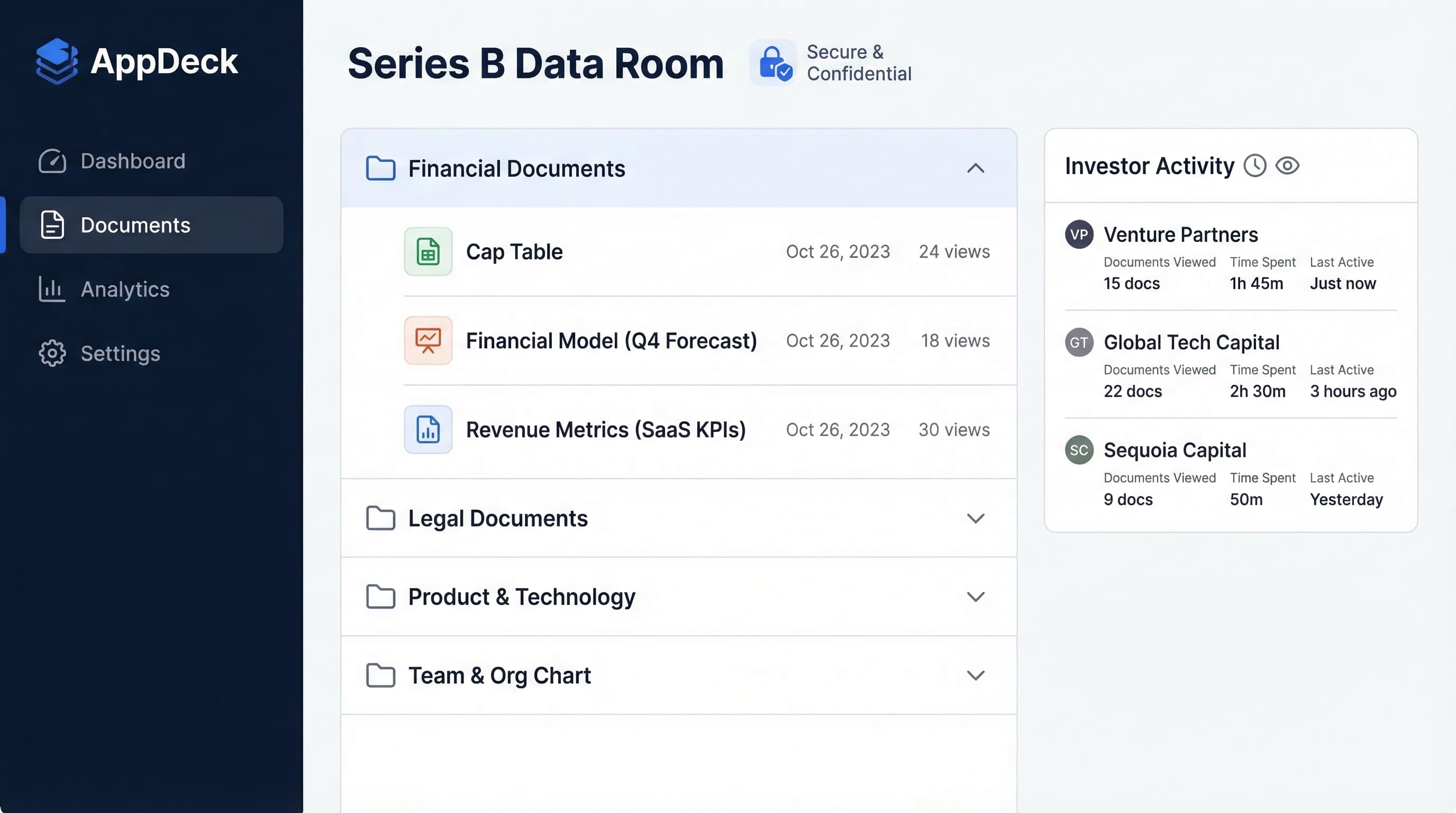
- AppDeck Investor Data Room — Secure document sharing for institutional investors, due diligence processes, and confidential communications
- Transfer agent platform — Share registry, dividend processing, ownership data
- Earnings call platform — Webcasting, Q&A management, replay hosting
- IR website — Public-facing investor information for prospective investors
- CRM — Relationship tracking for institutional investors
What to Look for in a Shareholder Portal
Must-have capabilities:
- ✅ SEC filing integration (automatic publication from EDGAR)
- ✅ Document management with version control
- ✅ Proxy voting integration (electronic voting)
- ✅ Dividend information center (schedules, history, DRIP, tax docs)
- ✅ Engagement analytics (who's reading what?)
- ✅ Shareholder segmentation and targeted communications
- ✅ Secure messaging between shareholders and IR team
- ✅ Mobile-responsive design
- ✅ Custom branding (your company's brand, not the vendor's)
- ✅ Compliance audit trail
Nice-to-have capabilities: Virtual meeting hosting, shareholder surveys, ESG reporting integration, multi-language support, transfer agent API integration, AI-powered FAQ, and sentiment analysis.
Selection criteria: Operational in days (not months), intuitive for retail shareholders, predictable pricing, SOC 2 Type II security, and responsive vendor support with IR domain expertise.
Frequently Asked Questions
What counts as shareholder communications?
Shareholder communications cover every formal channel a company uses to inform its equity holders: SEC filings (10-K, 10-Q, 8-K), annual reports, proxy materials, dividend announcements, earnings releases and calls, shareholder letters, investor presentations, AGM/EGM notices, and ongoing IR website disclosures. For private companies, the scope is similar but unregulated by SEC rules: cap table updates, quarterly investor letters, KPI reporting, and notices for shareholder consents or board changes. Regulated communications fall under Regulation FD, proxy rules, and exchange listing standards — informal communications must still avoid material non-public information disclosures.
Is a shareholder portal different from a board portal or investor data room?
Yes — three distinct tools with overlapping technology. A board portal serves directors and contains confidential governance materials (board books, executive sessions, compensation). An investor data room serves prospective investors during fundraising and contains pre-launch diligence materials (financial models, pitch decks, customer references). A shareholder portal serves existing equity holders with ongoing disclosures (SEC filings, proxy voting, dividends, AGM materials). Some platforms span all three, but the audiences, content lifecycles, and access models are fundamentally different. Don't try to repurpose one for another.
How often should companies communicate with shareholders?
Public companies have mandatory cadence: quarterly earnings, annual proxy and report, 8-K for material events. Best-in-class IR teams supplement this with monthly investor updates, sector commentary, and proactive announcements at strategic milestones. Private companies should send a quarterly shareholder letter at minimum, with monthly updates during active fundraising or major operational changes. The pattern: predictable cadence builds trust, while sporadic communication signals problems. Shareholders read silence as bad news.
Which shareholder communications channels work best for retail vs. institutional shareholders?
Institutional shareholders consume earnings calls, SEC filings, IR website content, and direct IR team relationships — they want depth and access to management. Retail shareholders prefer mobile-friendly digests, plain-language annual reports, electronic proxy voting, and self-service FAQ. The mistake is using one channel for both. A shareholder portal that segments content by audience (institutional research vs. retail-friendly summaries) drives meaningfully higher engagement on both sides. Electronic proxy voting alone typically lifts retail participation by 35-45% over paper-based voting.
When does manual shareholder communication stop scaling?
Manual processes break around 500-1,000 shareholders, or whenever cap table complexity exceeds what a spreadsheet can track without errors. Symptoms include: dividend payments going to wrong addresses, proxy votes lost or miscounted, regulatory filing deadlines missed, and IR team time consumed by routine "where is X document?" emails. Public companies hit this threshold immediately upon IPO. Late-stage private companies hit it once they cross 100+ employees with options or have a secondary tender event. At that point, a purpose-built shareholder portal pays back within one filing cycle.
Conclusion
Shareholder communications are more than a compliance obligation — they're a strategic asset that builds trust, drives governance participation, and supports long-term shareholder value. The IR teams that communicate proactively, transparently, and through modern channels consistently outperform those that treat communications as a checkbox exercise.
Key takeaways:
- Centralize communications in a shareholder portal — Give shareholders a single destination for everything they need, from SEC filings to dividend information to proxy voting
- Digitize proxy voting — Electronic voting increases retail participation by 35-45% and cuts processing costs by 60-70%
- Make annual reports accessible — Digital-first, mobile-friendly, plain-language design ensures shareholders actually read them
- Communicate dividends proactively — Anticipate shareholder questions with comprehensive, always-available dividend information
- Segment your communications — Institutional and retail shareholders have different needs; serve both well
- Track engagement — You can't improve what you don't measure; know which shareholders engage with which content
- Build compliance into workflows — Regulation FD, proxy rules, and filing deadlines should be systematically managed, not manually tracked
- Embrace virtual meetings — Broader participation, lower costs, better record-keeping
- Maintain a comprehensive FAQ — Handle 60-70% of routine inquiries without IR team involvement
- Invest in technology — A modern shareholder portal reduces IR workload by 50%+ while improving the shareholder experience
Where to start: If you're still relying primarily on mail and email, start with practices #1 (launch a shareholder portal) and #2 (digitize proxy voting). These two changes deliver the highest immediate impact on both efficiency and shareholder engagement.
If you're ready to modernize your shareholder communications, AppDeck Shareholder Portal provides a centralized platform for SEC filings, proxy voting, dividend communications, and shareholder self-service — with setup in under an hour and an interface that both institutional and retail shareholders will actually use.
Related reading:

Founder & CEO, AppDeck
Serial entrepreneur with 20+ years building B2B software companies. Former executive managing 2,800+ employees across three continents. Vik reviews all AppDeck content for accuracy and practical relevance.
Share this article
Explore Related Solutions
Related Articles
Annual Shareholder Meeting Guide: Planning, Agenda & Best Practices
Complete guide to planning and running annual shareholder meetings (AGMs). Includes timelines, agenda templates, proxy voting, virtual meeting setup, and compliance requirements.
10 AI Fundraising Tools That Actually Help Startups Raise Capital
The best AI tools for startup fundraising in 2026. Investor matching, pitch deck builders, CRM automation, due diligence prep, and outreach tools.
Board Meeting Best Practices: 25 Tips for More Effective Board Meetings
Proven board meeting best practices and protocol from 100+ board meetings. Pre-meeting preparation, agenda design, formal procedures, engagement strategies, and follow-up.