
10 AI Fundraising Tools That Actually Help Startups Raise Capital
The best AI tools for startup fundraising in 2026. Investor matching, pitch deck builders, CRM automation, due diligence prep, and outreach tools.
TL;DR: The best AI tools for startup fundraising in 2026. Investor matching, pitch deck builders, CRM automation, due diligence prep, and outreach tools.
Introduction
Let me be direct: AI will not raise your round for you. No tool is going to replace the trust you build over a coffee meeting, the conviction you show when an investor pushes back on your TAM, or the judgment you need to pick the right partner for your cap table.
But fundraising involves a staggering amount of manual work that has nothing to do with those moments. Researching which investors actually write checks in your space. Personalizing 200 outreach emails so they don't read like spam. Formatting your pitch deck at 2am. Organizing 47 documents in an investor data room. Following up with investors who went quiet after a "great meeting."
That is where AI fundraising tools earn their keep. Used well, they can cut 40-50% of the grunt work out of a fundraising process, freeing you to focus on the parts that actually close deals: storytelling, relationship building, and negotiation.
I have raised capital multiple times and helped portfolio companies through their raises. This is my honest assessment of the AI tools that are actually worth your time in 2026, what they do well, where they fall short, and how to assemble them into a stack that works.
Where AI Actually Helps in Fundraising
Before diving into specific tools, it is worth understanding the five areas where AI delivers real value in a fundraising process.
1. Investor Discovery and Matching
The old way: manually scrolling through Crunchbase, asking your network for intros, guessing which firms invest in your stage and sector. AI tools can now scan thousands of investor profiles, match them against your company attributes, and surface warm connection paths. This alone can save weeks of research.
2. Outreach Personalization
Generic "Dear Investor" emails get deleted. AI can pull an investor's recent portfolio moves, blog posts, and tweet history to generate personalized opening lines that demonstrate you actually did your homework. The difference in response rates between a templated email and a well-personalized one is dramatic -- often 3-5x.
3. Pitch Deck Creation
AI will not write your strategy for you, but it can handle the formatting, layout, and visual polish that eats up founder time. Some tools can also suggest narrative structure based on what resonates with investors in your vertical.
4. Data Room Organization
When due diligence kicks in, you need to share dozens of sensitive documents with controlled access. AI can help categorize documents, suggest what is missing from your data room, and flag inconsistencies across your financials.
5. Follow-Up Automation
After meetings, AI can transcribe conversations, extract action items, draft follow-up emails, and keep your investor pipeline organized. This is especially valuable when you are running 30-40 investor conversations in parallel.
Where AI Falls Short
I want to be honest about the limitations because I see too many founders over-indexing on tools and under-indexing on fundamentals.
Relationship building. Investors back founders, not pitch decks. No AI tool replaces the trust built through genuine human interaction. The best founders I know spend 70% of their fundraising energy on relationships and 30% on process. AI should shift where you spend that 30%, not replace the 70%.
Negotiation. Term sheets involve nuance, leverage, and judgment calls that AI cannot make for you. What is the right valuation to push for? Should you accept that pro-rata right? Is this investor's reputation worth the lower offer? These are human decisions.
Reading the room. When an investor asks "How do you think about competition?" they might be genuinely curious or they might be signaling a concern. AI cannot tell you which. Pattern recognition in live conversations is still a fundamentally human skill.
Investor judgment. Choosing the right investor matters as much as getting the check. Culture fit, board dynamics, follow-on capacity, network value -- these are qualitative assessments that require experience and intuition.
Bottom line: use AI to be more efficient, not to replace the work that actually matters.
10 AI Fundraising Tools Worth Considering
1. Harmonic -- Investor Matching and Signal Tracking
Harmonic has become the go-to tool for founders who want to move beyond guesswork in building their investor target list. It uses AI to map investor-company relationships and surface investors who are most likely to be interested in your specific deal.
Key features:
- AI-powered investor matching based on your company profile, stage, and sector
- Real-time signal tracking (new fund raises, partner moves, recent investments)
- Warm intro path identification through your existing network
- Investor engagement scoring to prioritize outreach
Pricing: Starts around $400/month for startup plans. Enterprise pricing for larger teams.
Best for: Seed and Series A founders who need to build a targeted investor list quickly and find warm introduction paths.
2. Clay -- Enrichment and Personalized Outreach
Clay is not fundraising-specific, but it has become a favorite among founders for automating the research and personalization that makes outreach effective. Think of it as a spreadsheet that automatically enriches every row with data from dozens of sources.
Key features:
- Pulls investor data from LinkedIn, Crunchbase, Twitter, and 50+ other sources
- AI-generated personalized email drafts based on investor activity
- Automated sequencing with follow-up triggers
- Waterfall enrichment (tries multiple data sources until it finds what you need)
Pricing: Free tier available. Paid plans start at $149/month. Credit-based system for enrichment.
Best for: Founders who want to send highly personalized outreach at scale without spending hours on manual research per investor.
3. Tome and Gamma -- AI Pitch Deck Creation
Both Tome and Gamma use AI to help you create visually polished pitch decks without design skills. They are not going to write your strategy, but they dramatically reduce the time spent on layout, formatting, and visual consistency.
Key features:
- Generate deck layouts from text prompts or outlines
- Consistent branding and design across all slides
- AI-suggested content structure based on your industry
- Real-time collaboration and version history
- Export to PDF, PowerPoint, or shareable link
Pricing: Gamma offers a free tier with watermarks. Paid plans from $10/month. Tome starts at $16/month per user.
Best for: First-time founders who do not have a designer and need a professional-looking deck fast. Experienced founders should use these for first drafts, then customize heavily.
4. ChatGPT and Claude -- The Swiss Army Knife
Large language models like ChatGPT and Claude are not fundraising tools per se, but they have become indispensable in the fundraising workflow. I use them daily.
Key features:
- Draft and refine pitch narratives, executive summaries, and investor memos
- Stress-test your pitch by simulating tough investor questions
- Build and validate financial models (Claude and ChatGPT can both write and debug spreadsheet formulas)
- Research market sizing, competitive landscapes, and industry trends
- Draft follow-up emails, thank-you notes, and investor update templates
Pricing: ChatGPT Plus at $20/month. Claude Pro at $20/month. Both have free tiers with usage limits.
Best for: Every founder. Seriously. If you are not using an LLM to pressure-test your pitch narrative and prep for tough questions, you are leaving value on the table.
5. Visible.vc -- Investor Updates and CRM
I will be transparent -- Visible is a competitor in some areas. But they have built a solid product for investor updates and fundraising CRM, and I would be doing you a disservice to leave them off this list.
Key features:
- Templated investor update emails with metric tracking
- Fundraising CRM to track pipeline stages and investor interactions
- KPI dashboards that pull from your data sources
- Investor engagement tracking (opens, clicks)
- Portfolio management features for post-raise
Pricing: Starts at $99/month for the fundraising plan. Higher tiers for portfolio management.
Best for: Founders who want a single tool for investor updates, pipeline tracking, and basic CRM during and after their raise.
6. DocSend -- Deck Analytics and Tracking
DocSend (now part of Dropbox) remains the standard for sharing pitch decks with tracking. It is not AI-powered in any flashy way, but the analytics it provides are genuinely useful for understanding investor interest.
Key features:
- Per-page view analytics showing which slides investors spend time on
- Real-time notifications when investors view your deck
- Link-level permissions and expiration controls
- Email capture before viewing
- Version control so you can update decks without breaking links
Pricing: Personal plan at $10/month. Standard at $45/month per user with full analytics.
Best for: Any founder sharing a pitch deck. The slide-level analytics alone are worth the price -- knowing that investors spend 3 minutes on your market slide and 10 seconds on your team slide tells you exactly what to fix.
7. Affinity -- Relationship Intelligence CRM
Affinity is a CRM built specifically for relationship-driven industries like venture capital and fundraising. Its AI automatically captures interactions from your email and calendar, so you do not have to manually log every touchpoint.
Key features:
- Automatic contact and interaction logging from email and calendar
- Relationship strength scoring based on communication patterns
- Deal flow management with customizable pipelines
- Introduction path mapping through shared connections
- Integration with Gmail and Outlook
Pricing: Starts around $2,000/year per user. Not cheap, but the time saved on manual CRM entry is significant.
Best for: Founders running a structured fundraising process with 50+ investor conversations. Overkill for a small seed round; essential for a Series A or later.
8. PitchBook -- Market Data and Investor Research
PitchBook is the gold standard for venture capital data. It is expensive, but if you can access it (many accelerators and universities have subscriptions), it provides market intelligence that is hard to get elsewhere.
Key features:
- Comprehensive investor profiles with fund size, stage preference, and recent deals
- Comparable company valuations and deal terms
- Industry reports and market sizing data
- Custom search filters for investor targeting
- Deal flow and exit data for benchmarking
Pricing: Enterprise pricing, typically $20,000+/year. Check if your accelerator, university, or co-working space has access.
Best for: Founders who need detailed market data to support their pitch, or who want comprehensive investor research for a Series A+ round. Look for institutional access before paying retail.
9. Otter.ai -- Meeting Transcription and Follow-Up Notes
After every investor meeting, you should be capturing what was discussed, what concerns were raised, and what follow-ups were promised. Otter.ai automates this so you can be fully present in the conversation instead of frantically taking notes.
Key features:
- Real-time meeting transcription with speaker identification
- AI-generated meeting summaries and action items
- Searchable transcript archive across all meetings
- Integration with Zoom, Google Meet, and Microsoft Teams
- Highlight and share key moments from conversations
Pricing: Free tier with 300 minutes/month. Pro at $16.99/month with 1,200 minutes. Business at $30/month per user.
Best for: Founders running a high-volume fundraising process. When you are taking 5-8 investor meetings a week, having searchable transcripts of every conversation is invaluable for tracking concerns and tailoring follow-ups.
10. AppDeck -- Investor Data Room with Analytics
Full disclosure: this is our product. I am including it because it solves a specific problem in the fundraising stack that the AI tools above do not address -- secure document sharing with granular view analytics.
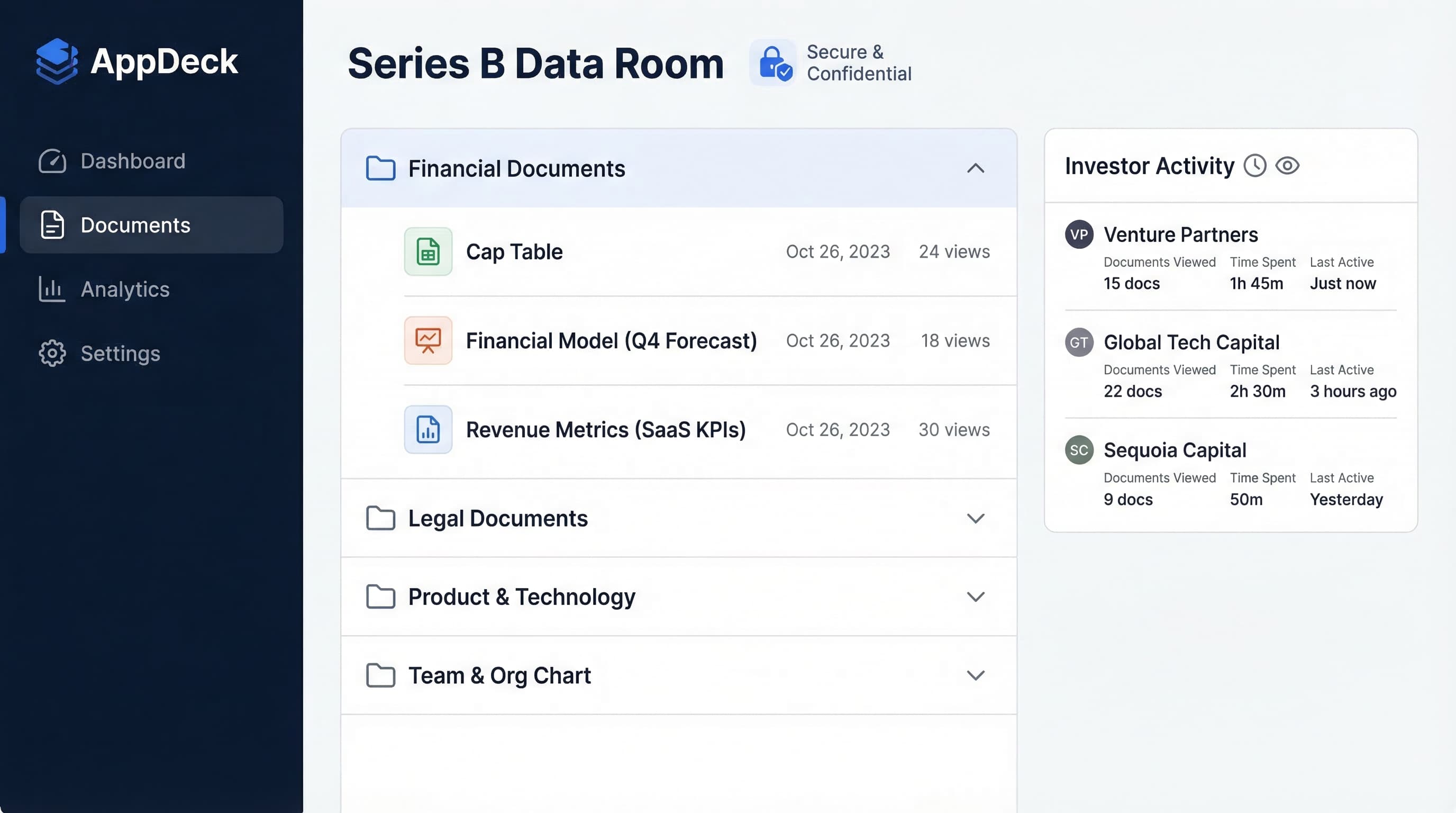
AppDeck is not an AI tool. It is a portal platform for investor data rooms that gives you a branded, secure space to share due diligence documents with investors. What makes it relevant to this list is the analytics layer: you can see exactly which investors viewed which documents, how long they spent on each file, and when they last accessed the data room.
Key features:
- Branded investor data room with your company's logo and domain
- Granular document-level view analytics (who viewed what, when, for how long)
- Role-based access controls so different investors see different document sets
- Secure sharing with watermarking and download controls
- Clean, professional interface that reflects well on your company
Pricing: Starts at $49/month. No per-user fees for investors accessing the data room.
Best for: Founders entering due diligence who need a professional data room that tracks investor engagement. The view analytics are particularly useful -- if an investor has spent two hours in your data room this week, that is a strong buying signal worth acting on.
How to Build an AI-Powered Fundraising Stack
Not every founder needs every tool. Here is what I recommend based on stage.
Pre-Seed and Seed (Minimal Stack)
At this stage, you are raising from angels and early-stage funds. Keep it lean.
- ChatGPT or Claude (free-$20/month) -- pitch narrative, Q&A prep, financial modeling
- Gamma (free-$10/month) -- pitch deck creation and formatting
- DocSend ($10/month) -- deck sharing with analytics
- Otter.ai (free) -- meeting transcription
- Google Drive or Notion (free) -- basic data room (you likely do not need a dedicated data room tool yet)
Total cost: $0-40/month
Series A (Full Stack)
At Series A, you are running a structured process with dozens of investor conversations and formal due diligence. Invest in the tools.
- ChatGPT or Claude ($20/month) -- narrative, Q&A prep, market research
- Harmonic ($400/month) -- investor matching and targeting
- Clay ($149/month) -- outreach personalization
- Affinity ($170/month) -- relationship CRM
- DocSend ($45/month) -- deck analytics
- Otter.ai ($17/month) -- meeting transcription
- AppDeck ($49/month) -- investor data room with view analytics
Total cost: ~$850/month
That is real money, but if these tools save you even two weeks in your fundraising process, the math works out overwhelmingly in your favor. Two extra weeks of runway at Series A burn rates is worth far more than $850.
Series B+ (Enterprise Stack)
Add PitchBook for market intelligence, upgrade to enterprise tiers on your CRM and data room tools, and consider Visible.vc for structured investor reporting post-close.
Frequently Asked Questions
Can AI tools actually replace a human fundraising team?
No. AI tools handle the mechanical work of fundraising -- investor research, outreach personalization, deck formatting, meeting transcription, and data room analytics -- but they cannot build trust, negotiate term sheets, or read the room during a partner meeting. The founders who raise successfully in 2026 use AI to free up time for the human work that actually closes deals: storytelling, relationship building, and conviction. Plan to spend 70% of your fundraising energy on relationships and 30% on process; AI should shift where the 30% goes, not replace the 70%.
Is Harmonic worth $400/month over manually using Crunchbase?
For most seed and Series A founders running a structured process, yes. Harmonic's investor matching pulls signal data Crunchbase does not surface -- recent partner moves, fund close dates, portfolio overlap, and warm intro paths through your network. If you are targeting 100+ investors and Crunchbase research is eating 10+ hours per week, Harmonic pays for itself in two weeks. If you are raising a small angel round with 20 conversations, Crunchbase plus LinkedIn is fine.
How much should an early-stage founder budget for fundraising tools?
A pre-seed or seed founder can run a complete fundraising process for $0 to $40 per month using free tiers of ChatGPT, Gamma, Otter.ai, and Google Drive plus a $10 DocSend subscription. At Series A, expect to spend $800 to $900 per month across Harmonic, Clay, Affinity, DocSend, an LLM, transcription, and a data room. The math works if these tools save you even two weeks of fundraising time, since two weeks of Series A burn is typically worth far more than the annualized tool cost.
Which founders should skip AI fundraising tools entirely?
Founders raising a small friends-and-family or angel round of under $500K from people they already know rarely need a dedicated stack. If your investor list is under 15 names, you have warm intros to all of them, and your pitch deck already exists, you can run the process in Gmail and a Google Doc. AI tools shine when you are managing 30 to 100+ parallel investor conversations across discovery, partner meetings, and diligence -- which usually starts at institutional seed.
When should I upgrade from Google Drive to a dedicated investor data room?
The moment a serious investor asks for diligence access. A messy Google Drive folder signals to a partner that you have not run this process before, and Drive cannot tell you which investors viewed which files. A dedicated data room with per-document analytics shows you who is leaning in -- an investor who spends two hours in your data room this week is sending a strong buying signal worth a same-day follow-up. The trigger is not stage; it is the first investor who says "send over the data room."
Conclusion
The AI fundraising landscape is evolving quickly, and the tools available today are genuinely useful -- not in the "AI will replace VCs" sense, but in the practical "I just saved 15 hours this week on investor research and outreach" sense.
My advice: start with the free tools (ChatGPT/Claude, Gamma free tier, Otter.ai free tier), add paid tools only when you hit the limits of what free can do, and never let tools substitute for the human work that actually closes deals.
The founders who raise successfully in 2026 will not be the ones with the fanciest tech stack. They will be the ones who use AI to handle the process so they can focus on the pitch, the relationships, and the conviction that makes investors say yes.
Related Reading

Founder & CEO, AppDeck
Serial entrepreneur with 20+ years building B2B software companies. Former executive managing 2,800+ employees across three continents. Vik reviews all AppDeck content for accuracy and practical relevance.
Share this article
Explore Related Solutions
Related Articles
Fundraising for Startups: The Complete Guide to Raising Capital in 2026
Everything founders need to know about startup fundraising. Funding stages from pre-seed to Series C, how to build a data room, create a pitch deck, find investors, and close rounds.
Annual Shareholder Meeting Guide: Planning, Agenda & Best Practices
Complete guide to planning and running annual shareholder meetings (AGMs). Includes timelines, agenda templates, proxy voting, virtual meeting setup, and compliance requirements.
Due Diligence Checklist: Complete Guide for M&A, Fundraising & Investors
The definitive due diligence checklist for fundraising, M&A, and investor review. 100+ items organized by category with templates and data room setup tips.