
Board Meeting Agenda Template: 7 Free Templates for Every Board Type
Download free board meeting agenda templates for corporate boards, nonprofits, startups, and advisory boards. Includes time allocations, best practices, and examples.
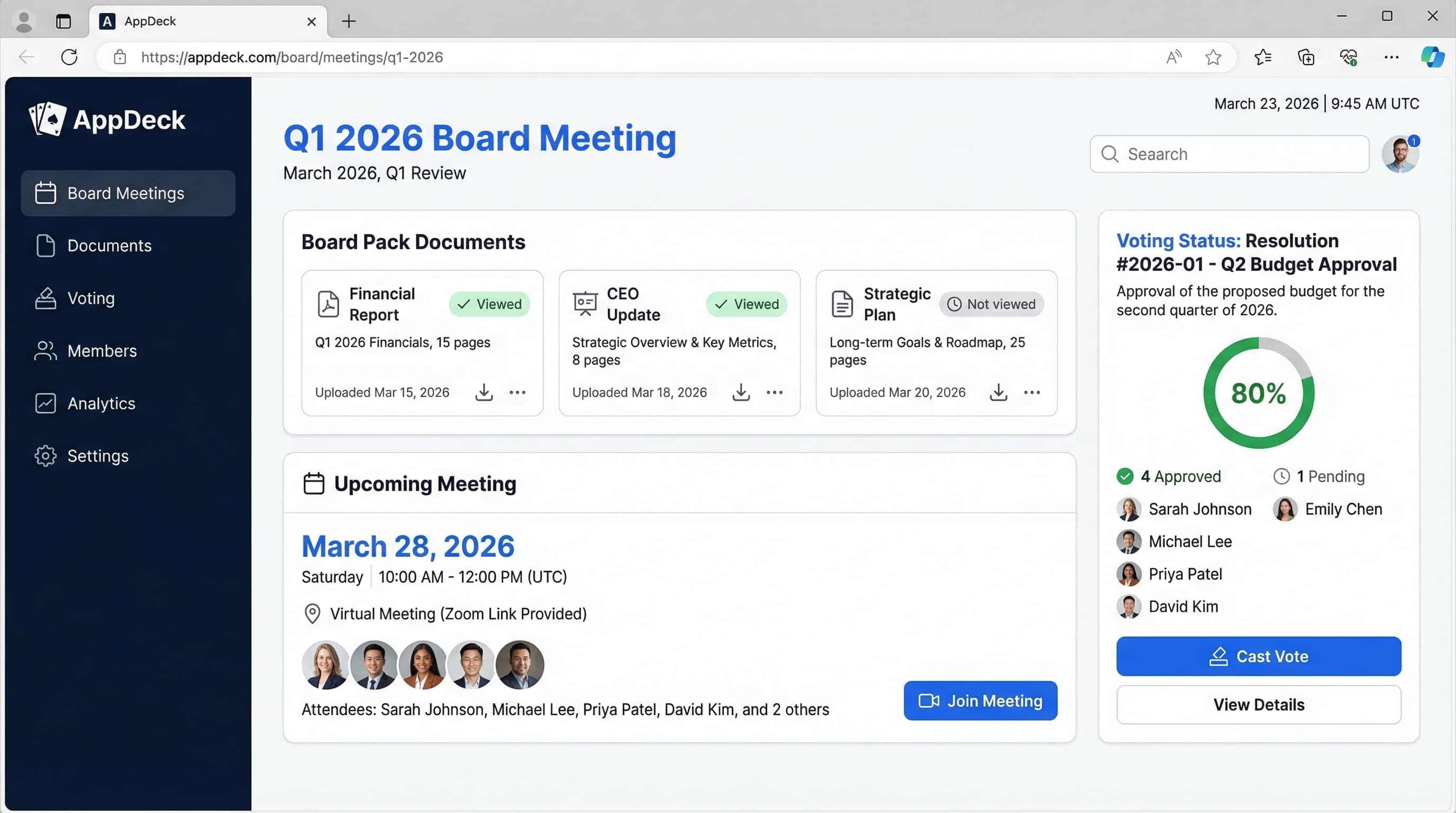
Download the template: Get the agenda as a free Word doc — Board Meeting Agenda Template (.docx) — pre-formatted with timing, owners, decision flags, and a consent agenda block. No paywall.
Introduction
A great board meeting starts with a great agenda. Without one, meetings drift, critical topics get rushed at the end, and directors leave feeling like their time was wasted. With one, every minute has a purpose, every participant knows what to expect, and decisions get made efficiently.
After 19+ years advising boards on governance best practices, the single most impactful change I recommend to any organization is a structured, well-distributed agenda. It costs nothing, takes 30 minutes to create, and transforms the quality of board meetings overnight.
In this guide, I'm sharing 7 board meeting agenda templates covering every board type—corporate, nonprofit, startup, advisory, annual, emergency, and consent agenda formats. Each template includes realistic time allocations, presenter assignments, and notes on how to adapt it to your organization.
Whether you're a board secretary preparing your first meeting or a seasoned corporate governance professional looking for a better framework, these templates will save you hours and improve every meeting going forward.
Why Your Board Meeting Needs a Structured Agenda
If you're still running board meetings from a loose list of topics scribbled the night before, you're leaving governance quality on the table. Here's why a structured agenda matters:
Keeps Meetings on Track and on Time
Without time allocations, discussions expand to fill whatever time is available. A 20-minute financial review becomes a 45-minute deep dive into line items that belong in a committee meeting. A structured agenda with time blocks gives the chair permission to move things along.
Ensures All Critical Topics Are Covered
Every board meeting should address certain standing items—financial health, strategic progress, compliance updates. Without a structured template, these items get bumped when "urgent" topics eat up the clock. A template guarantees nothing important gets missed.
Gives Directors Time to Prepare
When directors receive a detailed agenda 5-7 days before the meeting, they know exactly what decisions are coming, what materials to review, and what questions to prepare. Unprepared directors lead to poor decisions or deferred votes.
Creates Accountability for Follow-Up
A good agenda includes action item review from the previous meeting. This creates a built-in accountability loop—nothing falls through the cracks because every meeting starts with "what did we commit to last time?"
Required for Good Governance
For public companies, the agenda becomes part of the corporate record. For nonprofits, regulators and auditors expect evidence of structured governance. Even for private companies, a professional agenda signals to investors and board members that governance is taken seriously.
The Data Backs It Up
Research from the National Association of Corporate Directors (NACD) shows that boards with structured agendas run meetings that are 30% shorter with higher director satisfaction scores and better follow-through on action items. The ROI on a well-built agenda is enormous.
Standard Board Meeting Agenda Structure
Before diving into specific templates, let's walk through the universal components that appear in most board meeting agendas. Think of this as the foundation—each template below adapts these components to a specific context.
1. Call to Order (2 minutes)
The chair formally opens the meeting, states the date and time, and confirms the meeting was properly noticed.
What to include:
- Statement that meeting is called to order
- Date, time, and location (or virtual platform)
- Confirmation that proper notice was given
2. Roll Call and Quorum Confirmation (3 minutes)
The secretary records attendance and confirms a quorum is present. No official business can be conducted without a quorum.
What to include:
- Names of directors present
- Names of directors absent (excused or unexcused)
- Names of guests or observers
- Formal quorum declaration
3. Approval of Previous Minutes (5 minutes)
Directors review and approve the minutes from the last meeting. This is typically a quick consent item unless corrections are needed.
What to include:
- Motion to approve minutes
- Call for corrections or amendments
- Vote to approve (with any corrections noted)
4. CEO / Executive Report (15 minutes)
The CEO provides a high-level update on company performance, key wins, challenges, and strategic priorities since the last meeting.
What to include:
- Key business highlights and milestones
- Progress against strategic plan
- Significant challenges or risks
- Market and competitive landscape updates
- Key hires or organizational changes
5. Financial Report (15 minutes)
The CFO presents financial performance, comparing actuals to budget and prior periods. This should focus on trends and implications, not line-by-line review.
What to include:
- Revenue and expense summary vs. budget
- Cash position and runway (for startups)
- Key financial ratios and metrics
- Forecast updates
- Capital expenditure or fundraising updates
6. Committee Reports (20 minutes)
Each standing committee (audit, compensation, governance, etc.) reports on recent activity and brings items requiring full board action.
What to include:
- Summary of committee meetings since last board meeting
- Recommendations requiring board approval
- Upcoming committee work or concerns
7. Old Business / Action Item Review (10 minutes)
Review outstanding action items from previous meetings. Each item should have an owner, a deadline, and a status update.
What to include:
- Status update on each open action item
- Identify completed items (close them out)
- Escalate blocked or overdue items
- Reassign if needed
8. New Business (20 minutes)
This is where strategic discussions, new proposals, and decisions happen. Prioritize items that require board input or approval.
What to include:
- Strategic discussion topics
- Proposals requiring board vote
- New initiatives or partnerships
- Policy changes or approvals
9. Executive Session (if needed, 15 minutes)
A closed session without management present. Used for CEO evaluation, compensation discussions, sensitive legal matters, or board-only strategic discussions.
What to include:
- Management and guests excused
- Topics discussed (high-level, for the record)
- Any decisions or actions resulting from the session
10. Next Meeting Date (2 minutes)
Confirm the date, time, and format (in-person or virtual) for the next board meeting. Address any scheduling conflicts.
11. Adjournment
The chair formally closes the meeting. The secretary records the adjournment time.
Total estimated time: approximately 2 hours
7 Board Meeting Agenda Templates
Template 1: Standard Corporate Board Meeting Agenda
Best for: Private and public companies with established boards of 5-15 directors Duration: 2 hours Format: Formal, with motions and votes
[COMPANY NAME] BOARD OF DIRECTORS MEETING Date: [Date] Time: [Start Time] - [End Time] Location: [Address / Virtual Meeting Link]
| Time | Item | Presenter | Type |
|---|---|---|---|
| 0:00 - 0:02 | Call to Order | Board Chair | Procedural |
| Welcome and opening remarks | |||
| Confirmation of proper notice | |||
| 0:02 - 0:05 | Roll Call & Quorum Confirmation | Corporate Secretary | Procedural |
| Record attendance, confirm quorum | |||
| Note guests and observers present | |||
| 0:05 - 0:10 | Approval of Previous Meeting Minutes | Board Chair | Action |
| Review minutes from [date] meeting | |||
| Motion to approve (with corrections if any) | |||
| 0:10 - 0:15 | Consent Agenda | Board Chair | Action |
| Routine committee reports | |||
| Policy renewals | |||
| Minor approvals (below threshold) | |||
| 0:15 - 0:30 | CEO Report | CEO | Information |
| Business highlights and milestones | |||
| Strategic plan progress update | |||
| Key challenges and risks | |||
| Market and competitive update | |||
| 0:30 - 0:45 | CFO Financial Report | CFO | Information |
| Revenue and expense vs. budget | |||
| Cash position and forecast | |||
| Key financial metrics and ratios | |||
| Capital expenditure update | |||
| 0:45 - 1:05 | Committee Reports | Committee Chairs | Information / Action |
| Audit Committee (10 min) | |||
| Compensation Committee (5 min) | |||
| Governance/Nominating Committee (5 min) | |||
| 1:05 - 1:15 | Action Item Review | Corporate Secretary | Discussion |
| Status update on open items from prior meetings | |||
| Close completed items | |||
| Escalate overdue items | |||
| 1:15 - 1:35 | New Business / Strategic Discussion | Various | Discussion / Action |
| [Strategic Topic 1] (10 min) | |||
| [Strategic Topic 2] (10 min) | |||
| 1:35 - 1:50 | Executive Session (if needed) | Board Chair | Discussion |
| Management excused | |||
| [Confidential topic] | |||
| 1:50 - 1:55 | Action Item Summary & Next Steps | Corporate Secretary | Information |
| Recap new action items and owners | |||
| Confirm deadlines | |||
| 1:55 - 2:00 | Next Meeting & Adjournment | Board Chair | Procedural |
| Confirm next meeting: [date, time, location] | |||
| Motion to adjourn |
Pre-read Materials (distribute 5-7 days before meeting):
- Previous meeting minutes
- CEO written report
- Financial statements and dashboard
- Committee reports
- Strategic discussion background materials
- Any resolutions requiring a vote
Template 2: Nonprofit Board Meeting Agenda
Best for: Nonprofit organizations with volunteer boards of 7-20 directors Duration: 90 minutes Format: Semi-formal, mission-focused
[ORGANIZATION NAME] BOARD OF DIRECTORS MEETING Date: [Date] Time: [Start Time] - [End Time] Location: [Address / Virtual Meeting Link]
| Time | Item | Presenter | Type |
|---|---|---|---|
| 0:00 - 0:05 | Call to Order & Mission Moment | Board Chair | Procedural |
| Welcome and opening remarks | |||
| Mission moment: [brief story of impact] | |||
| Quorum confirmation | |||
| 0:05 - 0:10 | Approval of Previous Minutes | Secretary | Action |
| Review and approve minutes from [date] | |||
| 0:10 - 0:15 | Consent Agenda | Board Chair | Action |
| Routine committee reports | |||
| Policy renewals | |||
| Accept meeting calendar for next quarter | |||
| 0:15 - 0:30 | Executive Director Report | Executive Director | Information |
| Program highlights and outcomes | |||
| Staffing and organizational updates | |||
| Key partnerships and community engagement | |||
| Upcoming events and initiatives | |||
| 0:30 - 0:40 | Financial Report | Treasurer / Finance Dir. | Information |
| Income and expense vs. budget | |||
| Cash reserves and restricted funds | |||
| Grant status and upcoming deadlines | |||
| 0:40 - 0:50 | Fundraising Update | Development Chair | Information / Action |
| Campaign progress vs. goals | |||
| Major donor pipeline | |||
| Upcoming fundraising events | |||
| Board giving participation rate | |||
| 0:50 - 1:00 | Program Report | Program Director | Information |
| Key program metrics and outcomes | |||
| Client/beneficiary stories | |||
| Program expansion or changes | |||
| 1:00 - 1:10 | Grant Approvals & Compliance | Executive Director | Action |
| New grant applications for approval | |||
| Grant reporting requirements | |||
| Compliance updates | |||
| 1:10 - 1:20 | Strategic Discussion | Board Chair | Discussion |
| [Key strategic topic for the quarter] | |||
| Board input and direction | |||
| 1:20 - 1:25 | Volunteer & Board Recognition | Board Chair | Information |
| Recognize outstanding volunteer contributions | |||
| Board member milestones | |||
| 1:25 - 1:30 | Action Items, Next Meeting & Adjournment | Secretary | Procedural |
| Recap action items and owners | |||
| Next meeting: [date, time, location] | |||
| Adjourn |
Pre-read Materials:
- Previous meeting minutes
- Executive Director written report
- Financial statements with budget comparison
- Program metrics dashboard
- Grant applications for review
- Fundraising campaign update
Nonprofit-specific notes:
- Start with a "mission moment" to remind the board why they serve
- Track board giving participation (100% board giving is a fundraising best practice)
- Include program outcomes, not just financials
- Recognize volunteer contributions to maintain engagement
Template 3: Startup Board Meeting Agenda
Best for: Venture-backed startups (Seed through Series C) with small, active boards of 3-7 directors Duration: 60 minutes Format: Informal, metrics-driven, forward-looking
[COMPANY NAME] BOARD MEETING Date: [Date] Time: [Start Time] - [End Time] Location: [Address / Video Call Link]
| Time | Item | Presenter | Type |
|---|---|---|---|
| 0:00 - 0:02 | Opening | CEO | Procedural |
| Welcome, confirm attendees | |||
| Approve prior meeting minutes | |||
| 0:02 - 0:15 | Key Metrics Review | CEO / CRO | Information |
| MRR / ARR and growth rate | |||
| Net revenue retention | |||
| New customers / logos | |||
| Churn rate and analysis | |||
| Sales pipeline and conversion rates | |||
| 0:15 - 0:22 | Financial Overview | CFO / CEO | Information |
| Burn rate (monthly) | |||
| Runway (months remaining) | |||
| Actual vs. plan variance | |||
| Cash position | |||
| 0:22 - 0:30 | Product Update | CTO / CPO | Information |
| Key releases since last meeting | |||
| Product roadmap highlights | |||
| Technical debt or infrastructure updates | |||
| Customer feedback themes | |||
| 0:30 - 0:35 | Team & Hiring | CEO | Information |
| Headcount: current vs. plan | |||
| Key hires made | |||
| Open roles and recruiting pipeline | |||
| Option grant approvals (if any) | Action | ||
| 0:35 - 0:40 | Fundraising / Capital | CEO | Information |
| Fundraising status or timeline | |||
| Investor conversations update | |||
| Bridge or extension considerations | |||
| 0:40 - 0:55 | Strategic Discussion | CEO / Board | Discussion |
| [Topic 1: e.g., enter new market?] (8 min) | |||
| [Topic 2: e.g., pricing model change?] (7 min) | |||
| 0:55 - 1:00 | Action Items & Wrap-Up | CEO | Procedural |
| Recap decisions and action items | |||
| Asks of the board (intros, advice, etc.) | |||
| Next meeting date |
Pre-read Materials (send 3-5 days before):
- Metrics dashboard (ideally live via AppDeck Board Portal)
- Financial summary (one page)
- Product update memo
- Org chart with open roles
- Strategic discussion context (1-2 pages per topic)
Startup-specific notes:
- Keep it to 60 minutes—startup boards should be efficient
- Lead with metrics, not narrative (board members can read the narrative in advance)
- Spend at least 25% of time on strategic discussion (not just reporting)
- End with specific asks of the board (introductions, domain expertise, hiring help)
- Use a real-time dashboard tool like AppDeck so board members can review metrics before the meeting
Template 4: Advisory Board Meeting Agenda
Best for: Advisory boards providing strategic guidance to executives (no fiduciary duty) Duration: 60 minutes Format: Informal, discussion-heavy, advisor-input focused
[COMPANY NAME] ADVISORY BOARD MEETING Date: [Date] Time: [Start Time] - [End Time] Location: [Address / Video Call Link]
| Time | Item | Presenter | Type |
|---|---|---|---|
| 0:00 - 0:05 | Welcome & Context Setting | CEO / Founder | Information |
| Brief company update (high-level) | |||
| What has changed since last meeting | |||
| What we need from advisors today | |||
| 0:05 - 0:15 | Business Update | CEO | Information |
| Key metrics snapshot (2-3 slides max) | |||
| Major wins and challenges | |||
| Strategic priorities for next quarter | |||
| 0:15 - 0:35 | Strategic Discussion Topic 1 | CEO / Exec | Discussion |
| Context and background (3 min) | |||
| Specific questions for advisors (2 min) | |||
| Advisor discussion and input (15 min) | |||
| 0:35 - 0:50 | Strategic Discussion Topic 2 | CEO / Exec | Discussion |
| Context and background (3 min) | |||
| Specific questions for advisors (2 min) | |||
| Advisor discussion and input (10 min) | |||
| 0:50 - 0:55 | Market & Industry Insights | All Advisors | Discussion |
| What are advisors seeing in the market? | |||
| Trends, threats, or opportunities to flag | |||
| Competitive intelligence | |||
| 0:55 - 1:00 | Action Items & Next Meeting | CEO | Procedural |
| Summarize key takeaways and advice | |||
| Specific follow-ups for advisors | |||
| Next meeting date |
Pre-read Materials (send 3-5 days before):
- One-page company update
- Context documents for each strategic discussion topic
- Specific questions you want advisors to address
Advisory board notes:
- Advisory boards exist to advise, so maximize discussion time (at least 50% of meeting)
- Come with specific, concrete questions—not open-ended "what do you think?"
- Limit reporting to the minimum needed for context
- Rotate strategic topics based on advisor expertise
- Send a follow-up summary within 48 hours
Template 5: Annual Board Meeting Agenda
Best for: The annual meeting required by most corporate bylaws; covers elections, annual reports, and strategic planning Duration: 3 hours Format: Formal, with elections and annual review components
[COMPANY NAME] ANNUAL BOARD OF DIRECTORS MEETING Date: [Date] Time: [Start Time] - [End Time] Location: [Address]
| Time | Item | Presenter | Type |
|---|---|---|---|
| 0:00 - 0:05 | Call to Order | Board Chair | Procedural |
| Welcome and opening remarks | |||
| Confirm proper notice for annual meeting | |||
| Roll call and quorum confirmation | |||
| 0:05 - 0:10 | Approval of Previous Meeting Minutes | Secretary | Action |
| Approve minutes from last regular meeting | |||
| Approve minutes from last annual meeting | |||
| 0:10 - 0:35 | Annual Report: Year in Review | CEO | Information |
| Key accomplishments and milestones | |||
| Performance vs. annual goals | |||
| Market position and competitive landscape | |||
| Customer and revenue growth | |||
| Major challenges and lessons learned | |||
| 0:35 - 0:55 | Annual Financial Report | CFO | Information |
| Annual financial statements | |||
| Revenue, profitability, and cash flow | |||
| Year-over-year comparisons | |||
| Key financial metrics and trends | |||
| Capital structure and debt | |||
| 0:55 - 1:10 | Auditor Report (if applicable) | External Auditor / Audit Chair | Information |
| Audit findings and opinion | |||
| Material weaknesses or concerns | |||
| Appointment of auditor for coming year | Action | ||
| 1:10 - 1:20 | Break | ||
| 1:20 - 1:40 | Election of Officers and Directors | Governance Chair | Action |
| Nominating committee report | |||
| Slate of director nominees | |||
| Vote on director elections | |||
| Election of officers (Chair, Secretary, Treasurer) | |||
| 1:40 - 1:55 | Compensation Review | Compensation Chair | Action |
| Executive compensation summary | |||
| Proposed changes for coming year | |||
| Equity plan updates or approvals | |||
| Board compensation (if applicable) | |||
| 1:55 - 2:25 | Strategic Plan Review | CEO / Board | Discussion |
| Review of current strategic plan progress | |||
| Proposed strategic priorities for coming year | |||
| Market opportunities and threats | |||
| Board discussion and input | |||
| Approve strategic plan (if ready) | Action | ||
| 2:25 - 2:40 | Committee Structure & Assignments | Board Chair | Action |
| Review committee charters | |||
| Appoint committee members for coming year | |||
| Committee goals and priorities | |||
| 2:40 - 2:50 | Board Governance & Self-Evaluation | Governance Chair | Discussion |
| Board effectiveness survey results | |||
| Areas for improvement | |||
| Board composition and diversity review | |||
| Director development and education | |||
| 2:50 - 2:55 | Action Item Summary | Secretary | Information |
| Recap all decisions and votes | |||
| Assign action items with deadlines | |||
| 2:55 - 3:00 | Next Meeting & Adjournment | Board Chair | Procedural |
| Approve meeting calendar for coming year | |||
| Motion to adjourn |
Pre-read Materials (distribute 7-10 days before):
- Annual report (comprehensive written report)
- Audited financial statements
- Nominating committee report with director bios
- Compensation committee recommendations
- Strategic plan draft or update
- Board self-evaluation survey results
- Committee charters for review
- Proposed meeting calendar for coming year
Template 6: Emergency / Special Board Meeting Agenda
Best for: Urgent situations requiring board action outside the regular meeting cycle (M&A, crisis, litigation, leadership changes) Duration: 30 minutes Format: Highly focused, single-topic, action-oriented
[COMPANY NAME] SPECIAL MEETING OF THE BOARD OF DIRECTORS Date: [Date] Time: [Start Time] - [End Time] Location: [Secure Video Call Link]
PURPOSE: [One-sentence statement of the reason for this special meeting]
| Time | Item | Presenter | Type |
|---|---|---|---|
| 0:00 - 0:02 | Call to Order | Board Chair | Procedural |
| Confirm proper notice was given | |||
| Roll call and quorum confirmation | |||
| State the purpose of the special meeting | |||
| 0:02 - 0:10 | Background & Context | CEO / General Counsel | Information |
| Situation overview | |||
| Timeline of events | |||
| Key facts and data | |||
| Materials reviewed (reference pre-read) | |||
| 0:10 - 0:20 | Discussion | All Directors | Discussion |
| Questions from directors | |||
| Legal counsel input (if applicable) | |||
| Risk assessment | |||
| Options and recommendations | |||
| 0:20 - 0:25 | Resolution & Vote | Board Chair | Action |
| Present proposed resolution | |||
| Motion and second | |||
| Discussion on the motion | |||
| Vote and record result | |||
| 0:25 - 0:30 | Next Steps & Adjournment | Board Chair | Procedural |
| Immediate action items and owners | |||
| Communication plan (internal and external) | |||
| Follow-up meeting if needed | |||
| Adjourn |
Pre-read Materials (distribute as early as possible):
- Situation briefing document (2-3 pages max)
- Relevant legal opinions or analysis
- Financial impact assessment (if applicable)
- Proposed resolution text
- Any supporting documents
Emergency meeting notes:
- Keep it focused—this is not the time for unrelated topics
- Ensure proper notice per bylaws (some allow shorter notice for special meetings)
- Document everything carefully—emergency decisions face more scrutiny
- Have legal counsel present or on standby
- Follow up with a detailed written summary within 24 hours
- Use a secure platform like AppDeck Board Portal for confidential material distribution—never email sensitive documents
Template 7: Consent Agenda Format
Best for: Boards that want to spend less time on routine approvals and more time on strategic discussion Duration: 90 minutes Format: Bulk approval of routine items, followed by focused strategic work
[COMPANY NAME] BOARD OF DIRECTORS MEETING Date: [Date] Time: [Start Time] - [End Time] Location: [Address / Virtual Meeting Link]
| Time | Item | Presenter | Type |
|---|---|---|---|
| 0:00 - 0:03 | Call to Order & Roll Call | Board Chair | Procedural |
| Welcome, quorum confirmation | |||
| 0:03 - 0:08 | Consent Agenda | Board Chair | Action |
| The following items are approved as a block unless a director requests removal for separate discussion: | |||
| a. Minutes from [date] meeting | |||
| b. Audit Committee report | |||
| c. Compensation Committee report | |||
| d. Governance Committee report | |||
| e. Policy renewals: [list policies] | |||
| f. Routine contracts below $[threshold] | |||
| g. Updated meeting calendar | |||
| Motion to approve consent agenda | |||
| 0:08 - 0:10 | Items Removed from Consent Agenda (if any) | Board Chair | Discussion / Action |
| Discuss and vote on any removed items individually | |||
| 0:10 - 0:25 | CEO Strategic Update | CEO | Information |
| Focus on strategic themes (not operational details) | |||
| Progress against top 3 annual priorities | |||
| Key decisions needed from the board | |||
| 0:25 - 0:35 | Financial Highlights | CFO | Information |
| Dashboard review (key metrics only) | |||
| Variance analysis on material items | |||
| Forecast and outlook | |||
| 0:35 - 0:55 | Strategic Discussion Block 1 | CEO / Board | Discussion |
| [Major strategic topic] | |||
| Pre-read summary (2 min) | |||
| Board discussion and input (18 min) | |||
| 0:55 - 1:10 | Strategic Discussion Block 2 | Exec / Board | Discussion |
| [Second strategic topic] | |||
| Pre-read summary (2 min) | |||
| Board discussion and input (13 min) | |||
| 1:10 - 1:20 | Decision Items | Board Chair | Action |
| [Resolution 1: description] — Vote | |||
| [Resolution 2: description] — Vote | |||
| 1:20 - 1:25 | Executive Session (if needed) | Board Chair | Discussion |
| Management excused | |||
| 1:25 - 1:30 | Action Items, Next Meeting & Adjournment | Secretary | Procedural |
| Recap action items and owners | |||
| Next meeting: [date] | |||
| Adjourn |
How the Consent Agenda Works:
- Before the meeting: All consent agenda items and supporting materials are distributed via your board portal 5-7 days in advance
- Directors review: Each director reviews the materials and flags any items they want to discuss
- At the meeting: The chair asks if any director wants to remove an item from the consent agenda for separate discussion
- Single vote: All remaining items are approved with one motion and one vote
- Removed items: Any pulled items are discussed and voted on individually
What belongs on the consent agenda:
- Previous meeting minutes
- Routine committee reports (no action items)
- Policy renewals without changes
- Contracts below a pre-set dollar threshold
- Informational reports
- Ratification of routine actions
What does NOT belong on the consent agenda:
- Anything requiring discussion or debate
- New policies or significant policy changes
- Large financial commitments
- Strategic decisions
- Anything a director has flagged in advance
How to Build an Effective Board Agenda
Creating a great board agenda is a skill. Here's a step-by-step process for building one that maximizes your board's time and impact.
Step 1: Start with Standing Items
Every meeting should have a foundation of recurring items: call to order, minutes approval, financial report, CEO update, and action item review. Build these into a template so you don't have to recreate the structure each time.
Step 2: Prioritize Strategic Over Operational
The board's job is governance and strategy, not operations. For every agenda item, ask: "Does this require board-level input, or can management handle it?" If it's operational, move it to a committee or a written report.
Rule of thumb: At least 30% of meeting time should be dedicated to strategic discussion, not status updates.
Step 3: Allocate Realistic Time Blocks
The single biggest agenda mistake is underestimating time. If you've never discussed a topic in under 20 minutes, don't allocate 10. Build in buffer time for discussions that run long.
Guideline for time allocation:
- Information items: 5-15 minutes (directors should read pre-materials)
- Discussion items: 15-25 minutes
- Action/decision items: 5-15 minutes (if properly prepared)
- Buffer: Add 10-15 minutes to total meeting time
Step 4: Include Pre-Read Requirements
For every agenda item, specify what materials directors should review before the meeting. This shifts the meeting from "presenting information" to "discussing what to do about it."
Example: Instead of the CFO spending 15 minutes walking through financial statements, the pre-read note says: "Review Q2 financial statements (pages 12-18 of board packet). The CFO will focus discussion on the 15% revenue variance and proposed corrective actions."
Step 5: Mark Items as Information, Discussion, or Action
Directors should know at a glance what's expected of them for each agenda item:
- Information (I): Listen, ask clarifying questions, no decision needed
- Discussion (D): Board input and debate wanted, no vote at this meeting
- Action (A): A vote or formal decision is required
This simple labeling system prevents the most common meeting dysfunction: spending 30 minutes discussing an item that was meant to be a 5-minute informational update.
Step 6: Send 5-7 Days Before the Meeting
The agenda and all supporting materials should reach directors at least 5 business days before the meeting. This gives them adequate time to review materials, formulate questions, and arrive prepared.
Best practice: Use a board portal like AppDeck to distribute materials. Directors get notified when new materials are available, you can track who has reviewed what, and all documents are in one secure location with version control.
Step 7: Use a Board Portal for Distribution
Email is not a board distribution tool. Board materials contain confidential financial data, strategic plans, and legal opinions that should never sit in personal email inboxes.
A board portal provides:
- Secure, encrypted document storage
- Version control (no "is this the latest version?" confusion)
- Read tracking (know who's prepared before the meeting)
- Annotations and comments
- Complete audit trail
- Mobile access for on-the-go review
Board Agenda Best Practices
After facilitating and observing hundreds of board meetings, here are the 10 practices that separate great agendas from mediocre ones:
1. Limit the Agenda to What Can Realistically Be Covered
If your 2-hour meeting has 15 agenda items, you're setting yourself up for a rushed, unproductive session. Be honest about how much can be accomplished. It's better to cover 6 topics well than 12 topics poorly.
2. Put Strategic Items First (When Energy is Highest)
Director attention peaks in the first 45 minutes and steadily declines. Front-load your most important strategic discussions when everyone is fresh and engaged. Save routine approvals and informational items for later.
3. Use a Consent Agenda for Routine Approvals
If you're spending 20 minutes approving last month's minutes and hearing routine committee reports, you're wasting your board's time. Bundle routine items into a consent agenda (see Template 7) and approve them in a single vote.
4. Include Time Allocations for Each Item
Every agenda item should have a start time and duration. This gives the chair a framework for keeping the meeting on track and signals to presenters how long they have. Without time allocations, a "quick update" becomes a 30-minute monologue.
5. Identify the Purpose of Each Item (Inform, Discuss, or Decide)
When directors know whether they're expected to listen, debate, or vote, they engage more effectively. A simple (I), (D), or (A) next to each item sets clear expectations.
6. Assign a Presenter for Each Topic
Every agenda item needs an owner. This creates accountability for preparation and ensures someone is responsible for leading the discussion. Avoid "TBD" presenters—if no one owns it, it shouldn't be on the agenda.
7. Share Supporting Materials in Advance via a Board Portal
The meeting should not be the first time directors see financial statements or strategic proposals. Distribute all materials through a secure board portal at least 5 days in advance. This transforms meetings from information presentation to strategic discussion.
8. Leave Buffer Time (10-15 Minutes)
No board meeting in history has run exactly to schedule. Build in 10-15 minutes of buffer across the meeting to accommodate discussions that run long or unexpected topics that arise. This prevents the last items on the agenda from getting rushed or cut.
9. End with Clear Action Items and Next Steps
The last 5 minutes of every board meeting should be a crisp summary of decisions made, action items assigned (with owners and deadlines), and confirmation of the next meeting date. If directors leave without clarity on what happens next, the meeting failed.
10. Distribute via AppDeck Board Portal for Version Control and Tracking
Using a purpose-built board portal like AppDeck ensures every director accesses the same version of materials, provides read receipts so you know who has prepared, and creates a complete audit trail. No more "I didn't get the email" or "I was looking at the old version."
Common Board Agenda Mistakes to Avoid
Even experienced board secretaries fall into these traps. Here's what to watch for:
Mistake 1: Overloading the Agenda
The problem: Cramming 15 items into a 2-hour meeting because everything feels important.
The result: Rushed discussions, deferred votes, directors checking out by hour two, and critical topics getting 5 minutes instead of 20.
The fix: Limit your agenda to 8-10 items maximum for a 2-hour meeting. Move lower-priority items to the next meeting or handle them via written consent between meetings.
Mistake 2: No Time Allocations
The problem: Listing agenda items without any indication of how long each should take.
The result: The CEO's "quick update" takes 40 minutes, committee reports expand to fill the void, and the strategic discussion you planned gets squeezed into 10 minutes at the end.
The fix: Assign specific time blocks to every item. Include start times so the chair can redirect conversations that go over.
Mistake 3: All Operational, No Strategic Topics
The problem: The entire meeting is status updates and routine approvals. No time allocated for strategic discussion.
The result: The board becomes a rubber stamp rather than a strategic asset. Directors disengage because they're not adding value. The company misses out on the collective wisdom of its board.
The fix: Reserve at least 30% of meeting time for strategic discussion. Use the consent agenda to compress routine items. Send operational updates as pre-reads.
Mistake 4: Sending the Agenda Too Late
The problem: Directors receive the agenda and materials 1-2 days before the meeting (or worse, at the meeting itself).
The result: Unprepared directors who ask basic questions that could have been answered by reading the materials. Discussions start from zero instead of building on a shared understanding.
The fix: Distribute the agenda and all materials 5-7 days before the meeting. For annual meetings, aim for 7-10 days. Use a board portal to distribute materials and track who has reviewed them.
Mistake 5: No Consent Agenda for Routine Items
The problem: Spending 20-30 minutes on routine approvals (minutes, committee reports, policy renewals) that no one wants to discuss.
The result: Wasted time that could be spent on strategic topics. Directors disengage during routine items and have trouble re-engaging for important discussions.
The fix: Implement a consent agenda (see Template 7). Bundle routine items into a single vote. Any director can pull an item for separate discussion if needed.
Mistake 6: Missing Pre-Read Materials
The problem: Agenda items listed without supporting documents, or materials distributed without context on what directors should focus on.
The result: Presenters spend the first 10 minutes of their slot providing context that should have been a pre-read. Discussion time gets cut in half.
The fix: Every agenda item should reference specific pre-read materials. Include a note on what to focus on: "Review pages 5-8, specifically the market expansion analysis. We will be voting on whether to proceed."
Frequently Asked Questions
What should a typical board meeting agenda include?
A standard board meeting agenda has eight core sections: call to order and roll call, approval of minutes, consent agenda for routine items, financial review, CEO/management report, strategic discussion (the largest time block), committee reports, and a closing with action items and next meeting date. The total should fit 8-10 items into 2 hours, with at least 30% of time reserved for forward-looking strategic discussion. Each item should have a time allocation, a designated presenter, and a purpose label (Information, Discussion, or Action) so directors know what is expected of them.
Is a consent agenda actually better than voting on items individually?
For routine items, yes -- it can save 20-30 minutes per meeting. A consent agenda bundles non-controversial approvals (last meeting's minutes, routine committee reports, standard policy renewals) into a single vote, freeing the board to spend that time on strategic discussion instead. Any director can pull an item out for separate debate if they have concerns, so nothing is buried. The risk is misuse -- never put controversial items, large financial commitments, or compensation decisions on the consent agenda just to avoid discussion. Used correctly, it is the single highest-ROI agenda change a board can make.
How far in advance should the board agenda be distributed?
5-7 days before a regular board meeting, and 7-10 days before annual or strategic planning meetings. This gives directors enough time to read materials, formulate questions, and arrive prepared to discuss rather than absorb. Distributing 1-2 days out -- or worse, at the meeting itself -- guarantees unprepared directors and surface-level conversations. A secure board portal automates distribution, tracks who has opened the materials, and ensures everyone is reading the same version.
Which boards need a formal agenda template versus an informal email?
Any board fiduciary entity -- nonprofit, corporation, or association -- should use a formal agenda for every meeting. This includes startup boards with two directors, advisory boards, and committee meetings. The reason is partly governance hygiene (formal agendas create defensible meeting minutes) and partly culture (informal meetings normalize unprepared discussion). The template scales: a seed-stage startup board can use a simple 6-item agenda; a Fortune 500 board uses a 25-page board book. The structure should be consistent regardless of size.
When should I switch from emailing agendas to using a board portal?
Once you have more than 4 directors or are distributing more than 20 pages of board materials per meeting. At that scale, email creates version-control nightmares ("I was looking at the old draft"), security exposure (sensitive financials in inboxes), and zero visibility into who has actually read the pre-reads. A board portal solves all three: a single source of truth, encrypted access, and read receipts. Below 4 directors with simple materials, a shared Google Drive folder is usually enough.
Conclusion
A structured board meeting agenda is the single most impactful governance tool available to any organization. It costs nothing to implement, takes minimal time to create (especially with templates), and dramatically improves the quality of every board meeting.
Key takeaways:
- Use a template — Don't start from scratch each meeting. Pick the template above that matches your board type and customize it.
- Allocate time — Every item needs a time block. Without it, meetings drift.
- Label the purpose — Mark items as information, discussion, or action so directors know what's expected.
- Prioritize strategy — At least 30% of meeting time should be forward-looking strategic discussion.
- Implement consent agendas — Stop wasting time on routine approvals.
- Distribute early — 5-7 days before the meeting, via a secure board portal.
- End with clarity — Action items, owners, deadlines, and next meeting date.
Ready to streamline your board meetings? AppDeck Board Portal makes it easy to distribute agendas, share materials securely, track director engagement, and keep your board organized—all in one platform. Setup takes 30 minutes.
Related Resources:
- The Complete Guide to Board Portals
- Board Meeting Best Practices — Comprehensive guide to running effective board meetings
- How to Run a Board Meeting: Step by Step — From preparation to follow-up
- Board Portal Software Comparison 2026 — Find the right platform for your board

Founder & CEO, AppDeck
Serial entrepreneur with 20+ years building B2B software companies. Former executive managing 2,800+ employees across three continents. Vik reviews all AppDeck content for accuracy and practical relevance.
Share this article
Explore Related Solutions
Related Articles
Board Meeting Minutes Template: 5 Free Templates for 2026
Download free board meeting minutes templates for corporations, nonprofits, and startups. Includes formal, informal, and action-focused formats with examples.
Board Resolution Template: 8 Free Templates with Examples
Download free board resolution templates for corporate actions, officer appointments, banking, dividends, and more. Proper formatting and examples.
Board Report Template: 6 Free Templates for Effective Board Reporting
Download free board report templates for CEOs, CFOs, and committee chairs. Financial reports, operational updates, and strategic review formats.