
Board Resolution Template: 8 Free Templates with Examples
Download free board resolution templates for corporate actions, officer appointments, banking, dividends, and more. Proper formatting and examples.
Download the template: Get the Unanimous Written Consent format as a free Word doc — Board Resolution Template (.docx) — with recital and resolved blocks, officer-authorization language, and a secretary certification page. No paywall.
Introduction
Board resolutions are the backbone of corporate governance. They're the formal, legally binding record of decisions made by a board of directors — and they carry real weight. Banks require them to open accounts. Courts rely on them to determine what a company authorized. Regulators examine them during audits and investigations.
Yet many organizations treat resolutions as an afterthought — hastily drafted, inconsistently formatted, and poorly stored. I've seen resolutions scrawled on notebook paper, buried in email threads, and written so vaguely that nobody could tell what the board actually approved.
After 19+ years advising boards on governance best practices, I've developed a set of resolution templates that cover the most common corporate actions. They use proper legal language (WHEREAS and RESOLVED clauses), include all required elements, and are formatted for immediate use.
In this guide, I'll share 8 free board resolution templates for the situations you'll encounter most often:
- General Corporate Resolution — a universal template for any board action
- Banking Resolution — opening accounts, authorizing signers, approving transactions
- Officer Appointment Resolution — appointing CEO, CFO, Secretary, and other officers
- Dividend Declaration Resolution — declaring cash or stock dividends
- Share Issuance Resolution — authorizing new shares, stock options, or equity grants
- Major Contract Approval Resolution — approving contracts above a threshold amount
- Written Consent Resolution — action without a formal meeting (unanimous written consent)
- Nonprofit Board Resolution — adapted for nonprofit grant approvals and program decisions
Plus, I'll cover the anatomy of a proper resolution, best practices for drafting and storing them, common mistakes to avoid, and how to build a resolution management system that actually works.
What Is a Board Resolution?
A board resolution is a formal written statement documenting a decision made by a corporation's board of directors. It is a legal document that authorizes specific corporate actions and serves as evidence that those actions were properly approved.
Key characteristics of board resolutions:
- Legal authority: Resolutions are the mechanism by which a board exercises its power. Without a resolution, many corporate actions lack proper authorization.
- Evidentiary value: In litigation, audits, and regulatory reviews, resolutions prove that the board authorized a specific action. A verbal agreement at a board meeting isn't sufficient — the resolution is the official record.
- Third-party reliance: Banks, government agencies, vendors, and counterparties routinely require certified copies of board resolutions before proceeding with transactions.
- Liability protection: A properly documented resolution protects individual directors by demonstrating that decisions were made through proper governance channels.
Who Can Propose and Approve Resolutions?
Proposing resolutions: Any director can propose a resolution for board consideration. In practice, resolutions are often drafted by the corporate secretary, legal counsel, or management and presented to the board for approval.
Approving resolutions: Resolutions are approved by a vote of the board of directors. Most resolutions require a simple majority of directors present at a meeting where a quorum exists. However, certain actions (mergers, bylaw amendments, dissolution) may require a supermajority or unanimous vote under the company's bylaws or applicable state law.
Corporate secretary's role: The corporate secretary is responsible for drafting resolutions in proper form, recording the vote, and maintaining the resolution in the corporate records.
When Do You Need a Board Resolution?
Not every board decision requires a formal resolution, but many do — either by law, by the company's bylaws, or as a matter of best practice. Here are the most common situations:
Required by Law (in Most Jurisdictions)
- Declaring dividends — state corporate laws typically require board authorization
- Issuing or transferring shares — stock issuances must be authorized by the board
- Approving mergers or acquisitions — statutory requirement in virtually all jurisdictions
- Amending the articles of incorporation — requires board resolution followed by shareholder vote
- Dissolving the corporation — requires formal board resolution
- Filing for bankruptcy — requires board authorization
Required by Bylaws or Policy
- Appointing or removing officers — CEO, CFO, Secretary, Treasurer
- Approving annual budgets — most bylaws require board approval
- Setting executive compensation — including salary, bonus, equity, and benefits
- Entering into leases above a specified threshold
- Approving loans or lines of credit — borrowing on behalf of the corporation
- Amending bylaws — requires board resolution (and sometimes shareholder approval)
Required by Third Parties
- Opening or changing bank accounts — banks require a certified banking resolution
- Executing major contracts — counterparties may require proof of board authorization
- Applying for loans or credit — lenders require resolution authorizing the borrowing
- Filing government applications — licenses, permits, and registrations often require board authorization
Best Practice (Even When Not Strictly Required)
- Approving major expenditures above a threshold amount
- Entering into strategic partnerships
- Changing auditors or legal counsel
- Establishing or dissolving committees
- Adopting significant corporate policies
The rule of thumb: If an action is significant enough that someone might later ask "Did the board approve this?" — document it with a resolution.
Anatomy of a Board Resolution
Every well-drafted board resolution contains the same core elements. Understanding these components will help you customize the templates below for your specific needs.
1. Title / Heading
A clear, descriptive title identifies the subject of the resolution.
Example: "Resolution of the Board of Directors Authorizing the Opening of a Corporate Bank Account"
2. Date
The date the resolution was adopted. This is critical for establishing when authorization was granted.
3. Recitals (WHEREAS Clauses)
Recitals provide the background and context for the resolution. They explain why the board is taking this action. Each recital begins with "WHEREAS" and states a relevant fact, circumstance, or authority.
Example:
WHEREAS, the Corporation requires a new operating bank account to manage day-to-day business transactions; and
WHEREAS, the Board has reviewed proposals from three financial institutions and determined that [Bank Name] offers the most favorable terms;
Recitals are not legally operative — they don't create obligations — but they provide important context if the resolution is later reviewed by a court, auditor, or regulatory body.
4. Resolution (RESOLVED Clauses)
The operative part of the resolution. RESOLVED clauses state exactly what the board is authorizing. They should be specific, unambiguous, and actionable.
Example:
RESOLVED, that the Corporation is hereby authorized to open a commercial checking account at [Bank Name], and
FURTHER RESOLVED, that [Officer Name], [Title], is authorized to execute all documents necessary to open and maintain said account.
5. Vote Count
The record of how the board voted: number in favor, number opposed, number abstaining, and whether a quorum was present.
6. Signatures
At minimum, the corporate secretary signs to certify the resolution. Many organizations also require the chairperson's signature. Some resolutions (particularly banking resolutions) require signatures from all directors who voted in favor.
7. Corporate Seal (If Applicable)
Some jurisdictions and some third parties still require the corporate seal. While many states have eliminated the seal requirement, banks and foreign entities may still request it.
8. Certificate of Secretary
For resolutions that will be presented to third parties, a certificate of the secretary attesting to the authenticity of the resolution is typically attached.
8 Board Resolution Templates
Template 1: General Corporate Resolution
Best for: Any board action not covered by a specialized template. Use this as your default starting point and customize the WHEREAS and RESOLVED clauses for your specific situation.
RESOLUTION OF THE BOARD OF DIRECTORS
OF
[COMPANY LEGAL NAME]
(General Corporate Resolution)
Date Adopted: [Month Day, Year]
Meeting Type: [Regular / Special] Meeting of the Board of Directors
The undersigned, being the [Secretary / Assistant Secretary] of [Company Legal Name], a [State] corporation (the "Corporation"), hereby certifies that the following resolution was duly adopted by the Board of Directors at a [regular / special] meeting held on [Month Day, Year], at which a quorum was present and acting throughout:
WHEREAS, the Board of Directors of the Corporation has determined that it is in the best interest of the Corporation to [brief description of the action or matter]; and
WHEREAS, the Board has reviewed and considered [relevant information, reports, recommendations, or circumstances]; and
WHEREAS, the Board has determined that the following action is advisable and in the best interest of the Corporation and its shareholders;
NOW, THEREFORE, BE IT RESOLVED, that the Board of Directors hereby authorizes and approves [specific action being authorized — be as detailed and specific as possible]; and
FURTHER RESOLVED, that [Officer Name], [Title], is hereby authorized and directed to execute and deliver any and all documents, agreements, certificates, and instruments, and to take any and all actions, as may be necessary or desirable to carry out the intent and purposes of the foregoing resolution; and
FURTHER RESOLVED, that all actions heretofore taken by any officer or director of the Corporation in connection with the matters contemplated by the foregoing resolutions are hereby ratified, confirmed, and approved in all respects.
VOTE:
Directors present: [Number] of [Total Number] (quorum confirmed)
In favor: [Number]
Opposed: [Number]
Abstaining: [Number]
The resolution was declared [adopted / not adopted].
CERTIFICATION
I, [Secretary Name], Secretary of [Company Legal Name], hereby certify that the foregoing is a true and correct copy of a resolution duly adopted by the Board of Directors on [Date], and that said resolution has not been rescinded or modified and remains in full force and effect.
[Secretary Name], Secretary Date: [Date]
[Chairperson Name], Chairperson Date: [Date]
[CORPORATE SEAL]
Template 2: Banking Resolution
Best for: Opening bank accounts, adding or removing authorized signers, authorizing wire transfers, and establishing signatory authority for financial transactions.
Banks almost always require a certified copy of a banking resolution before they will open an account or change signers. This template includes the specific language most banks expect to see.
RESOLUTION OF THE BOARD OF DIRECTORS
OF
[COMPANY LEGAL NAME]
(Banking Resolution)
Date Adopted: [Month Day, Year]
The following resolution was duly adopted by the Board of Directors of [Company Legal Name], a [State] corporation (the "Corporation"), at a [regular / special] meeting held on [Month Day, Year], at which a quorum was present and acting throughout:
WHEREAS, the Corporation requires [a new commercial checking account / a new savings account / updated signatory authority] to conduct its business operations; and
WHEREAS, the Board of Directors has determined that [Bank Name] is an appropriate financial institution for the Corporation's banking needs; and
WHEREAS, the Board has reviewed the terms and conditions of the proposed account(s) and finds them acceptable;
NOW, THEREFORE, BE IT RESOLVED, that the Corporation is hereby authorized to open and maintain the following account(s) at [Bank Name]:
- [Account Type — e.g., Commercial Checking Account]
- [Account Type — e.g., Business Savings Account]
- [Account Type — e.g., Money Market Account]
FURTHER RESOLVED, that the following individuals are hereby authorized as signers on the above-referenced account(s) and are empowered to conduct banking transactions on behalf of the Corporation:
Name Title Signature Authority [Name] [Title — e.g., CEO] Full authority — no dollar limit [Name] [Title — e.g., CFO] Full authority — no dollar limit [Name] [Title — e.g., Controller] Up to $[Amount] per transaction FURTHER RESOLVED, that the authorized signers listed above are empowered to:
- Deposit and withdraw funds
- Sign checks, drafts, and orders for payment
- Initiate wire transfers and ACH transactions
- Execute agreements with the bank relating to the account(s)
- Endorse checks and other instruments for deposit
- Access online banking services
- Obtain account statements and information
FURTHER RESOLVED, that any [one / two] of the authorized signers may act independently to conduct transactions up to $[Amount], and that transactions exceeding $[Amount] require [two signatures / approval of both the CEO and CFO];
FURTHER RESOLVED, that this resolution supersedes any prior banking resolutions of the Corporation with respect to [Bank Name], and that all prior authorizations not consistent with this resolution are hereby revoked; and
FURTHER RESOLVED, that the officers of the Corporation are authorized to execute all documents, signature cards, and agreements required by [Bank Name] to effectuate the foregoing resolutions.
VOTE:
Directors present: [Number] of [Total Number] (quorum confirmed)
In favor: [Number] | Opposed: [Number] | Abstaining: [Number]
The resolution was declared adopted.
CERTIFICATION
I, [Secretary Name], Secretary of [Company Legal Name], hereby certify that the foregoing is a true and correct copy of a resolution duly adopted by the Board of Directors on [Date], and that said resolution has not been rescinded or modified and remains in full force and effect.
[Secretary Name], Secretary Date: [Date]
[CORPORATE SEAL]
Template 3: Officer Appointment Resolution
Best for: Appointing a new CEO, CFO, Secretary, Treasurer, or other corporate officer. Also useful for removing officers, changing titles, or redefining officer responsibilities.
RESOLUTION OF THE BOARD OF DIRECTORS
OF
[COMPANY LEGAL NAME]
(Appointment of Officer)
Date Adopted: [Month Day, Year]
The following resolution was duly adopted by the Board of Directors of [Company Legal Name], a [State] corporation (the "Corporation"), at a [regular / special] meeting held on [Month Day, Year], at which a quorum was present and acting throughout:
WHEREAS, the position of [Title — e.g., Chief Executive Officer] of the Corporation is [vacant / currently held by [Name], who is departing effective [Date]]; and
WHEREAS, the Board of Directors has conducted a [search / review / evaluation] and has identified [Appointee Full Name] as a qualified candidate for the position of [Title]; and
WHEREAS, the Board has reviewed [Appointee Name]'s qualifications, experience, and background, and has determined that [his/her/their] appointment is in the best interest of the Corporation;
NOW, THEREFORE, BE IT RESOLVED, that [Appointee Full Name] is hereby appointed to the position of [Full Title — e.g., Chief Executive Officer] of the Corporation, effective [Date], to serve at the pleasure of the Board in accordance with the Corporation's Bylaws; and
FURTHER RESOLVED, that [Appointee Name] shall have the duties, responsibilities, and authority customarily associated with the position of [Title] as set forth in the Corporation's Bylaws, including but not limited to:
- [Key responsibility 1 — e.g., General management and supervision of the business and affairs of the Corporation]
- [Key responsibility 2 — e.g., Execution of contracts and agreements on behalf of the Corporation]
- [Key responsibility 3 — e.g., Representation of the Corporation before regulatory agencies and third parties]
- [Key responsibility 4 — e.g., Such other duties as may be assigned by the Board of Directors from time to time]
FURTHER RESOLVED, that the compensation of [Appointee Name] shall be as set forth in the Employment Agreement between the Corporation and [Appointee Name] dated [Date], which has been reviewed and approved by the [Compensation Committee / Board of Directors]; and
FURTHER RESOLVED, that the Secretary is directed to update the corporate records to reflect this appointment and to notify all relevant parties, including banks, regulatory bodies, and registered agents, as appropriate.
VOTE:
Directors present: [Number] of [Total Number] (quorum confirmed)
In favor: [Number] | Opposed: [Number] | Abstaining: [Number]
The resolution was declared adopted.
CERTIFICATION
I, [Secretary Name], Secretary of [Company Legal Name], hereby certify that the foregoing is a true and correct copy of a resolution duly adopted by the Board of Directors on [Date].
[Secretary Name], Secretary Date: [Date]
[Chairperson Name], Chairperson Date: [Date]
Template 4: Dividend Declaration Resolution
Best for: Declaring cash dividends, stock dividends, or special one-time dividends. This template includes the specific elements that tax authorities and shareholders expect.
RESOLUTION OF THE BOARD OF DIRECTORS
OF
[COMPANY LEGAL NAME]
(Declaration of Dividend)
Date Adopted: [Month Day, Year]
The following resolution was duly adopted by the Board of Directors of [Company Legal Name], a [State] corporation (the "Corporation"), at a [regular / special] meeting held on [Month Day, Year], at which a quorum was present and acting throughout:
WHEREAS, the Board of Directors has reviewed the Corporation's financial statements for the period ending [Date] and has determined that the Corporation has sufficient [surplus / retained earnings / net profits] to declare a dividend; and
WHEREAS, the Board has considered the Corporation's current financial position, cash flow requirements, capital expenditure plans, and contractual obligations, and has determined that the declaration of a dividend will not impair the Corporation's ability to meet its obligations or fund its operations; and
WHEREAS, the Board has determined that the declaration of a dividend is in the best interest of the Corporation and its shareholders;
NOW, THEREFORE, BE IT RESOLVED, that the Board of Directors hereby declares a [cash / stock] dividend as follows:
- Dividend Amount: $[Amount] per share of [Common / Preferred — Series A / etc.] Stock
- Record Date: [Date] — shareholders of record as of the close of business on this date shall be entitled to receive the dividend
- Payment Date: [Date] — the dividend shall be paid on this date
- Total Distribution: Approximately $[Total Amount] based on [Number] shares outstanding as of the date of this resolution
FURTHER RESOLVED, that the [Treasurer / CFO] is hereby authorized and directed to make payment of said dividend on the Payment Date to all shareholders of record as of the Record Date; and
FURTHER RESOLVED, that the officers of the Corporation are authorized to take all actions and execute all documents necessary to effectuate the payment of said dividend, including the issuance of applicable tax documentation (Form 1099-DIV or equivalent); and
FURTHER RESOLVED, that the [Treasurer / CFO] shall record the dividend payment in the Corporation's financial records and shall provide confirmation of payment to the Board at its next regular meeting.
VOTE:
Directors present: [Number] of [Total Number] (quorum confirmed)
In favor: [Number] | Opposed: [Number] | Abstaining: [Number]
The resolution was declared adopted.
CERTIFICATION
I, [Secretary Name], Secretary of [Company Legal Name], hereby certify that the foregoing is a true and correct copy of a resolution duly adopted by the Board of Directors on [Date].
[Secretary Name], Secretary Date: [Date]
Template 5: Share Issuance Resolution
Best for: Authorizing the issuance of new shares, stock options, restricted stock units, or equity compensation grants. Essential for startups raising capital, companies granting employee equity, and any share-related transactions.
RESOLUTION OF THE BOARD OF DIRECTORS
OF
[COMPANY LEGAL NAME]
(Authorization of Share Issuance)
Date Adopted: [Month Day, Year]
The following resolution was duly adopted by the Board of Directors of [Company Legal Name], a [State] corporation (the "Corporation"), at a [regular / special] meeting held on [Month Day, Year], at which a quorum was present and acting throughout:
WHEREAS, the Corporation's [Certificate of Incorporation / Articles of Incorporation] authorizes the issuance of up to [Number] shares of [Common / Preferred] Stock; and
WHEREAS, as of the date hereof, [Number] shares of [Common / Preferred] Stock are issued and outstanding, and [Number] shares remain authorized but unissued; and
WHEREAS, the Board of Directors has determined that it is in the best interest of the Corporation to [issue additional shares for the purpose of (state purpose — e.g., raising capital, compensating employees, completing an acquisition)]; and
WHEREAS, the Board has determined that the consideration to be received for said shares is adequate and that the issuance is fair to existing shareholders;
NOW, THEREFORE, BE IT RESOLVED, that the Board of Directors hereby authorizes the issuance of [Number] shares of [Common / Preferred — Series __] Stock of the Corporation as follows:
Recipient Number of Shares Class/Series Price per Share Total Consideration Vesting (if applicable) [Name/Entity] [Number] [Common/Preferred] $[Price] $[Amount] [N/A or vesting terms] [Name/Entity] [Number] [Common/Preferred] $[Price] $[Amount] [N/A or vesting terms] FURTHER RESOLVED, that the shares authorized for issuance herein shall be [fully paid and non-assessable / subject to the terms and conditions of the [Stock Purchase Agreement / Subscription Agreement / Equity Incentive Plan] dated [Date]]; and
FURTHER RESOLVED, that the officers of the Corporation are hereby authorized to execute stock certificates (or book-entry entries), stock purchase agreements, subscription agreements, and any other documents necessary to effectuate the share issuance; and
FURTHER RESOLVED, that the Secretary is directed to update the Corporation's stock ledger and capitalization table to reflect the issuance authorized herein; and
FURTHER RESOLVED, that the officers are authorized to make all required filings with the Securities and Exchange Commission, state securities regulators, and any other governmental bodies in connection with the issuance authorized herein.
VOTE:
Directors present: [Number] of [Total Number] (quorum confirmed)
In favor: [Number] | Opposed: [Number] | Abstaining: [Number]
The resolution was declared adopted.
CERTIFICATION
I, [Secretary Name], Secretary of [Company Legal Name], hereby certify that the foregoing is a true and correct copy of a resolution duly adopted by the Board of Directors on [Date].
[Secretary Name], Secretary Date: [Date]
Template 6: Major Contract Approval Resolution
Best for: Approving contracts, agreements, or expenditures that exceed the authority delegated to management. Many corporate bylaws require board approval for contracts above a specified dollar threshold.
RESOLUTION OF THE BOARD OF DIRECTORS
OF
[COMPANY LEGAL NAME]
(Approval of Major Contract)
Date Adopted: [Month Day, Year]
The following resolution was duly adopted by the Board of Directors of [Company Legal Name], a [State] corporation (the "Corporation"), at a [regular / special] meeting held on [Month Day, Year], at which a quorum was present and acting throughout:
WHEREAS, the Corporation has negotiated a [type of agreement — e.g., Master Services Agreement, Lease Agreement, Supply Agreement, Technology License Agreement] (the "Agreement") with [Counterparty Legal Name] (the "Counterparty"); and
WHEREAS, the Agreement has a total value of approximately $[Amount] over a term of [Duration — e.g., 3 years], which exceeds the authority delegated to management under the Corporation's [Delegation of Authority Policy / Bylaws]; and
WHEREAS, the Board has reviewed the material terms of the Agreement, including [key terms — e.g., scope of services, pricing, payment terms, termination provisions, indemnification, intellectual property rights]; and
WHEREAS, the Board has determined that entering into the Agreement is in the best interest of the Corporation;
NOW, THEREFORE, BE IT RESOLVED, that the Board of Directors hereby approves the Agreement between the Corporation and [Counterparty Legal Name] substantially in the form presented to the Board, with such changes as the [CEO / authorized officer] may approve that do not materially alter the terms; and
FURTHER RESOLVED, that [Officer Name], [Title], is hereby authorized to execute and deliver the Agreement on behalf of the Corporation, together with any ancillary documents, schedules, exhibits, or amendments necessary to effectuate the Agreement; and
FURTHER RESOLVED, that the [CEO / authorized officer] is authorized to make non-material modifications to the Agreement without further board approval, provided that any modification that increases the Corporation's total financial commitment by more than [X]% or $[Amount] shall require additional Board approval; and
FURTHER RESOLVED, that the officers of the Corporation are authorized to take all actions necessary to perform the Corporation's obligations under the Agreement.
VOTE:
Directors present: [Number] of [Total Number] (quorum confirmed)
In favor: [Number] | Opposed: [Number] | Abstaining: [Number]
The resolution was declared adopted.
CERTIFICATION
I, [Secretary Name], Secretary of [Company Legal Name], hereby certify that the foregoing is a true and correct copy of a resolution duly adopted by the Board of Directors on [Date].
[Secretary Name], Secretary Date: [Date]
Template 7: Written Consent Resolution (Action Without Meeting)
Best for: Situations where the board needs to approve an action but cannot convene a formal meeting. Most state corporate laws allow boards to act by unanimous written consent in lieu of a meeting.
Important: Check your state's corporate code and your company's bylaws. Most jurisdictions require unanimous consent for action without a meeting, though some allow a lesser threshold.
UNANIMOUS WRITTEN CONSENT
OF THE BOARD OF DIRECTORS
OF
[COMPANY LEGAL NAME]
(Action Without Meeting)
Effective Date: [Month Day, Year]
The undersigned, being all of the members of the Board of Directors of [Company Legal Name], a [State] corporation (the "Corporation"), acting pursuant to [Section ___ of the (State) (Business Corporation Act / General Corporation Law)] and [Article ___, Section ___ of the Corporation's Bylaws], which authorize action by the Board of Directors without a meeting upon the unanimous written consent of all directors, hereby adopt the following resolutions:
WHEREAS, [background and context for the action — explain why the action is being taken by written consent rather than at a meeting, if desired]; and
WHEREAS, [additional context or facts supporting the resolution]; and
WHEREAS, the Board has determined that the following action is in the best interest of the Corporation;
NOW, THEREFORE, BE IT RESOLVED, that [specific action being authorized]; and
FURTHER RESOLVED, that [additional operative provisions as needed]; and
FURTHER RESOLVED, that the officers of the Corporation are hereby authorized and directed to execute and deliver any and all documents and to take any and all actions necessary or desirable to carry out the foregoing resolutions; and
FURTHER RESOLVED, that this Unanimous Written Consent may be executed in counterparts, each of which shall be deemed an original, and all of which together shall constitute one and the same instrument; and
FURTHER RESOLVED, that this Unanimous Written Consent shall be filed with the minutes of the proceedings of the Board of Directors of the Corporation and shall have the same force and effect as a vote of the Board of Directors at a duly convened meeting.
IN WITNESS WHEREOF, the undersigned directors have executed this Unanimous Written Consent as of the date first set forth above.
[Director Name] Date: [Date]
[Director Name] Date: [Date]
[Director Name] Date: [Date]
[Director Name] Date: [Date]
[Director Name] Date: [Date]
Template 8: Nonprofit Board Resolution
Best for: Nonprofit organizations approving grants, program changes, major donations, partnerships, or policy decisions. This template includes nonprofit-specific language and considerations.
RESOLUTION OF THE BOARD OF DIRECTORS
OF
[ORGANIZATION NAME]
A [State] Nonprofit Corporation / 501(c)(3) Organization
Date Adopted: [Month Day, Year]
Meeting Type: [Regular / Special] Meeting of the Board of Directors
The following resolution was duly adopted by the Board of Directors of [Organization Name], a [State] nonprofit corporation (the "Organization"), at a [regular / special] meeting held on [Month Day, Year], at which a quorum of [X] out of [Y] directors was present and acting throughout.
Conflict of Interest Disclosure: Prior to discussion of this resolution, the Chair asked whether any director had a conflict of interest regarding the matter. [No conflicts were disclosed. / [Director Name] disclosed a conflict and recused [himself/herself/themselves] from discussion and voting on this resolution.]
WHEREAS, the Organization's mission is to [brief statement of mission]; and
WHEREAS, [background facts relevant to the resolution — e.g., a grant opportunity has been identified, a program expansion is proposed, a partnership has been negotiated]; and
WHEREAS, the Board has reviewed [relevant materials — e.g., the proposed grant application, program budget, partnership agreement, financial impact analysis]; and
WHEREAS, the Board has determined that the proposed action is consistent with the Organization's mission and exempt purposes, and is in the best interest of the Organization;
NOW, THEREFORE, BE IT RESOLVED, that the Board of Directors hereby [approves / authorizes] [specific action — e.g.:
- the submission of a grant application to [Funder Name] requesting $[Amount] to fund [program/purpose]
- the establishment of [Program Name] with an annual budget of $[Amount]
- the execution of a partnership agreement with [Partner Organization]
- the acceptance of a donation of $[Amount] from [Donor Name] designated for [purpose]
- the adoption of [Policy Name]]; and
FURTHER RESOLVED, that the Executive Director is hereby authorized to execute all documents and take all actions necessary to carry out the foregoing resolution, subject to the following conditions:
- [Condition 1 — e.g., Final agreement must be reviewed by legal counsel]
- [Condition 2 — e.g., Total expenditure shall not exceed $[Amount] without further Board approval]
- [Condition 3 — e.g., Quarterly progress reports shall be provided to the Board]; and
FURTHER RESOLVED, that the Treasurer shall ensure that all financial transactions related to this resolution are recorded in accordance with generally accepted accounting principles for nonprofit organizations and are properly segregated in the Organization's books and records; and
FURTHER RESOLVED, that the Secretary shall record this resolution in the official minutes and maintain it in the Organization's corporate records.
VOTE:
Directors present: [Number] of [Total Number] (quorum confirmed)
In favor: [Number] | Opposed: [Number] | Abstaining: [Number] | Recused: [Number]
The resolution was declared adopted.
CERTIFICATION
I, [Secretary Name], Secretary of [Organization Name], hereby certify that the foregoing is a true and correct copy of a resolution duly adopted by the Board of Directors on [Date], and that said resolution is consistent with the Organization's Articles of Incorporation, Bylaws, and tax-exempt purposes.
[Secretary Name], Board Secretary Date: [Date]
[Board Chair Name], Board Chair Date: [Date]
Board Resolution Best Practices
Over nearly two decades of advising boards, I've identified the practices that consistently produce clear, enforceable, and well-organized resolutions.
1. Use Clear, Unambiguous Language
A resolution should leave no room for interpretation. Avoid vague terms like "reasonable," "appropriate," or "as needed" without defining what they mean. Be specific about amounts, dates, names, and actions.
- Vague: "RESOLVED, that the CEO is authorized to enter into contracts as appropriate."
- Specific: "RESOLVED, that the CEO is authorized to execute contracts with a total value not exceeding $500,000, provided that any contract with a term longer than 24 months requires prior Board approval."
2. Include WHEREAS Recitals for Context
Recitals aren't legally required, but they serve a critical purpose: they explain the "why" behind the resolution. If a resolution is reviewed five years later — by a new board member, an auditor, or a court — the recitals provide the context needed to understand the board's reasoning.
3. Record Exact Vote Counts
Always record the number of directors in favor, opposed, and abstaining. If the vote is not unanimous, record the names of those who voted against or abstained. This protects dissenting directors from personal liability for decisions they opposed.
4. Get Proper Signatures
The corporate secretary should sign every resolution. For resolutions presented to third parties (banks, government agencies, counterparties), include the secretary's certificate of authenticity. For written consent resolutions, every director must sign.
5. Store Securely in a Board Portal
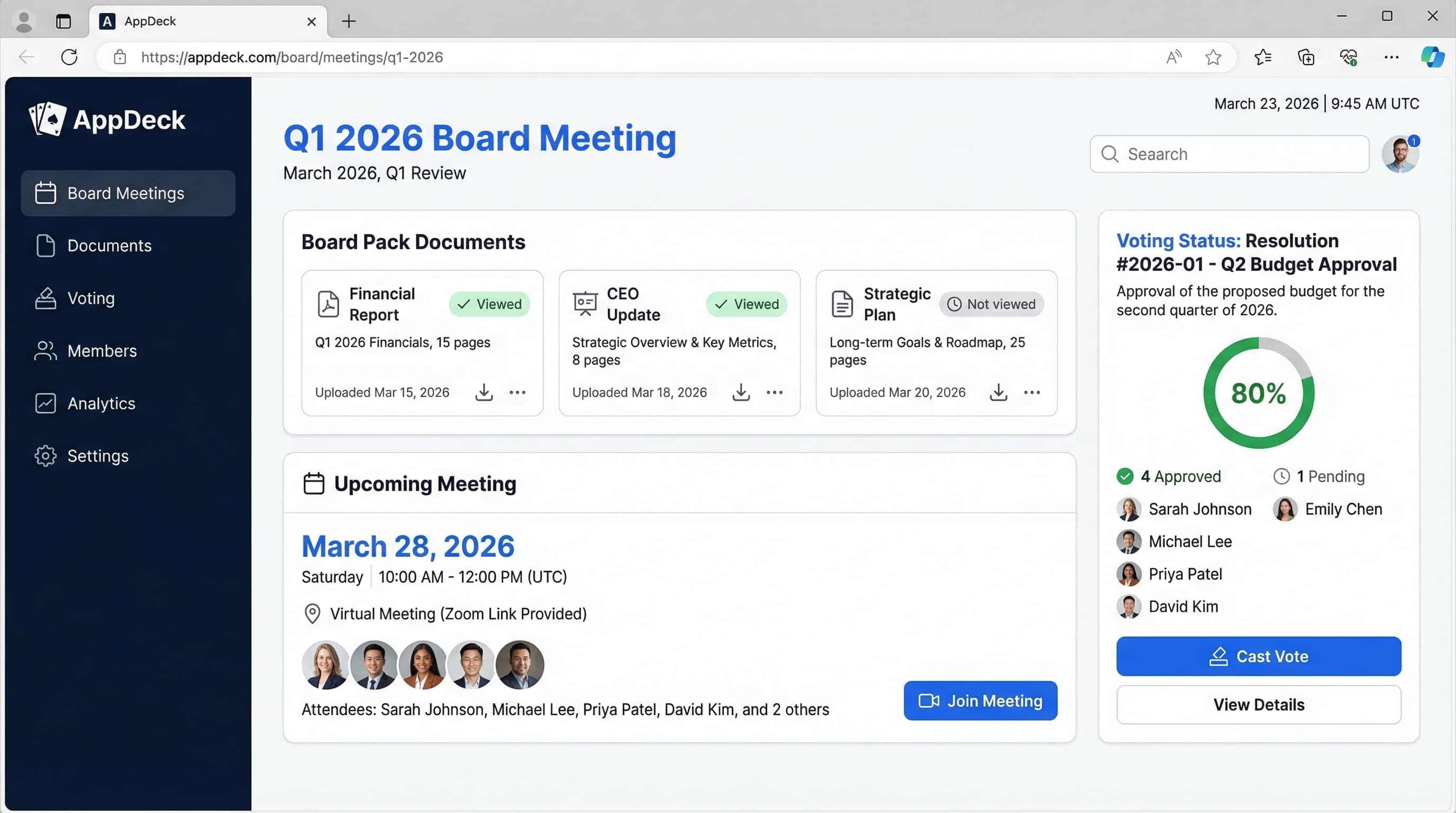
Board resolutions contain sensitive corporate information — financial authorizations, officer appointments, strategic decisions. They should be stored in a secure system with access controls, encryption, and audit trails. A board portal like AppDeck provides all of this out of the box.
6. Maintain a Resolution Register
A resolution register (or resolution index) is a master list of all resolutions adopted by the board. It should include the date, resolution number, subject, and status (active, superseded, or rescinded). This makes it easy to find specific resolutions and identify which authorizations are currently in effect.
7. Have Legal Counsel Review Significant Resolutions
For high-stakes actions — mergers, stock issuances, major contracts, bylaw amendments — have your corporate attorney review the resolution before it goes to the board. They can ensure the language is legally sufficient and that all required formalities are addressed.
8. Number Resolutions Sequentially
Assign each resolution a unique number (e.g., "Resolution 2026-001") for easy reference and retrieval. A consistent numbering system prevents confusion when multiple resolutions are adopted at the same meeting and makes it simple to cross-reference resolutions in future board materials.
How to Track and Store Board Resolutions
Resolutions are only useful if you can find them when you need them. Banks ask for certified copies. Auditors want to review them. New board members need to understand what's been authorized. A disorganized resolution archive creates real operational problems.
Build a Resolution Management System
At minimum, you need:
- A resolution register — a spreadsheet or database that logs every resolution with its number, date, subject, status, and storage location
- Secure storage — a central, encrypted repository with access controls
- Version tracking — the ability to see when a resolution was adopted, amended, or superseded
- Search capability — the ability to find resolutions by date, subject, keyword, or resolution number
Use a Board Portal
A board portal like AppDeck is the most effective solution for resolution management:
- Centralized repository — all resolutions in one place, organized and searchable
- Access controls — only authorized users can view, download, or share resolutions
- Audit trail — complete record of who accessed each resolution and when
- Version control — track amendments and superseded resolutions
- Certification workflow — generate certified copies for banks and third parties
- Integration with meeting minutes — link resolutions to the meetings where they were adopted
- Mobile access — directors and officers can access resolutions from any device
Resolution Register Format
At a minimum, your resolution register should track:
| Resolution # | Date | Subject | Proposed By | Vote Result | Status | Related Documents |
|---|---|---|---|---|---|---|
| 2026-001 | Jan 15, 2026 | Banking authority — First National Bank | CFO | Unanimous (5-0) | Active | Banking agreement |
| 2026-002 | Jan 15, 2026 | Appointment of Jane Smith as CFO | Governance Committee | 4-1-0 | Active | Employment agreement |
| 2026-003 | Mar 12, 2026 | Q1 dividend declaration — $0.50/share | Treasurer | Unanimous (5-0) | Completed | Payment records |
| 2026-004 | Mar 12, 2026 | Approval of office lease renewal | CEO | Unanimous (5-0) | Active | Lease agreement |
Common Board Resolution Mistakes
1. Vague Language That Doesn't Specify the Action
The mistake: "RESOLVED, that the Board approves the proposed transaction."
Why it's a problem: Which transaction? On what terms? Who is authorized to execute it? A vague resolution provides no clear authorization and may be challenged by third parties or in litigation.
The fix: Be specific. Name the parties, the action, the dollar amounts, the authorized individuals, and any conditions.
2. Missing Vote Counts
The mistake: "The resolution was approved by the Board."
Why it's a problem: Without vote counts, there's no proof the resolution achieved the required threshold. A simple majority? A supermajority? Unanimous consent? Without the numbers, you can't prove it.
The fix: Always record: directors present, number in favor, number opposed, number abstaining. Name dissenting and abstaining directors.
3. No WHEREAS Context
The mistake: Jumping straight to the RESOLVED clause without any background.
Why it's a problem: Five years from now, nobody will remember why the board authorized this action. Recitals provide the institutional memory and legal context that make resolutions understandable over time.
The fix: Include at least two or three WHEREAS clauses that explain the facts and rationale behind the resolution.
4. Storing Resolutions in Email Instead of a Secure Repository
The mistake: Emailing resolution PDFs as attachments and considering that "storage."
Why it's a problem: Email is not secure, not searchable, not organized, and not controllable. Former employees retain copies. Resolutions get buried in inboxes. There's no audit trail and no access control.
The fix: Store resolutions in a secure board portal with encryption, access controls, and a complete audit trail.
5. Not Getting All Required Signatures
The mistake: Circulating a resolution for written consent and filing it before all directors have signed.
Why it's a problem: In most jurisdictions, written consent requires unanimous consent of all directors. A missing signature means the resolution was never validly adopted.
The fix: Track signature collection systematically. Use a board portal with electronic signature capabilities and automated reminders for outstanding signatures.
6. Failing to Record the Resolution in Meeting Minutes
The mistake: Adopting a resolution at a board meeting but not recording it in the meeting minutes.
Why it's a problem: If the resolution isn't reflected in the minutes, there's no contemporaneous record that it was adopted at a properly convened meeting. The standalone resolution document may be challenged as fabricated or post-dated.
The fix: Always record adopted resolutions in the meeting minutes, including the exact wording, the proposer, the seconder, and the vote count.
Frequently Asked Questions
What is the difference between a board resolution and meeting minutes?
Meeting minutes are the comprehensive record of an entire board meeting — attendance, discussions, reports, all motions, and all votes. A board resolution is a specific, standalone document recording a single decision or authorization. Resolutions are often adopted during a board meeting and recorded in the minutes, but they also exist as separate documents — especially when certified copies are needed for banks or other third parties.
Can a board resolution be overturned?
Yes. A board resolution can be rescinded, amended, or superseded by a subsequent resolution adopted by the board. The new resolution should explicitly reference the prior resolution it is modifying or replacing (e.g., "RESOLVED, that Resolution 2025-003 dated March 15, 2025 is hereby rescinded in its entirety"). The rescission should be recorded in both the meeting minutes and the resolution register.
Does a board resolution need to be notarized?
Generally, no. Most board resolutions do not require notarization. However, certain resolutions — particularly those involving real estate transactions, filings with government agencies, or international transactions — may need to be notarized depending on the jurisdiction and the requirements of the receiving party. When in doubt, check with legal counsel.
What is a "certified copy" of a board resolution?
A certified copy is a copy of the resolution accompanied by a certificate of the corporate secretary (or assistant secretary) attesting that the resolution is a true and correct copy, that it was duly adopted by the board, and that it remains in full force and effect. Banks, government agencies, and counterparties routinely request certified copies as proof of corporate authorization.
How long should board resolutions be retained?
Permanently. Board resolutions are part of the permanent corporate record and should be retained for the life of the corporation. Even after a resolution is superseded or rescinded, the original should be retained for historical reference and legal protection. Use a secure storage system with proper backup and disaster recovery.
Can board resolutions be signed electronically?
Yes, in most jurisdictions. The federal ESIGN Act and state Uniform Electronic Transactions Act (UETA) laws generally permit electronic signatures on corporate documents, including board resolutions. However, some third parties (particularly banks and government agencies) may still require wet signatures. Check with the receiving party before relying on electronic signatures for resolutions that will be submitted externally.
Conclusion
Board resolutions are more than bureaucratic formalities — they're the legal foundation for corporate action. A well-drafted resolution protects the corporation, its directors, and its officers by creating a clear, verifiable record of what was authorized, by whom, and on what terms.
The eight templates in this guide cover the most common scenarios:
- General Corporate — your default template for any board action
- Banking — for opening accounts and establishing signatory authority
- Officer Appointment — for appointing or removing corporate officers
- Dividend Declaration — for declaring cash or stock dividends
- Share Issuance — for authorizing stock issuances and equity grants
- Major Contract Approval — for contracts exceeding delegated authority
- Written Consent — for board action without a formal meeting
- Nonprofit — for grant approvals, program decisions, and nonprofit governance
Use proper legal language (WHEREAS and RESOLVED clauses), record exact vote counts, get the right signatures, and store everything securely. If you're still managing resolutions through email attachments and shared folders, a board portal like AppDeck will transform your resolution management with secure storage, access controls, version tracking, and instant retrieval.
Related reading:
- The Complete Guide to Board Portals
- Board Meeting Minutes Template: 5 Free Templates for 2026
- Board Meeting Agenda Template
- Board Portal Software Comparison 2026
- How to Run a Board Meeting: Step-by-Step Guide

Founder & CEO, AppDeck
Serial entrepreneur with 20+ years building B2B software companies. Former executive managing 2,800+ employees across three continents. Vik reviews all AppDeck content for accuracy and practical relevance.
Share this article
Explore Related Solutions
Related Articles
Board Meeting Minutes Template: 5 Free Templates for 2026
Download free board meeting minutes templates for corporations, nonprofits, and startups. Includes formal, informal, and action-focused formats with examples.
Board Meeting Agenda Template: 7 Free Templates for Every Board Type
Download free board meeting agenda templates for corporate boards, nonprofits, startups, and advisory boards. Includes time allocations, best practices, and examples.
Board Meeting Best Practices: 25 Tips for More Effective Board Meetings
Proven board meeting best practices and protocol from 100+ board meetings. Pre-meeting preparation, agenda design, formal procedures, engagement strategies, and follow-up.