
Vendor Scorecard Template
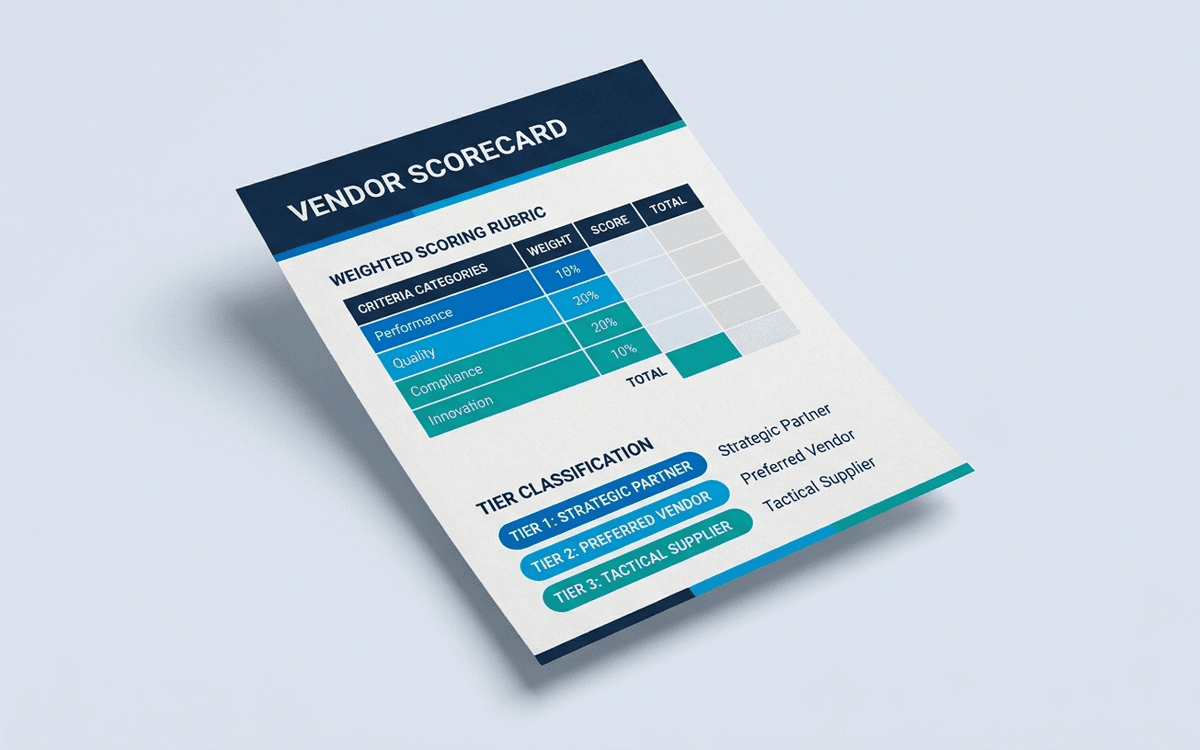
A vendor scorecard template gives you a one-page quarterly performance review covering delivery, quality, responsiveness, cost, and risk — so vendor conversations move from anecdote to evidence and renewal decisions get made on data.
- Format:
- Word (.docx) (38 KB)
- Price:
- Free, no paywall
- Published May 2026
Download this template — free
Tell us where to send the link. We'll never share your email.
What's included
- Vendor metadata block (name, category, contract term, spend YTD)
- Scoring rubric with weighted criteria (1–5 scale)
- Delivery — on-time, complete, predictable
- Quality — first-time accept rate, defect rate, rework
- Responsiveness — communication speed, escalation handling
- Cost — budget variance, price stability, value vs. comparable
- Risk — concentration, financial health, security posture
- Weighted total and tier classification (Strategic / Preferred / Approved / Watchlist)
- Strengths and concerns narrative block
- Action items and review date
- Reviewer signoff
How to use this template
1. Score every vendor at the same cadence
Quarterly for strategic vendors, semi-annually for preferred, annually for approved. Picking a consistent cadence is more important than the specific interval — apples-to-apples comparison across vendors and over time is what makes the scorecard useful.
2. Use the same reviewer pool
A different reviewer applies different mental anchors. For each vendor, assign a primary reviewer (typically the day-to-day owner) and a secondary (typically procurement or ops). Score independently, then reconcile. This catches both blind spots and capture.
3. Anchor your 1–5 scale with definitions
A "3" should mean the same thing across every reviewer and every vendor. The template includes anchor definitions for each criterion (e.g., Delivery 5 = "consistently early or on-time, never a surprise"; Delivery 1 = "frequently late, requires escalation"). Reviewers calibrate to the anchors, not to each other.
4. Tier vendors, then act on the tier
Strategic vendors get more attention, more frequent reviews, and quarterly business reviews. Watchlist vendors get either a remediation plan with milestones, or a replacement timeline. The tier IS the action — if every vendor stays "Preferred" no matter what, you're not using the scorecard.
5. Share scorecards with the vendor
Counterintuitively, the most useful thing you can do with a vendor scorecard is share it with the vendor. Vendors who know the rubric improve toward it. Vendors who don't know it can't. Confidential exceptions: detailed financial-health and security-posture concerns stay internal.
Who it's for
- Procurement teams running structured vendor reviews
- Operations leaders managing service providers
- CFOs and controllers evaluating vendor renewals
- Boards wanting visibility into key vendor concentration
Frequently asked questions
- How many vendors should I scorecard?
- Score every vendor above a meaningful spend threshold — typical thresholds are $25K/year for SMBs and $100K/year for mid-market. Below that, the overhead of formal scoring doesn't pay back. For your top 5–10 spend vendors, scorecard them whether they're above threshold or not.
- What's the right weighting between criteria?
- Depends on the vendor category. A logistics vendor's weighting should heavily favor Delivery (40%); a SaaS vendor's should favor Responsiveness and Quality. The default in the template is 25-20-20-20-15 across Delivery / Quality / Responsiveness / Cost / Risk — adjust per category before scoring.
- How do I score a brand-new vendor?
- Don't score them in their first quarter. Score for the first time at the end of the first full quarter of meaningful service. Earlier than that, you're scoring an implementation, not the vendor's actual performance.
- Should I share scorecards with vendors?
- Yes — for the operational portions (delivery, quality, responsiveness, cost variance). Vendors who know the rubric improve toward it. Keep the internal-only sections (financial health concerns, replacement timelines, escalation plans) confidential.
- What do I do with a Watchlist vendor?
- Either remediation or replacement. Remediation: a documented improvement plan with milestones and a re-evaluation date (typically 90 days). Replacement: a procurement timeline. Letting a Watchlist vendor stay Watchlist indefinitely without action is the most common failure mode of vendor scorecards.
When the template isn't enough
AppDeck's vendor portal turns this template into a live workspace — version control, permissions, signatures, and analytics built in.