
Investor Data Room Software Comparison 2026: 8 Best Platforms Reviewed
Compare the best virtual data room software for 2026. Intralinks, Datasite, Box, AppDeck, and 4 others. Features, pricing, and user reviews.
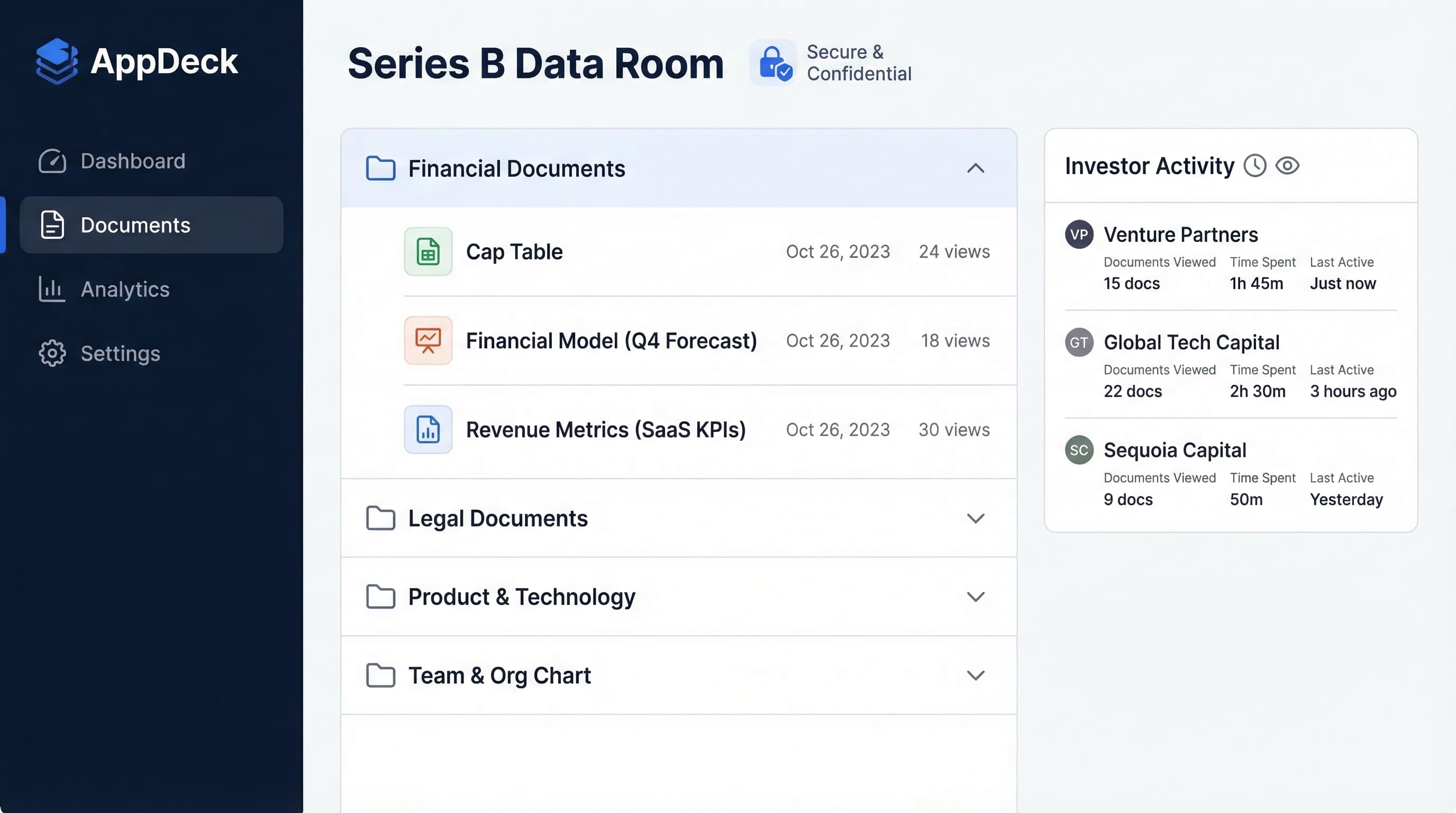
TL;DR: Compare the best virtual data room software for 2026. Intralinks, Datasite, Box, AppDeck, and 4 others. Features, pricing, and user reviews.
Introduction
Choosing virtual data room software is one of the highest-stakes decisions a CFO or founder will make during fundraising. The right platform keeps sensitive financials organized, gives investors confidence you run a tight ship, and accelerates due diligence timelines. The wrong one? Leaked cap tables, disorganized folders that spook investors, and a deal timeline that drags from weeks into months.
After managing fundraising and due diligence processes for 40+ startups and growth-stage companies over 12 years, I've seen what works—and what kills deals. In this comprehensive comparison, I'll break down the top 8 virtual data room platforms with honest assessments of features, pricing, and real-world performance.
What is a Virtual Data Room?
A virtual data room (VDR) is a secure online repository used to store and share confidential documents during financial transactions, fundraising, due diligence, and corporate governance:
Core capabilities:
- Secure document storage with granular access controls
- Investor and stakeholder permission management
- Document watermarking and download restrictions
- Activity tracking and audit trails
- Q&A workflows for investor questions
- Real-time analytics on document engagement
- Version control and document indexing
- Compliance and regulatory support (SOC 2, GDPR, HIPAA)
How it differs from generic file sharing (Google Drive, Dropbox):
- Granular permissions at the document level (view-only, no download, watermarked)
- Full audit trails showing who viewed what, when, and for how long
- Dynamic watermarking that embeds viewer identity on every page
- Secure viewer that prevents screenshots and printing
- Q&A workflows for investor questions
- Compliance certifications required for financial transactions
- Activity analytics showing which investors are most engaged
Who needs this: Startups raising venture capital, companies preparing for M&A, CFOs managing investor relations and board governance, legal teams running due diligence, investment banks managing deal flow, and companies preparing for IPO.
When You Need a Data Room
Fundraising (Seed through Series D+)
Investors expect organized, professional data rooms—it signals operational maturity. Multiple investors reviewing simultaneously need different permission levels, you need engagement analytics to know who's serious, and sensitive financials require security beyond email attachments. A well-organized data room can shave weeks off due diligence.
M&A Transactions
Buy-side and sell-side due diligence requires thousands of documents organized across dozens of categories, multiple parties with different access levels, strict audit trails for regulatory compliance, Q&A workflows managing hundreds of questions, and redaction capabilities for sensitive information.
Board Governance & IPO Preparation
Ongoing board management needs secure distribution of board materials, historical archives of minutes and resolutions, investor updates, and cap table documentation. IPO preparation demands SEC-compliant document management, underwriter access with granular permissions, and audit trails that satisfy regulatory scrutiny.
Key Features to Compare
Before diving into specific platforms, here's what matters when evaluating virtual data room software:
1. Security & Access Controls
SOC 2 Type II compliance (non-negotiable), AES-256 encryption at rest, TLS 1.3 in transit, granular permissions (view-only, download, print, no-access per document), dynamic watermarking with viewer identity, 2FA, IP-based access restrictions, remote document shredding, and fence-view technology that prevents screenshots.
Why it matters: A single leaked cap table or financial model can derail a fundraise. Your data room security is a direct reflection of how seriously you take confidentiality.
2. Document Management
Drag-and-drop bulk upload, automatic indexing and numbering, full-text search, version control, support for all common file types (PDF, Excel, Word, PowerPoint), OCR for scanned documents, and folder templates for common deal structures.
Why it matters: Investors reviewing hundreds of documents need to find what they need fast. Poor organization slows due diligence and makes your company look unprepared.
3. Investor Engagement Analytics
Who viewed which documents and when, time spent per document and per page, most-viewed documents across all investors, download and print activity logs, login frequency, heat maps showing engagement patterns, and exportable analytics reports.
Why it matters: During fundraising, engagement analytics are gold. If an investor spends 45 minutes in your financial model but skips your product roadmap, that tells you exactly what to address in your next conversation.
4. Q&A Workflows
Structured question submission by investors, assignment and routing to your team members, status tracking (pending, answered, follow-up), bulk Q&A export, private notes visible only to your team, and version history of answers.
5. Real-Time Dashboards & Reporting
Live KPI dashboards (revenue, burn rate, runway), investor update distribution and tracking, board reporting templates, custom metric visualization, and integration with accounting and financial systems. Investors increasingly expect live metrics, not static PDFs.
6. Integration & Compliance
Critical integrations include accounting software (QuickBooks, Xero, NetSuite), cap table management (Carta, Pulley), CRM systems (Salesforce, HubSpot), SSO providers, and e-signature platforms. Must-have certifications: SOC 2 Type II, GDPR, ISO 27001, HIPAA (healthcare), and FINRA (financial services).
The 8 Best Data Room Platforms for 2026
1. AppDeck Investor Data Room
Best for: Startups and growth companies wanting real-time dashboards + secure document sharing
Pricing: $499/month (unlimited users)
Key features:
- ✅ Secure document storage with granular view/download/print permissions
- ✅ Real-time KPI dashboards (connects to QuickBooks, Xero, NetSuite, Stripe)
- ✅ Investor engagement analytics (who viewed what, when, how long)
- ✅ Q&A workflows for investor questions during due diligence
- ✅ Dynamic watermarking with viewer identity
- ✅ Investor update distribution and tracking
- ✅ Board materials management and meeting archive
- ✅ AES-256 encryption, RBAC, and audit logging (designing for SOC 2 Type II audit readiness)
- ✅ White-label branding (your logo, your colors, your domain)
- ✅ 30-minute setup (not 6 weeks)
Pros:
- Real-time dashboards that pull live data from your accounting and payment systems—investors see live metrics, not month-old spreadsheets
- Modern design that impresses investors (your data room is a reflection of your company)
- Flat pricing with unlimited users (no per-investor fees that punish you for sharing with more funds)
- Fast implementation (live in an afternoon, not weeks)
- Engagement analytics show exactly which investors are serious and which documents they care about
- Dual-purpose — use it as your investor data room AND ongoing board portal
- Affordable at $499/mo vs. $15K-50K/year for legacy VDR platforms
- Excellent for ongoing investor relations beyond just the fundraise
Cons:
- Newer platform (less brand recognition than Intralinks or Datasite)
- Not purpose-built for massive M&A transactions with 10,000+ documents
- Fewer advanced redaction tools than legacy VDR platforms
- Smaller customer base in investment banking (though growing rapidly in VC/PE ecosystem)
Best fit:
- Startups raising Seed through Series D
- Growth-stage companies ($5M-$200M revenue)
- CFOs wanting a combined data room + investor dashboard
- Companies that want investors to see live metrics, not static uploads
- Founders who want to set up a data room in hours, not weeks
- Organizations needing ongoing board portal after the fundraise
User review:
"We raised our Series B in 8 weeks. AppDeck's real-time dashboards were a game-changer—investors could see our live revenue metrics and burn rate without asking us for updated spreadsheets every week. The engagement analytics told us exactly which VCs were serious. One partner spent 3 hours in our financials on a Sunday night—we knew they'd make an offer. At $499/mo with unlimited users, we saved $20K+ compared to Intralinks. After the round closed, we kept using it as our board portal." — CFO, Series B SaaS Company ($28M ARR)
Try it: AppDeck Investor Data Room
2. Intralinks
Best for: Large M&A transactions and investment banking deal management
Pricing: Custom ($15,000-$50,000+/year)
Key features:
- ✅ Enterprise-grade virtual data room for M&A
- ✅ AI-powered document organization and redaction
- ✅ Advanced permissions with 8+ access levels
- ✅ Q&A workflows with assignment and tracking
- ✅ Bulk upload with automatic indexing
- ✅ Full audit trails and compliance reporting
- ✅ Integration with DealManager for pipeline tracking
- ✅ Multi-language support (20+ languages)
Pros:
- Industry standard for large M&A transactions (used by top investment banks)
- AI-powered tools for document organization, redaction, and classification
- Extremely robust security with SOC 2, ISO 27001, and FINRA compliance
- DealManager integration for tracking multiple concurrent deals
- Battle-tested at scale (handles 100K+ document data rooms)
- Multi-language support essential for cross-border M&A
- Strong audit trails that satisfy regulatory requirements
- 24/7 global support with dedicated deal managers
Cons:
- Very expensive ($15K-50K+ per year, often per-deal pricing)
- Complex setup (typically 1-2 weeks with support team)
- Dated user interface (functional but not modern)
- Overkill for fundraising (designed for billion-dollar M&A, not Series A)
- Per-page pricing models can be unpredictable
- No real-time dashboards (static document storage only)
- Learning curve for admins managing permissions
- Contract lock-in with annual minimums
Best fit:
- Investment banks managing sell-side M&A
- Companies in $100M+ M&A transactions
- Legal teams running complex due diligence processes
- Cross-border transactions requiring multi-language support
- Regulated industries needing FINRA compliance
- Budgets above $15K/year for data room software
User review:
"Intralinks is the gold standard for M&A data rooms—every bank and law firm knows it. We use it for all our sell-side mandates. The AI-powered redaction saved us hundreds of hours on our last deal. But the interface feels like 2015, the pricing is painful, and it's absurd for anything smaller than a $50M transaction. For fundraising, it's like using a sledgehammer to hang a picture frame." — Managing Director, Mid-Market Investment Bank
3. Datasite (formerly Merrill)
Best for: Enterprise M&A and complex multi-party transactions
Pricing: Custom ($15,000-$60,000+/year)
Key features:
- ✅ AI-powered document management and classification
- ✅ Advanced redaction with machine learning
- ✅ Multi-phase deal support (marketing, due diligence, integration)
- ✅ Detailed analytics and reporting
- ✅ Q&A management with smart routing
- ✅ Bulk upload with AI-assisted indexing
- ✅ Integration with deal lifecycle tools
- ✅ Compliance with global data protection regulations
Pros:
- AI-first approach (Datasite has invested heavily in AI for document management)
- Excellent for complex M&A with multiple bidders and deal phases
- Smart redaction using ML to identify and redact sensitive information automatically
- Deal lifecycle management beyond just the data room
- Strong global presence with offices and support worldwide
- Robust analytics showing buyer engagement across deal phases
- Handles massive document sets (100K+ documents without performance issues)
- Regulatory compliance across multiple jurisdictions
Cons:
- Expensive ($15K-60K+ per year, with per-deal and per-page models)
- Complex admin interface requires training
- Designed for M&A professionals (overwhelming for startup founders)
- No real-time financial dashboards (pure document management)
- Setup takes 1-3 weeks depending on deal complexity
- Per-page pricing makes costs unpredictable for large document sets
- Contract terms can be rigid
- Overkill for fundraising and smaller transactions
Best fit:
- Large M&A transactions ($100M+)
- Companies with complex multi-phase deals
- Investment banks and PE firms running concurrent deals
- Regulated transactions requiring robust compliance
- Document-heavy due diligence (10,000+ documents)
- Organizations with dedicated deal team resources
User review:
"Datasite's AI capabilities are genuinely impressive—the automatic document classification and smart redaction saved our legal team 200+ hours on a recent sell-side mandate. But it's built for M&A professionals, not startup founders. The pricing is opaque, the interface takes weeks to learn, and for a simple fundraise data room it's massive overkill. If you're running a $500M deal, Datasite is excellent. If you're raising a Series A, look elsewhere." — VP of Corporate Development, PE-Backed Technology Company
4. Firmex
Best for: Mid-market M&A and legal due diligence
Pricing: Starting at $500/month
Key features:
- ✅ Secure document storage with drag-and-drop upload
- ✅ Granular permissions (view, print, download, fence-view)
- ✅ Q&A management with workflow automation
- ✅ Dynamic watermarking
- ✅ Activity tracking and audit reports
- ✅ Bulk upload with auto-indexing
- ✅ Redaction tools
- ✅ Multi-language support
Pros:
- Good balance of features and price for mid-market deals
- Clean interface that's easier to navigate than Intralinks or Datasite
- Strong for legal teams (purpose-built for law firm workflows)
- Flat-rate pricing available (more predictable than per-page models)
- Quick setup (2-5 days for most data rooms)
- Good Q&A workflows for managing due diligence questions
- Canadian company with strong data residency options
- Reliable customer support with dedicated project managers
Cons:
- Limited real-time dashboards (document-focused, not metrics-focused)
- Fewer AI features than Datasite or Intralinks
- Not ideal for ongoing investor relations (deal-focused, not relationship-focused)
- Per-project pricing can add up for companies running multiple concurrent deals
- Integration options are more limited than enterprise platforms
- Mobile experience could be improved
- Smaller ecosystem than the big two (Intralinks, Datasite)
- Reporting is functional but not exceptional
Best fit:
- Mid-market M&A ($10M-$100M transactions)
- Law firms managing due diligence for clients
- Companies wanting a reliable VDR without enterprise pricing
- Legal teams that need strong Q&A workflows
- Organizations with budgets of $6K-15K/year
- Canadian and European companies wanting data residency
User review:
"Firmex hits the sweet spot for mid-market deals. We've used it on 20+ transactions ranging from $15M to $80M. It's not as powerful as Datasite for massive deals, but it's significantly easier to use and more affordable. Setup is fast, the Q&A workflow is solid, and our clients can navigate it without a training session. The lack of real-time dashboards is a miss though—our portfolio companies want more than just a document dump." — M&A Partner, Mid-Market Law Firm
5. Box
Best for: Teams already using Box ecosystem who need light data room features
Pricing: $25-47/user/month (Business and Enterprise plans)
Key features:
- ✅ Secure cloud storage with strong file sharing
- ✅ Granular sharing permissions
- ✅ Box Shield for advanced security and compliance
- ✅ Watermarking (Enterprise plan)
- ✅ Audit trails and activity reporting
- ✅ Integration with 1,500+ business applications
- ✅ Box Sign for e-signatures
- ✅ Workflow automation with Box Relay
Pros:
- Widely known and trusted by enterprise organizations
- Excellent integrations (1,500+ apps including Salesforce, Slack, Office 365)
- Per-user pricing is affordable for small teams
- Strong collaboration features beyond just document storage
- Good security with Box Shield for compliance
- Teams may already have licenses (no new vendor to onboard)
- Modern interface familiar to most users
- Good mobile apps for on-the-go access
Cons:
- Not a purpose-built data room (file sharing platform with VDR-like features bolted on)
- Limited deal-specific features (no Q&A workflows, no deal phases)
- No investor engagement analytics (can't see time-per-page or heat maps)
- No dynamic watermarking (basic watermarks only on Enterprise)
- Per-user pricing gets expensive with many investors (10 investors = $250-470/mo)
- No fence-view technology (screenshot prevention)
- No document indexing or auto-numbering for data room structure
- Security is adequate but not VDR-grade for highly sensitive M&A
Best fit:
- Companies already paying for Box Enterprise
- Internal document sharing with basic access controls
- Early-stage startups needing a quick, cheap "good enough" solution
- Teams that need collaboration features alongside document storage
- Organizations where integration with existing tools is priority
User review:
"We tried using Box as our data room for a Series A because we already had licenses. It worked... barely. Investors could access documents, but there were no engagement analytics, no Q&A workflows, and the watermarking was basic. When one investor asked why we weren't using a 'real data room,' we realized Box made us look unprofessional. We switched to AppDeck for the actual fundraise and closed in 6 weeks. Box is great for internal file sharing—it's not a data room." — Founder/CEO, Series A SaaS Company
6. Ansarada
Best for: Deal preparation and AI-powered readiness insights
Pricing: Custom pricing (typically $3,000-$15,000+ per deal)
Key features:
- ✅ AI-powered deal readiness scoring
- ✅ Secure virtual data room with granular permissions
- ✅ Automated document organization with AI
- ✅ Bidder engagement analytics
- ✅ Q&A management workflows
- ✅ Board management capabilities
- ✅ Deal workflow templates
- ✅ Post-deal integration tools
Pros:
- AI-powered readiness scoring tells you exactly how prepared you are for due diligence
- Deal preparation tools help you organize before investors even get access
- Good engagement analytics showing bidder interest and activity
- Board management module provides ongoing governance capabilities
- Template library for common deal structures speeds setup
- Australian company with strong APAC presence
- End-to-end deal lifecycle from preparation through integration
- Improving rapidly with significant AI investment in 2025-2026
Cons:
- Per-deal pricing makes costs hard to predict for ongoing use
- Less established in North American market than Intralinks or Datasite
- AI features are promising but still maturing
- No real-time financial dashboards (document and deal management focus)
- Board management module is adequate but not exceptional
- Smaller customer base means fewer integrations and ecosystem partners
- Interface can feel cluttered with all the AI features
- Support hours can be limited outside APAC business hours
Best fit:
- Companies wanting help preparing for due diligence (not just storing documents)
- Mid-market M&A ($10M-$200M transactions)
- APAC-based companies or cross-border APAC deals
- Organizations that value AI-powered insights and readiness scoring
- Companies running 2-5 deals per year
- Budgets of $5K-20K per transaction
User review:
"Ansarada's deal readiness score was a wake-up call—we thought we were prepared for due diligence, but the AI identified 40+ gaps in our documentation. That alone was worth the price. The data room itself is solid, the analytics are good, and the Q&A workflows work well. Downside: the per-deal pricing model makes it expensive if you're also using it for ongoing board management. We use Ansarada for deals and AppDeck for day-to-day investor relations." — CFO, Private Equity-Backed Healthcare Company
7. ShareVault
Best for: Life sciences, biotech, and IP-heavy transactions
Pricing: Starting at $150/month
Key features:
- ✅ Secure document sharing with granular permissions
- ✅ Click-through NDA enforcement
- ✅ Dynamic watermarking
- ✅ Document engagement analytics
- ✅ Q&A management
- ✅ Automatic document indexing
- ✅ Compliance with FDA 21 CFR Part 11
- ✅ Patent and IP document management
Pros:
- Affordable entry point ($150/mo is accessible for early-stage biotech)
- Strong for life sciences (FDA compliance, patent management, clinical trial data)
- Click-through NDAs ensure legal protection before document access
- Good engagement analytics for tracking investor interest
- Quick setup (live in 1-2 days)
- IP protection features designed for patent portfolios and trade secrets
- Compliance-focused for regulated industries
- Reasonable pricing scales well for growing companies
Cons:
- Dated interface (functional but not modern)
- Limited real-time dashboards (no live financial metrics)
- Fewer AI features than Intralinks, Datasite, or Ansarada
- Smaller company with less name recognition
- Integration options are limited compared to larger platforms
- Reporting is basic compared to enterprise VDRs
- Not ideal for large M&A (better suited for fundraising and licensing deals)
- Mobile experience needs improvement
Best fit:
- Biotech and life sciences companies raising capital
- IP-heavy companies licensing patents or technology
- Clinical-stage companies managing trial data for investors
- Early-stage companies wanting affordable VDR with compliance features
- FDA-regulated transactions
- Budgets under $5K/year
User review:
"As a biotech raising our Series A, we needed FDA-compliant document management and IP protection without enterprise pricing. ShareVault delivered. The click-through NDA feature was essential—every investor had to acknowledge confidentiality before accessing our clinical data. It's not fancy, but it's reliable and affordable. For our Series B, we moved to AppDeck because we wanted real-time dashboards and a more modern investor experience, but ShareVault served us well at the early stage." — VP of Finance, Clinical-Stage Biotech Company
8. Custom-Built (Google Drive, Dropbox, Notion)
Best for: Nobody (strongly not recommended)
Pricing: Variable ($0-$25/user/month)
What people try:
- Google Drive shared folders with investor emails
- Dropbox Business with shared links
- Notion databases with embedded documents
- Combination of email, Drive, and spreadsheets
- OneDrive / SharePoint sites
Pros:
- Free or very cheap (tools you already pay for)
- Familiar interface your team already knows
- Quick to set up (create a folder, share a link)
Cons:
- ❌ No granular permissions (shared link = full access, or nothing)
- ❌ No audit trails (you can't prove who viewed what, or when)
- ❌ No dynamic watermarking (documents can be shared freely with no trace)
- ❌ No engagement analytics (you have zero visibility into investor interest)
- ❌ No Q&A workflows (questions scattered across email threads)
- ❌ No screenshot prevention or fence-view technology
- ❌ No NDA enforcement before document access
- ❌ Signals to investors that you're not serious or experienced
- ❌ One wrong permission and your cap table is public
- ❌ No compliance certifications (SOC 2, GDPR, FINRA)
- ❌ Massive liability risk if confidential documents leak
Our strong recommendation: Don't do this. I've seen fundraises stall because investors questioned the founder's judgment after receiving a Google Drive link to their cap table and financial model. A VC partner once told me: "If a founder can't secure their own financials, how will they protect our investment?" That's the message you send with a shared Google Drive folder.
A proper data room costs $150-500/month. A leaked financial model or disorganized due diligence process can cost you the deal entirely. The ROI is not even close.
Feature Comparison Table
| Feature | AppDeck | Intralinks | Datasite | Firmex | Box | Ansarada | ShareVault |
|---|---|---|---|---|---|---|---|
| Pricing | $499/mo | $15K-50K+/yr | $15K-60K+/yr | From $500/mo | $25-47/user/mo | $3K-15K+/deal | From $150/mo |
| Setup Time | 30 minutes | 1-2 weeks | 1-3 weeks | 2-5 days | Same day | 2-5 days | 1-2 days |
| Unlimited Users | ✅ Yes | ❌ Per-user | ❌ Per-user | ⚠️ Plan-dependent | ❌ Per-user | ⚠️ Plan-dependent | ⚠️ Plan-dependent |
| Real-Time Dashboards | ✅ Live KPIs | ❌ No | ❌ No | ❌ No | ❌ No | ❌ No | ❌ No |
| Engagement Analytics | ✅ Detailed | ✅ Advanced | ✅ Advanced | ✅ Good | ⚠️ Basic | ✅ Good | ✅ Good |
| Q&A Workflows | ✅ Built-in | ✅ Advanced | ✅ Advanced | ✅ Good | ❌ No | ✅ Good | ✅ Basic |
| Dynamic Watermarking | ✅ Yes | ✅ Advanced | ✅ Advanced | ✅ Yes | ⚠️ Basic | ✅ Yes | ✅ Yes |
| AI Features | ⚠️ Growing | ✅ Advanced | ✅ Advanced | ⚠️ Basic | ⚠️ Box AI | ✅ Good | ❌ No |
| Board Portal | ✅ Included | ❌ Separate | ❌ Separate | ❌ No | ❌ No | ✅ Basic | ❌ No |
| Best For | Fundraising + IR | Large M&A | Enterprise M&A | Mid-market M&A | Existing Box users | Deal prep + AI | Life sciences |
How to Choose the Right Data Room
Step 1: Define Your Use Case
By transaction type:
- Seed / Series A fundraise → AppDeck or ShareVault
- Series B-D fundraise → AppDeck
- Mid-market M&A ($10M-$100M) → Firmex or AppDeck
- Large M&A ($100M+) → Intralinks or Datasite
- Ongoing investor relations → AppDeck
- Life sciences / biotech → ShareVault or AppDeck
- IPO preparation → Intralinks or Datasite
By budget:
- Under $2K/year → ShareVault
- $2K-6K/year → AppDeck
- $6K-15K/year → Firmex or AppDeck
- $15K-50K/year → Intralinks or Ansarada
- $50K+/year → Datasite or Intralinks
Step 2: Evaluate What Investors Actually See
Send yourself an investor invite and test the full experience: Is the login smooth? Can you find the financial model in 30 seconds? Do watermarks display correctly? Are download restrictions enforced? Can you see detailed engagement analytics? The investor experience is a direct reflection of your company—test it thoroughly.
Step 3: Calculate Total Cost of Ownership
Beyond the subscription: per-user or per-investor fees (10 investors at $47/user = $470/mo on Box), per-page or per-document fees, setup costs, training, overage charges, and contract termination fees. Some platforms triple in effective cost once you add all the extras.
Step 4: Run a Pilot
Select 2 finalist platforms, set up a real data room on each with actual fundraising documents, invite 2-3 friendly investors or advisors to test both, and make your final decision based on both admin and investor experience—not just a sales demo.
Common Data Room Mistakes to Avoid
Mistake #1: Using Google Drive for Due Diligence
Problem: "We'll just share a Google Drive folder—it's free and everyone knows how to use it."
Reality: This is the single most common and most damaging mistake I see founders make. A shared Google Drive folder signals you don't understand confidentiality, you haven't raised capital before, and you might be equally casual about protecting their investment. An investor forwards the link to a colleague—now 5 unauthorized people have access to your cap table. You have zero engagement analytics and no audit trail if documents leak.
Solution: Use a purpose-built data room. Even ShareVault at $150/month is infinitely better than Google Drive. If you're raising a real round, invest $499/month in AppDeck and present yourself like a company worth investing in.
Mistake #2: Disorganized Folder Structure
Problem: Dumping 200 documents into a data room with no structure, poor naming, and no index.
Reality: Investors review dozens of data rooms. If they can't find your revenue metrics in 30 seconds, they'll form a negative impression of how you run your company. Due diligence is a proxy for operational competence.
Solution: Use a standard structure: (1) Corporate Documents, (2) Financial Information, (3) Cap Table & Equity, (4) Revenue & Metrics, (5) Customers & Contracts, (6) Team, (7) IP & Technology, (8) Legal.
Mistake #3: Setting Up the Data Room Too Late
Problem: Scrambling to organize a data room after a term sheet arrives.
Reality: Due diligence typically takes 2-6 weeks. If you spend the first week organizing documents, you've lost 20-50% of that window. Set up your data room before you start fundraising—it forces you to identify documentation gaps early.
Mistake #4: Giving All Investors the Same Access
Problem: Every investor gets full access to everything from day one.
Solution: Use tiered access. Initial interest gets pitch deck and high-level metrics. Deep dive adds the financial model and customer contracts. Full due diligence opens everything. This protects sensitive information and lets you control the narrative.
Mistake #5: Ignoring Engagement Analytics
Problem: Setting up a data room but never checking who's actually reading the documents.
Reality: Engagement analytics tell you which investors are serious vs. window shopping, what topics concern them most, and when to follow up. Check analytics daily during an active fundraise—the founder who knows which VC spent 3 hours in the data room on Sunday night has a massive advantage.
Recommendations by Deal Type
Seed Round ($500K-$3M)
Recommended: AppDeck ($499/mo) or ShareVault ($150/mo). Small document set, 5-15 investors, budget-conscious. AppDeck for maximum investor impression with real-time dashboards, ShareVault for minimum viable data room. Skip Intralinks, Datasite, Ansarada (massive overkill).
Series A ($5M-$25M)
Recommended: AppDeck. Growing document set (100-300 docs), 10-25 investors needing access, engagement analytics critical for identifying your lead investor, and board portal functionality needed post-close. Consider Firmex if your lead investor's counsel specifically requests it.
Series B-C ($25M-$150M)
Recommended: AppDeck. Multiple investor groups with different access levels, live KPI dashboards increasingly expected by growth-stage investors, Q&A workflows essential at scale, and the combined data room + board portal eliminates tool sprawl. Consider Firmex or Intralinks if transaction involves complex legal structures.
M&A Transaction ($50M+)
Recommended: Intralinks or Datasite. Massive document sets (5,000-50,000+ docs), multiple bidders with segmented access, investment banks expect these platforms, AI-powered redaction essential at volume, and regulatory compliance requirements (FINRA, SEC). Consider Firmex for mid-market M&A ($10M-$100M).
IPO Preparation
Recommended: Intralinks or Datasite. SEC compliance requirements, underwriter and auditor access management, regulatory-grade audit trails, and industry-standard platforms expected by underwriting banks.
Pricing Deep Dive: What You Actually Pay
AppDeck Investor Data Room
- Base price: $499/month ($5,988/year)
- Implementation: $0 (DIY setup in 30 minutes)
- Training: Included
- Per-user fees: $0 (unlimited investors, board members, advisors)
- Support: Included (dedicated onboarding specialist)
- Real-time dashboards: Included
- Board portal: Included (use post-fundraise for ongoing governance)
- First year total: $5,988
- Scales well: Same price whether you have 5 or 50 investors
Intralinks
- Base price: $15,000-$50,000+/year (custom quote, often per-deal)
- Implementation: $2,000-$10,000
- First year total: $18,000-$65,000
- Per-deal models: Can be $5,000-15,000 per individual deal
Datasite
- Base price: $15,000-$60,000+/year (custom quote)
- Implementation: $2,000-$15,000
- First year total: $18,000-$80,000
- Watch for: Per-page fees and AI feature add-ons
Firmex
- Base price: Starting at $500/month ($6,000/year)
- Implementation: $0-$2,000
- First year total: $6,000-$18,000
ShareVault
- Base price: Starting at $150/month ($1,800/year)
- Implementation: $0 (DIY setup)
- First year total: $1,800-$5,000
My Personal Recommendation (After 12 Years)
After managing fundraising and due diligence for 40+ companies, here's what I recommend:
For startups and growth companies raising capital (85% of my clients): AppDeck
Why:
- Real-time dashboards are the single biggest differentiator—investors see live revenue metrics and KPIs instead of month-old spreadsheets, which accelerates due diligence and builds trust
- Engagement analytics tell you exactly which investors are serious (the founder who knows which VC spent 3 hours in the data room Sunday night has a massive advantage)
- Professional presentation that signals operational maturity (your data room is an extension of your brand)
- 30-minute setup means you can have a data room ready before your first investor meeting
- Flat $499/mo pricing with unlimited users means no per-investor penalties as you share with more funds
- Dual-purpose — keeps working as your board portal after the round closes, eliminating tool transitions
- Q&A workflows keep due diligence organized and trackable
When I'd choose alternatives:
- Large M&A ($100M+): Intralinks or Datasite (enterprise-grade features and AI redaction)
- Mid-market M&A: Firmex (good balance of features and price, familiar to M&A attorneys)
- Early-stage biotech: ShareVault (FDA compliance at $150/mo is hard to beat)
- Deal preparation with AI: Ansarada (readiness scoring genuinely useful for companies preparing for sale)
The Bottom Line
The best data room makes your investors confident and your due diligence fast. For 85% of companies raising capital, that means a platform combining secure documents with real-time metrics and engagement analytics—not a legacy VDR designed for billion-dollar M&A.
For most fundraising companies, that means AppDeck.
Frequently Asked Questions
What is virtual data room software and which transactions require it?
Virtual data room (VDR) software is a secure cloud platform for storing and sharing confidential documents during fundraising, M&A, due diligence, IPO preparation, or ongoing board governance. It differs from generic file storage by adding granular per-document permissions, dynamic watermarking, audit trails, Q&A workflows, engagement analytics, and compliance certifications (SOC 2, GDPR, FINRA). Any institutional fundraise (Seed through pre-IPO), any M&A transaction over roughly $10M, and any process involving regulated industries (healthcare, financial services) requires a real VDR rather than Google Drive or Dropbox.
How do enterprise VDRs like Intralinks and Datasite compare to mid-tier platforms like AppDeck and Firmex?
Enterprise VDRs (Intralinks, Datasite) are purpose-built for billion-dollar M&A: AI-powered redaction, advanced bidder management, multi-phase deal workflows, and battle-tested at 100,000+ document volumes. They cost $15,000 to $60,000+ per year and take 1 to 3 weeks to set up. Mid-tier platforms (AppDeck, Firmex) cost $500 to $1,000 per month, set up in hours, and cover everything a typical fundraise or mid-market M&A needs: secure documents, watermarking, engagement analytics, Q&A workflows. The right choice depends on transaction size: under $100M usually doesn't justify enterprise pricing.
How much does virtual data room software cost?
Pricing tiers: ShareVault at $150/month for biotech-friendly basics, Box at $25-47/user/month for teams already on Box, Firmex starting at $500/month for mid-market M&A, AppDeck at $499/month flat with unlimited users for fundraising and ongoing IR, Ansarada at $3,000-$15,000 per deal for AI-powered preparation, and Intralinks/Datasite at $15,000-$60,000+ per year for enterprise M&A. Watch for hidden costs: per-user fees, per-page fees, setup and training, and overage charges can double or triple sticker pricing. Calculate total annual cost including expected user count and document volume before signing.
Who should choose each platform?
Seed and Series A startups: AppDeck or ShareVault. Series B-D fundraises with multiple lead candidates: AppDeck. Mid-market M&A ($10M-$100M): Firmex or AppDeck. Large M&A ($100M+) and IPO preparation: Intralinks or Datasite. Life sciences and biotech with FDA compliance needs: ShareVault. Companies preparing 6 to 12 months ahead of a sale with limited internal deal experience: Ansarada for the readiness scoring. Companies that already pay for Box Enterprise and have only light data room needs: Box. Don't use Google Drive, Dropbox, or Notion for any institutional fundraise or M&A—the message it sends to investors costs more than any VDR subscription.
When should you set up your data room and how long does it stay active?
Set up your data room 2 to 3 months before fundraising starts. This forces you to surface documentation gaps and prevents a scramble after the first term sheet. During active fundraising, the data room runs hot for 6 to 12 weeks. After the round closes, archive the fundraising version and convert the platform into your ongoing investor relations and board portal—this is the biggest argument for platforms like AppDeck that double as board portals. For M&A, the data room runs for the duration of the transaction (3 to 9 months for most deals) plus a 12-month archive period for regulatory and indemnification purposes.
Conclusion
Virtual data room software is essential for any serious fundraise, M&A transaction, or due diligence process. Choosing the wrong platform—or worse, using Google Drive—can slow your deal, spook investors, and create real confidentiality risks.
Key takeaways:
- Never use Google Drive for due diligence — it sends exactly the wrong signal to investors
- Match the platform to your transaction — a Series A doesn't need a $50K/year M&A data room
- Real-time dashboards are the new standard — investors expect live metrics, not static uploads
- Engagement analytics are strategic gold — knowing which investors are most engaged gives you a massive advantage
- Calculate total cost — per-user fees, per-page fees, and setup costs can triple the sticker price
- Set up early — have your data room ready before the first investor meeting, not after a term sheet arrives
Next steps:
- Assess your transaction type and timeline
- Set a realistic budget (total cost, not just subscription price)
- Shortlist 2 platforms from this comparison
- Set up test data rooms and invite a trusted advisor to evaluate
- Organize your data room BEFORE starting the fundraise
- Check engagement analytics daily once investors have access
Your data room is often the first operational system investors interact with. Make it count.
Related reading:
- Investor Data Room Best Practices — Complete guide to organizing your data room for maximum impact
- Data Room Checklist — Downloadable checklist of every document you need
- AppDeck Investor Data Room — See how real-time dashboards transform the investor experience
- Board Portal Software Comparison 2026 — If you also need a board governance portal

Founder & CEO, AppDeck
Serial entrepreneur with 20+ years building B2B software companies. Former executive managing 2,800+ employees across three continents. Vik reviews all AppDeck content for accuracy and practical relevance.
Share this article
Explore Related Solutions
Related Articles
What Is a Virtual Data Room? The Complete Guide for 2026
Everything about virtual data rooms (VDRs): use cases, features, security, pricing, and how to set one up for M&A, fundraising, and due diligence.
Due Diligence Checklist: Complete Guide for M&A, Fundraising & Investors
The definitive due diligence checklist for fundraising, M&A, and investor review. 100+ items organized by category with templates and data room setup tips.
Investor Data Room Best Practices: A CFO's Complete Guide for 2026
Learn the essential best practices for creating and managing investor data rooms. Complete guide with checklist, templates, and real-world examples from successful fundraising rounds.